Once in a Lifetime, part 1
The Plague at My Country House, and a Life for a Life
- Written
- early 170s CE (plague events of the mid-160s, probably 165 or 166)
- Place
- Smyrna (modern İzmir) and Aristides' country house outside the city
- Language
- Ancient Greek (Attic, literary)
- Kind of source
- memoir
- Reading time
- 7 minutes
- Difficulty
- Moderate
- Intensity
- Medium: a near-death fever; the deaths of two children, told without graphic detail
Antonine Plague (from 165)Doctors and medical ideasGreek and Roman godsDreams and visionsFamily and loss
For most of his adult life, Aelius Aristides kept a record of his dreams. He believed the healing god Asclepius spoke to him in them, and he followed their orders: bathing in an icy river in midwinter, fasting, bleeding, purging. In the early 170s CE, working from memory and from the notes he had kept on his dreams, he turned those records into what he called the Sacred Tales: five books and the opening lines of a sixth.
Aristides was born in 117 and became one of the most famous public speakers in the Roman Empire. In late 143, as he was about to travel to Rome, he fell ill, and he never fully recovered. He went again and again to the great temple of Asclepius at Pergamum, in what is now western Turkey, to seek cures, and he made his home in Smyrna (modern İzmir). In the mid-160s, an epidemic swept the eastern Roman Empire, probably reaching Smyrna in 165 or 166. Aristides was at his country house when it struck his household.
Educated people of his time explained sickness through the four humors of the body, bad air, and the stars, and they also turned to the gods. These ideas did not compete in his mind. He took doctors' advice, but he trusted Asclepius more, and he read every turn of his illness as a message.
Aristides is a vivid witness but not a neutral one. He was there, and he describes the sickness running through his household with a careful eye. But he wrote years later, and he wrote to show the god's care for him. He tells us that even his friends feared he was raving when he saw Athena. He also had a reason to remember the epidemic as a turning point. Years before, he says, the god had promised him a set span of life, and the plague came when that time ran out.
As you read, watch how Aristides explains who lives and who dies. Two children in his household die during these years, and he sees both deaths as part of the same divine plan. Notice, too, what he leaves out: he names the god who saved him, but tells us almost nothing about the people who nursed him.
What we know now
The epidemic Aristides survived is known today as the Antonine Plague, after the ruling family of emperors. Ancient writers linked its spread to a Roman army returning from war in Mesopotamia around 165. The doctor Galen, who treated patients during it, described fever, diarrhea, and a dark rash that blistered and scabbed (Littman and Littman 1973). Many historians identify it as smallpox, though some have proposed measles. Studies of ancient DNA have raised doubts that smallpox existed this early (Newfield, Duggan, and Poinar 2022), while a study of the virus's rate of change argues that it did (Forni et al. 2023). How many died is uncertain. One widely cited estimate puts the deaths at about 7 to 10 percent of the empire's people, and perhaps 13 to 15 percent in its cities (Littman and Littman 1973); others run from 1 or 2 percent to a quarter of the population (Karasaridis and Chalupa 2025).
Read alongside
- The Plague at Athens, and Pericles Answers the Athenians
Thucydides also caught a plague and lived. He refuses to guess at causes and notes that prayers and oracles did no good; Aristides sees a god behind every turn.
- The Plague as a Test: A Bishop's Sermon at Carthage
Writing in Carthage in the 250s, the bishop Cyprian also read a plague through faith. He urged Christians not to fear dying in the epidemic and treated it as a test of faith. Where Aristides sees a god's care for one man, Cyprian speaks to a whole community.
The edited translation, in simplified modern English. Bracketed words were added for clarity; [...] marks a cut. Tap a note number to read the note. Point at or tap a phrase to see the original behind it. Phrase links checked in a separate review.
From the second Sacred Tale
18When we reached Smyrna, the god appeared to me in this form. He was Asclepius and Apollo at once: both the Apollo of Claros and the one called "Blessed in His Children" at Pergamum, whose temple comes first of the three there.1 In this form he stood in front of my bed, held out his fingers, and counted up some spans of time. "You get ten years from me," he said, "and three from Sarapis." And as he spoke, the way his fingers were set made the thirteen look like seventeen.2 This, he said, was no dream but a waking vision,3 and I would see that for myself.
[...]
37Come, let me tell the whole story from the beginning, and show how the prophecy about the years came out. Anyone who knows even a little about my life knows that the god kept me alive all that time, giving me one day after another. Or rather, he keeps me alive even now. Even so, once the time set by the prophecy had run out, this is what happened.
38First, though, I must go back a little. At the height of summer I was staying at my house outside the city. A plague-like sickness took hold of almost everyone who lived nearby. At first two or three of the household slaves fell sick, then one after another, until all of them lay sick, young and old alike. Last of all, I was taken.
Doctors came out from the city. We used their attendants as our servants, and some of the doctors themselves sat by us and did the servants' work. The pack animals fell sick too. If anyone so much as stirred, he soon lay collapsed at the door. As things stood, it was no longer easy to travel even by sea.4 The whole place was full of despair, wailing, groaning, and every kind of misery. In the city, too, there were terrible sicknesses.
39For a while I held out, caring for the others' safety as much as for my own. Then the sickness grew worse, and I was seized by a terrible fever and by bile of every kind,5 which tormented me night and day without a break. I could not take food, and my strength was gone. The doctors stepped back and finally gave up all hope, and word went out that I would die at any moment.
Even then, you could have said of me what Homer said: "But his mind stayed steady."6 I watched myself as if I were watching someone else, and I could feel my body slipping away, little by little, until I reached the very end.
40Things stood like this when I happened to turn toward the wall. Then I had what seemed to be a dream, though in fact it was the turning point.7 I seemed to have come to the end of a play, and I was taking off my actor's boots and getting ready to put on my father's shoes. While I was in this state, Asclepius the Savior suddenly turned me over to face the room.
41Not long after, Athena appeared. She had her aegis, and in beauty, in size, and in her whole form she looked just like Phidias's Athena in Athens.8 A wonderful sweet scent came from the aegis. It had something of wax about it, and it, too, was a marvel of beauty and size. She appeared to me alone. She stood right in front of me, where I could see her at her most beautiful.
I pointed her out to the people in the room, my nurse and two of my friends, shouting her name. I told them Athena was standing right in front of me and talking to me, and I pointed to her aegis. They were at a loss and feared I was raving—until they saw my strength coming back and heard the words I had heard from the goddess.
42Here is part of what I remember. She reminded me of Homer's Odyssey. She said its stories were not just tales, and that I should judge them by what was happening to me now. So I must hold on. I was both Odysseus and Telemachus, she said, and she had to help me.9 I heard other things like this. This is how the goddess appeared to me, comforted me, and saved me, as I lay there with nothing left between me and death.
43At once I thought of an enema made with Attic honey, and it purged the bile from my body.10 After that came cures and food. First, I think, came goose liver, after I had turned away from all food for so long. Then came some pork belly. Later, a long covered wagon carried me into the city, and little by little, slowly and with great effort, I got back on my feet.
44But the fever did not leave me completely until the dearest of my foster-children had died. On that same day, as I learned later, he died and the sickness left me. So I had held the years up to that point as a gift from the gods, and after that I lived again in their keeping. It was a kind of exchange.11
From the fifth Sacred Tale
19After I had stayed there a few days, word came that my foster-sister's daughter was sick and in danger.12 I sent her a doctor, and as soon as I could, I set out on my journey myself.
[...]
Here, too, dreams held me back, so I stayed.
20And besides those dreams, something else had happened. I dreamed I had sacrificed an animal and was inspecting the part of it called, I think, "the god" and also "the Releaser."13 One of the seers came up, and I asked what the Releaser meant. Would it release something for good? Or would it take something smaller in place of something greater, as a sign of delay? The seer did not seem to lean strongly toward "for good." Instead, he blamed the air and the stars and things like that.14 Just then the news came that the girl was dead.
21As soon as we heard it, it seemed to be the gods' doing that I had not been there for the disaster but had left ahead of time. Later oracles made it even clearer that all of this happened by some divine power.
22Two nights after I came down from the mountain, I had the following vision. (I stayed on for several more days, because the god kept me there.) A mule driver named Telesphorus seemed to have set out from there and to be on his way back. He brought news of the oracles given about Philumene (that was the girl's name). The oracles, he said, had come to her father, Alcimus, and Telesphorus seemed to carry written pages, sealed or not. Alcimus had heard these things from her at night, remembered them, and written them down. They were astonishing in number and power, and they all pointed to me. I marveled that he had been able to remember them at all.
23The main point was this: the whole story about her was written in Philumene's own body and in her insides, just as signs are written in the entrails of sacrificed animals.
[...]
24Anyway, the oracles went something like this. My name was written in full: Aelius Aristides. Here and there, at intervals, other titles were added to my name. The name Sosimenes was written there too,15 with other words like it that promised safety. And it said that Philumene had given a life for a life, a body for a body: she gave hers in place of mine. Other things pointing the same way were there too, all written in certain books. Alcimus had written them all down, and Telesphorus seemed to be carrying them home.
[...]
25This girl's brother was the Hermias who died during the great sickness, when the goddess appeared to me. He too died, one might almost say, in my place. He died, I learned afterward, on the very day I was freed from a fever that had lasted a very long time. Both were children of Callityche, my foster-sister. So much for that.
Notes
- Claros, near Colophon, south of Smyrna, had a famous oracle of Apollo. At Pergamum, home of Asclepius's great healing sanctuary, Apollo was worshiped as Asclepius's father, "blessed in his children." back
- Sarapis was an Egyptian healing god worshiped across the Roman world. People showed numbers with the positions of their fingers, so the god's one gesture could mean two figures: thirteen years, or seventeen. back
- Sick people slept in the temples of Asclepius, hoping the god would send a healing dream. A waking vision counted as surer proof. The phrase echoes Homer's Odyssey 19.547. back
- The Greek is compressed here. It seems to mean that no one could easily travel, even by boat. back
- Ancient doctors believed health depended on a balance of four body fluids, the humors: blood, phlegm, yellow bile, and black bile. Bile "of every kind" meant the balance had badly failed. back
- Homer, Iliad 11.813, describing the wounded warrior Eurypylus: blood poured from his wound, but his mind stayed steady. back
- The Greek word, lysis, means both the ending of a play and the end of an illness. In the dream, dying looks like an actor finishing his part, taking off his stage boots, and putting on his father's shoes. back
- The sculptor Phidias made the great gold-and-ivory statue of Athena that stood in the Parthenon in Athens. The aegis was the goddess's magic goatskin, worn as a cloak or carried as a shield. back
- In Homer's Odyssey, Athena rescues the hero Odysseus again and again and guides his son, Telemachus. She tells Aristides he is like both of them, so she will help him too. back
- Doctors purged patients, causing vomiting or diarrhea, to rebalance the humors. It was standard treatment for centuries and is now known to weaken patients. The idea came to him just after Athena's visit. back
- Many Greeks and Romans believed a god might accept one life in place of another. Aristides reads the death of a child in his household as the price of his own survival. back
- Our 1829 Greek text calls her "my nurse's daughter," but later in the passage she and her brother are children of Callityche, Aristides's foster-sister and probably the nurse's daughter. We follow modern scholars in reading "foster-sister's daughter." back
- Greek and Roman seers read the liver and other organs of a sacrificed animal for messages from the gods, and gave names to their parts. In this dream, a part is called "the god" and "the Releaser." back
- Many ancient doctors blamed epidemics on corrupted air, foul or poisoned air rising from rot or swamps. Others blamed the positions of the stars and planets. back
- The name means roughly "one who stays safe," from the Greek words for "safe" and "remain." back
A. The promise of seventeen years (Sacred Tale II)
ὡς τοίνυν ἐγενόμεθα ἐν τῇ Σμύρνῃ, φαίνεταί μοι ἐν τοιῷδέ τινι σχήματι.
When, then, we were in Smyrna, he appears to me in some such form [figure?] as this.
When we reached Smyrna, the god appeared to me in this form.
ἦν ἅμα μὲν Ἀσκληπιὸς, ἅμα δὲ Ἀπόλλων, ὅ τε δὴ Κλάριος καὶ ὁ καλλίτεκνος καλούμενος ἐν Περγάμῳ, οὗ ὁ πρῶτος ‖J295‖ τῶν ναῶν τῶν τριῶν ἐστιν.
He was at the same time Asclepius, and at the same time Apollo, both the Clarian one and the one called "of the fair offspring" in Pergamum, whose is the first of the three temples.
He was Asclepius and Apollo at once: both the Apollo of Claros and the one called "Blessed in His Children" at Pergamum, whose temple comes first of the three there.
- Claros, near Colophon, south of Smyrna, had a famous oracle of Apollo. At Pergamum, home of Asclepius's great healing sanctuary, Apollo was worshiped as Asclepius's father, "blessed in his children."
ἐν τούτῳ τῷ σχήματι στὰς ἔμπροσθεν τῆς εὐνῆς προβαλὼν τοὺς δακτύλους καὶ χρόνους τινὰς συλλογισάμενος, ἔχεις, ἔφη, δέκα ἔτη παρʼ ἐμοῦ καὶ τρία παρὰ τοῦ Σαράπιδος—καὶ ἅμα τὰ τρία καὶ δέκα ὡς ἑπτακαίδεκα ἐφάνη τῇ θέσει τῶν δακτύλων— ταῦτα δὲ εἶναι οὐκ ὄναρ, ἀλλʼ ὕπαρ, εἴσεσθαι δὲ καὶ αὐτόν.
In this form, standing before the bed, holding out his fingers and reckoning up certain periods of time, "You have," he said, "ten years from me and three from Sarapis" — and at the same time the three and the ten appeared as seventeen by the position of the fingers — and he said that these things were not a dream, but a waking vision, and that I myself [he himself?] would also know it.
In this form he stood in front of my bed, held out his fingers, and counted up some spans of time. "You get ten years from me," he said, "and three from Sarapis." And as he spoke, the way his fingers were set made the thirteen look like seventeen. This, he said, was no dream but a waking vision, and I would see that for myself.
- Sarapis was an Egyptian healing god worshiped across the Roman world. People showed numbers with the positions of their fingers, so the god's one gesture could mean two figures: thirteen years, or seventeen.
- Sick people slept in the temples of Asclepius, hoping the god would send a healing dream. A waking vision counted as surer proof. The phrase echoes Homer's Odyssey 19.547.
B. The plague at the country house (Sacred Tale II)
φέρε δὴ τὸν ἐξ ἀρχῆς ἀποδῶμεν λόγον, καὶ συνάψωμεν ὡς ἔσχε τὰ τῆς χρησμῳδίας τῆς περὶ τῶν ἐτῶν.
Come now, let us render the account from the beginning, and let us join together how the matters of the oracle [oracular utterance?] concerning the years turned out.
Come, let me tell the whole story from the beginning, and show how the prophecy about the years came out.
ὅτι μὲν γὰρ ἅπαντα τοῦτον τὸν χρόνον αὐτὸς ἦν ὁ σώζων καὶ ἡμέραν ἐφʼ ἡμέρᾳ δωρούμενος, μᾶλλον δὲ καὶ νῦν αὐτός ἐστιν ὁ σώζων, συνίσασιν ὅσοι καὶ μικρόν τι τῶν ἡμετέρων ἴσασιν.
For that during all this time he himself was the one saving me and granting me day upon day, or rather that even now he himself is the one saving me, all those know who know even some small thing of our affairs.
Anyone who knows even a little about my life knows that the god kept me alive all that time, giving me one day after another. Or rather, he keeps me alive even now.
ἀλλʼ ἐπειδὴ διεγένετο χρόνος ὁ τῆς προρρήσεως, συνέβη τοιάδε.
But when the time of the prediction had passed, the following things happened.
Even so, once the time set by the prophecy had run out, this is what happened.
μικρὸν δὲ ἀναλήψομαι.
But I will go back a little.
First, though, I must go back a little.
ἔτυχον μὲν ὢν ἐν τῷ προαστείῳ κατὰ θέρους ἀκμὴν, νόσος δὲ κατέσχε λοιμώδης πάντας σχεδὸν τοὺς προσχώρους.
I happened to be in the suburb [suburban estate?] at the height of summer, and a plague-like sickness seized almost all those living nearby.
At the height of summer I was staying at my house outside the city. A plague-like sickness took hold of almost everyone who lived nearby.
τῶν δὲ οἰκετῶν τὸ μὲν πρῶτον δύο καὶ τρεῖς ἔκαμνον, ἔπειτα ἄλλος καὶ ἄλλος· ἔπειτʼ ἔκειντο ἅπαντες καὶ νεώτεροι καὶ πρεσβύτεροι· τελευταῖος δὲ ἐλήφθην ἐγώ.
Of the household slaves, at first two and three were sick, then one after another; then all lay sick, both the younger and the older; and last I was taken.
At first two or three of the household slaves fell sick, then one after another, until all of them lay sick, young and old alike. Last of all, I was taken.
ἰατροὶ δὲ ἐφοίτων ἐξ ἄστεος καὶ τοῖς ἀκολούθοις αὐτῶν ἐχρώμεθα διακόνοις, οἱ δέ τινες καὶ αὐτοὶ προσεδρεύοντες ἀντὶ διακόνων ἦσαν.
Doctors came regularly from the city, and we used their attendants as servants, and some of them themselves, sitting beside us, were in place of servants.
Doctors came out from the city. We used their attendants as our servants, and some of the doctors themselves sat by us and did the servants' work.
ἔκαμνε δὲ καὶ ὑποζύγια, καὶ εἴ που κινηθείη τις, εὐθὺς πρὸ θυρῶν ἔκειτο· ὥστε οὐδʼ ἂν πλῷ χρήσασθαι περὶ τῶν συμβαινόντων ἐξῆν ἔτι ῥᾳδίως.
The beasts of burden too were sick, and if anyone moved anywhere, he immediately lay down before the doors; so that it was no longer easily possible even to make use of a voyage [to send by sea?] concerning what was happening.
The pack animals fell sick too. If anyone so much as stirred, he soon lay collapsed at the door. As things stood, it was no longer easy to travel even by sea.
- The Greek is compressed here. It seems to mean that no one could easily travel, even by boat.
πάντα δʼ ἦν μεστὰ ἀθυμίας, οἰμωγῆς, στόνου, δυσκολίας ἁπάσης, ἦσαν δὲ κἀν τῇ πόλει νόσοι δειναί.
Everything was full of despondency, wailing, groaning, every kind of distress, and there were also terrible sicknesses in the city.
The whole place was full of despair, wailing, groaning, and every kind of misery. In the city, too, there were terrible sicknesses.
τέως μὲν οὖν ἀντεῖχον οὐδὲν ἧττον τῆς τῶν ἄλλων σωτηρίας ἢ τῆς ἐμαυτοῦ προνοούμενος, ἔπειτα ἐπέτεινέ τε ἡ νόσος καὶ κατελήφθην ὑπὸ δεινοῦ πυρὸς χολῆς παντοίας, ἣ συνεχῶς νύκτα καὶ ἡμέραν ἠνώχλει, καὶ τῆς τροφῆς ἀπεκεκλείμην καὶ ἡ δύναμις κατελέλυτο.
For a time, then, I held out, taking thought no less for the safety of the others than for my own; then the sickness intensified and I was seized by a terrible fever of bile of every kind, which troubled me continuously night and day, and I had been shut off from food and my strength had been broken down.
For a while I held out, caring for the others' safety as much as for my own. Then the sickness grew worse, and I was seized by a terrible fever and by bile of every kind, which tormented me night and day without a break. I could not take food, and my strength was gone.
- Ancient doctors believed health depended on a balance of four body fluids, the humors: blood, phlegm, yellow bile, and black bile. Bile "of every kind" meant the balance had badly failed.
καὶ οἱ ἰατροὶ ἀφίσταντο καὶ τελευτῶντες ἀπέγνωσαν παντάπασι, καὶ διηγγέλθη ὡς οἰχησομένου αὐτίκα.
And the doctors withdrew and in the end gave up hope entirely, and it was reported that I was about to depart at once.
The doctors stepped back and finally gave up all hope, and word went out that I would die at any moment.
τὸ μέντοι τοῦ Ὁμήρου κἀν τούτοις εἶπες ἂν, τὸ νόος γε μὲν ἔμπεδος ἦεν.
Yet even in these circumstances you would have said that line of Homer: "my mind at least was steadfast."
Even then, you could have said of me what Homer said: "But his mind stayed steady."
- Homer, Iliad 11.813, describing the wounded warrior Eurypylus: blood poured from his wound, but his mind stayed steady.
οὕτω παρηκολούθουν ἐμαυτῷ, ὥσπερ ἂν ἄλλῳ τινὶ, καὶ ᾐσθανόμην ὑπολείποντος ἀεὶ τοῦ σώματος, ἕως εἰς τοὔσχατον ἦλθον.
So I followed myself, as I would some other person, and I perceived my body ever failing, until I came to the very end.
I watched myself as if I were watching someone else, and I could feel my body slipping away, little by little, until I reached the very end.
τοιούτων δὲ ὄντων ἔτυχον μὲν εἰς τὸ εἴσω τετραμμένος τῆς κλίνης, ἔδοξα δὲ ὡς ὄναρ· αὐτὸ δὲ ἦν ἄρα ἡ λύσις· ‖J300‖ ἔδοξα δὲ καὶ δὴ ἐπὶ τέλει τοῦ δράματος εἶναι, καὶ τοὺς ἐμβάτας ἀποτίθεσθαι, καὶ τὰς κρηπῖδας μεταλήψεσθαι τοῦ πατρός.
Things being so, I happened to be turned toward the inner side of the bed, and I seemed as in a dream — but this was, as it turned out, the resolution [the crisis of the illness? / the denouement?] — I seemed to be indeed at the end of the drama, and to be putting off the buskins, and to be about to take up in their place the shoes [boots?] of my father.
Things stood like this when I happened to turn toward the wall. Then I had what seemed to be a dream, though in fact it was the turning point. I seemed to have come to the end of a play, and I was taking off my actor's boots and getting ready to put on my father's shoes.
- The Greek word, lysis, means both the ending of a play and the end of an illness. In the dream, dying looks like an actor finishing his part, taking off his stage boots, and putting on his father's shoes.
κἀν τούτοις ὄντα στρέφει μὲ ὁ σωτὴρ Ἀσκληπιὸς τὴν εἰς τὸ ἔξω στροφὴν ἐξαίφνης.
And while I was in this state, the Savior Asclepius suddenly turns me with a turn toward the outer side.
While I was in this state, Asclepius the Savior suddenly turned me over to face the room.
ἔπειτα οὐ πολὺ ὕστερον ἡ Ἀθηνᾶ φαίνεται τήν τε αἰγίδα ἔχουσα καὶ τὸ κάλλος καὶ τὸ μέγεθος καὶ σύμπαν δὴ σχῆμα οἵα περ ἡ Ἀθήνησιν ἡ Φειδίου.
Then not much later Athena appears, having the aegis and the beauty and the size and indeed the whole form just like the one at Athens, the one of Pheidias.
Not long after, Athena appeared. She had her aegis, and in beauty, in size, and in her whole form she looked just like Phidias's Athena in Athens.
- The sculptor Phidias made the great gold-and-ivory statue of Athena that stood in the Parthenon in Athens. The aegis was the goddess's magic goatskin, worn as a cloak or carried as a shield.
ἀπῶζε δὲ καὶ τῆς αἰγίδος ὅτι ἥδιστον, καὶ ἦν κηρῷ τινι προσφερὴς, θαυμαστὴ καὶ αὕτη τὸ κάλλος καὶ τὸ μέγεθος.
And from the aegis too there came a smell as sweet as could be, and it was like some kind of wax, marvelous itself too in beauty and in size.
A wonderful sweet scent came from the aegis. It had something of wax about it, and it, too, was a marvel of beauty and size.
ἐφαίνετο μὲν δὴ μόνῳ στᾶσα καταντικρὺ καὶ ὅθεν αὐτὴν ὡς κάλλιστα ἔμελλεν ὄψεσθαι.
She appeared to me alone, standing opposite and where I would see her as well as possible [at her most beautiful?].
She appeared to me alone. She stood right in front of me, where I could see her at her most beautiful.
ἐγὼ δὲ ἐπεδείκνυν καὶ τοῖς παροῦσι, δύο δʼ ἤστην τῶν φίλων καὶ τροφὸς, βοῶν καὶ ὀνομάζων τὴν Ἀθηνᾶν ὅτι ἑστήκοι τε αὕτη ἀπαντικρὺ καὶ διαλέγοιτο καὶ τὴν αἰγίδα ἀπεδείκνυν· οἱ δʼ οὐκ εἶχον ὅ τι χρήσοιντο, ἀλλʼ ἠπόρουν τε καὶ ἐδεδοίκεσαν μὴ παραληρῶν ἄρα τυγχάνω, πρίν γε δὴ τήν τε δύναμιν συνεώρων ἀναφερομένην καὶ τῶν λόγων ἤκουσαν ὧν ἤκουσα παρὰ τῆς θεοῦ.
And I pointed her out also to those present — there were two of my friends and a nurse — shouting and naming Athena, saying that she herself was standing opposite and was conversing with me, and I pointed out the aegis; but they did not know what to make of it, but were at a loss and had become afraid that I was in fact raving, until indeed they saw my strength being restored and heard the words which I heard from the goddess.
I pointed her out to the people in the room, my nurse and two of my friends, shouting her name. I told them Athena was standing right in front of me and talking to me, and I pointed to her aegis. They were at a loss and feared I was raving—until they saw my strength coming back and heard the words I had heard from the goddess.
καὶ ἔστιν ἃ μέμνημαι τοιάδε.
And the things I remember are such as these.
Here is part of what I remember.
ἀνεμίμνησκέ με τῆς Ὀδυσσείας καὶ ἔφασκεν οὐ μύθους εἶναι ταῦτα, τεκμαίρεσθαι δὲ χρῆναι καὶ τοῖς παροῦσι.
She reminded me of the Odyssey and said that these things were not tales [myths?], but that one must judge also by the present circumstances.
She reminded me of Homer's Odyssey. She said its stories were not just tales, and that I should judge them by what was happening to me now.
δεῖν οὖν καρτερεῖν, εἶναι δʼ αὐτὸν πάντως καὶ τὸν Ὀδυσσέα καὶ τὸν Τηλέμαχον καὶ δεῖν αὐτῷ βοηθεῖν· καὶ ἄλλα τοιουτότροπα ἤκουσα.
That I must therefore endure, and that I [he?] was in every way both Odysseus and Telemachus, and that she must help me [one must help him?]; and other things of this sort I heard.
So I must hold on. I was both Odysseus and Telemachus, she said, and she had to help me. I heard other things like this.
- In Homer's Odyssey, Athena rescues the hero Odysseus again and again and guides his son, Telemachus. She tells Aristides he is like both of them, so she will help him too.
οὕτως ἐφάνη τε ἡ θεὸς καὶ παρεμυθήσατο καὶ ἀνέσωσε καὶ δὴ κείμενον καὶ τῶν εἰς τὴν τελευτὴν οὐδενὸς ἔτι ἐλλείποντος.
Thus the goddess both appeared and consoled me and saved me, even as I lay there and when nothing was any longer lacking for the end.
This is how the goddess appeared to me, comforted me, and saved me, as I lay there with nothing left between me and death.
καὶ δῆτα εὐθύς με εἰσῆλθε κλύσματι χρήσασθαι μέλιτος Ἀττικοῦ, καὶ ἐγένετο κάθαρσις χολῆς.
And indeed at once it came into my mind to use an enema of Attic honey, and there was a purging of bile.
At once I thought of an enema made with Attic honey, and it purged the bile from my body.
- Doctors purged patients, causing vomiting or diarrhea, to rebalance the humors. It was standard treatment for centuries and is now known to weaken patients. The idea came to him just after Athena's visit.
καὶ μετὰ ταῦτα ἧκεν ἰάματα καὶ τροφαί· πρῶτον μὲν ἧπαρ, οἶμαι, χηνὸς μετὰ τὴν πολλὴν ἀπόρρησιν πρὸς ἅπαντα τὰ σιτία· ἔπειτα ὑείου τι ὑπογαστρίου.
And after these things came remedies and foods: first a goose's liver, I think, after the long prohibition against all foods; then some part of a pig's belly [sow's paunch?].
After that came cures and food. First, I think, came goose liver, after I had turned away from all food for so long. Then came some pork belly.
ἔπειτʼ ἐκομίσθην εἰς τὴν πόλιν ἐπʼ ὀχήματος καταστέγου καὶ μακροῦ, καὶ κατὰ μικρὸν οὕτω συνηγειρόμην μόλις τε καὶ χαλεπῶς, οὐ μέντοι πρότερόν γε ὁ πυρετὸς παντελῶς ἐξέλιπε πρὶν ἐτελεύτησέ μοι τῶν τροφίμων ὁ πλείστου ἄξιος.
Then I was carried into the city on a covered and long carriage, and thus little by little I was raised up, barely and with difficulty; however, the fever did not entirely leave me before the most precious of my foster-children died.
Later, a long covered wagon carried me into the city, and little by little, slowly and with great effort, I got back on my feet. But the fever did not leave me completely until the dearest of my foster-children had died.
τῇ δʼ αὐτῇ ἡμέρᾳ, ὡς ὕστερον ἔγνων, ἐκεῖνός τε ἐτεθνήκει καὶ ἡ νόσος ᾤχετο ἀπιοῦσα.
On the same day, as I later learned, he had died and the sickness went away.
On that same day, as I learned later, he died and the sickness left me.
οὕτω τόν τε ἄχρι ‖J301‖ τούτου χρόνον δωρεὰν ἔσχον παρὰ τῶν θεῶν καὶ μετὰ τοῦτο ἀνεβίων ὑπὸ τοῖς θεοῖς καί τις οἷον ἀντίδοσις αὕτη συνέβη.
Thus I had the time up to this point as a gift from the gods, and after this I lived again under the gods, and this came about as a kind of exchange.
So I had held the years up to that point as a gift from the gods, and after that I lived again in their keeping. It was a kind of exchange.
- Many Greeks and Romans believed a god might accept one life in place of another. Aristides reads the death of a child in his household as the price of his own survival.
C. Philumene and Hermias (Sacred Tale V)
μένοντι δέ μοι αὐτόθι ἡμέρας τινὰς ἀγγέλλεται ἡ τῆς τροφοῦ θυγάτηρ ἀσθενοῦσα καὶ ἔχουσα σφαλερῶς.
While I was staying there for some days, it is announced [reported] to me that the daughter of my nurse is sick and is in a dangerous condition [faring precariously].
After I had stayed there a few days, word came that my foster-sister's daughter was sick and in danger.
- Our 1829 Greek text calls her "my nurse's daughter," but later in the passage she and her brother are children of Callityche, Aristides's foster-sister and probably the nurse's daughter. We follow modern scholars in reading "foster-sister's daughter."
κἀκείνῃ μὲν ἰατρὸν ἔπεμπον, αὐτὸς δὲ, ἐπειδὴ τάχιστα παρέσχεν, εἰχόμην τῆς ὁδοῦ.
And to her I sent a doctor, but I myself, as soon as it was possible [as soon as it allowed], kept to [set out on] the road.
I sent her a doctor, and as soon as I could, I set out on my journey myself.
Left out of this excerpt.
Left out of this excerpt.
Left out of this excerpt.
Left out of this excerpt.
ἐπισχόντων δέ με κἀνταῦθα ὀνειράτων ἐπέμεινα.
But since dreams held me back here too, I stayed on.
Here, too, dreams held me back, so I stayed.
πρὸς δὲ τοῖς ἐπισχοῦσι καὶ τοιόνδε ἐγεγόνει.
And in addition to the things that held [me] back, something of this sort also had happened.
And besides those dreams, something else had happened.
ἐδόκουν ἱερεῖόν τι τεθυκὼς ἐπισκοπεῖσθαι τόν τε δὴ θεὸν, οἶμαι, καλούμενον καὶ λυτῆρα, καί τινος τῶν μάντεων ἐπελθόντος πυνθάνεσθαι τί βούλοιτο ὁ λυτὴρ, πότερον καθάπαξ λύοι τι ἢ μικρότερον ἀντὶ μείζονος ποιοίη καὶ ἀναβολῆς εἴη σημεῖον.
I seemed, having sacrificed some victim, to be examining [inspecting] [it], and indeed the god, I think, being called also Releaser [Deliverer], and, when one of the seers came up, to be inquiring what the Releaser meant [wished], whether he was releasing [loosing] something once for all, or was making a smaller thing in exchange for a greater, and whether it was a sign of postponement.
I dreamed I had sacrificed an animal and was inspecting the part of it called, I think, "the god" and also "the Releaser." One of the seers came up, and I asked what the Releaser meant. Would it release something for good? Or would it take something smaller in place of something greater, as a sign of delay?
- Greek and Roman seers read the liver and other organs of a sacrificed animal for messages from the gods, and gave names to their parts. In this dream, a part is called "the god" and "the Releaser."
ὁ δʼ ἐῴκει οὐ πάνυ τι ἰσχυρότατα ἡγουμένῳ εἰς τὸ καθάπαξ, ἀλλὰ καὶ ἀέρας καὶ ἀστέρας καὶ τὰ τοιαῦτα ᾐτιᾶτο.
And he seemed like one not at all very strongly inclined [holding the view] toward the "once for all", but he also blamed the airs and the stars and such things.
The seer did not seem to lean strongly toward "for good." Instead, he blamed the air and the stars and things like that.
- Many ancient doctors blamed epidemics on corrupted air, foul or poisoned air rising from rot or swamps. Others blamed the positions of the stars and planets.
κἀν τούτῳ ἠγγέλθη περὶ τῆς κόρης ὅτι εἴη τεθνεῶσα.
And meanwhile it was announced about the girl that she was dead.
Just then the news came that the girl was dead.
εὐθὺς μὲν οὖν ἀκούσασιν ἐδόκει θεῖον εἶναι τὸ μὴ τυχεῖν παρόντα ἐμὲ τῇ συμφορᾷ, ἀλλὰ προεξελθεῖν· ἔτι δὲ σαφέστερον ἐκ τῶν ὕστερον χρησμῶν ἐγένετο ὡς οὐκ ἄνευ δαιμονίου τινὸς πᾶν τοῦτο συνέβη.
Immediately, then, to us on hearing [it] it seemed to be a divine thing that I did not happen to be present at the misfortune, but had gone away beforehand; and it became still clearer from the later oracles that not without some divine power [daimonic agency] did all this happen.
As soon as we heard it, it seemed to be the gods' doing that I had not been there for the disaster but had left ahead of time. Later oracles made it even clearer that all of this happened by some divine power.
ἐπειδὴ γὰρ κατέβην ἀπὸ τοῦ ὄρους δευτέρᾳ νυκτὶ ὕστερον, ὤφθη τοιάδε, ἔμεινα δὲ καὶ πλείους κατέχοντος τοῦ θεοῦ.
For when I came down from the mountain, on the second night afterward such things as these were seen, and I also stayed more [days], the god detaining [me].
Two nights after I came down from the mountain, I had the following vision. (I stayed on for several more days, because the god kept me there.)
Τελεσφόρος ἦν ὀρεωκόμος· οὗτος ἐδόκει μοι ὁρμηθεὶς αὐτόθεν βαδίζειν ὀπίσω, τὰ χρησθέντα ἐπὶ τῇ Φιλουμένῃ σημαίνων, τοῦτο γὰρ ὄνομα τῇ κόρῃ, κεχρῆσθαι δʼ αὐτὰ Ἀλκίμῳ πατρὶ τῆς κόρης, καὶ δὴ καὶ γράμματα ἔχειν, εἴτε δὴ σεσημασμένα εἴτε καὶ μή· ἃ τὸν Ἄλκιμον νύκτωρ ἀκούσαντα παρʼ αὐτῆς ἀπομνημονεύσαντα γράψασθαι, θαυμαστὰ πλήθει καὶ δυνάμει, φέροντα εἰς ἐμὲ, ὥστε ‖J352‖ θαυμάζειν ὅπως καὶ ἀπεμνημόνευσε.
Telesphorus was a muleteer; this man seemed to me, having set out from there, to be walking back, indicating the oracles given concerning Philumene, for this was the name of the girl, and that they had been given to Alcimus, the father of the girl, and indeed also to have writings [a letter], whether sealed or not; which Alcimus, having heard [them] by night from her and having remembered [them], had written down, wonderful in number and in power, bearing upon me, so that [I] marveled how he had even remembered [them].
A mule driver named Telesphorus seemed to have set out from there and to be on his way back. He brought news of the oracles given about Philumene (that was the girl's name). The oracles, he said, had come to her father, Alcimus, and Telesphorus seemed to carry written pages, sealed or not. Alcimus had heard these things from her at night, remembered them, and written them down. They were astonishing in number and power, and they all pointed to me. I marveled that he had been able to remember them at all.
κεφάλαιον δʼ ἦν, ὡς ἐν αὐτῷ τῷ σώματι τῆς Φιλουμένης καὶ τοῖς ἐντὸς, ὥσπερ ἐν σπλάγχνοις ἱερείων, ἐγγεγραμμένου παντὸς τοῦ περὶ αὐτὴν πράγματος.
And the main point [sum] was that in the very body of Philumene and in her inner parts, as in the entrails of sacrificial victims, the whole matter concerning her [it] had been inscribed.
The main point was this: the whole story about her was written in Philumene's own body and in her insides, just as signs are written in the entrails of sacrificed animals.
Left out of this excerpt.
Left out of this excerpt.
Left out of this excerpt.
Left out of this excerpt.
οἱ δʼ οὖν χρησμοὶ τοιοῦτοί τινες ἦσαν.
Well, the oracles were of some such sort.
Anyway, the oracles went something like this.
ἐνεγέγραπτο μὲν τὸ ὄνομα τὸ ἐμὸν οὑτωσὶ, Αἴλιος Ἀριστείδης· καὶ σχεδὸν ἐκ διαλειμμάτων ἄλλα καὶ ἄλλα ἐπίσημα τοῦ ὀνόματος· προσενεγέγραπτο δὲ Σωσιμένης καὶ ἕτερα τοιαῦτα σωτηρίαν ἐπαγγελλόμενα, καὶ ὅτι ἡ Φιλουμένη ψυχὴν ἀντὶ ψυχῆς καὶ σῶμα ἀντὶ σώματος ἀντέδωκε, τὰ αὑτῆς ἀντὶ τῶν ἐμῶν.
My name had been inscribed thus, Aelius Aristides; and almost at intervals other and other distinguishing marks [signs] of the name; and there had been inscribed in addition Sosimenes and other such things announcing [promising] salvation [safety], and that Philumene had given in exchange a life for a life and a body for a body, her own in exchange for mine.
My name was written in full: Aelius Aristides. Here and there, at intervals, other titles were added to my name. The name Sosimenes was written there too, with other words like it that promised safety. And it said that Philumene had given a life for a life, a body for a body: she gave hers in place of mine.
- The name means roughly "one who stays safe," from the Greek words for "safe" and "remain."
καὶ τἄλλα εἰς ταυτὸν φέροντα ἐνῆν, ἅπαντα ἐν βιβλίοις τισὶν ἐγγεγραμμένα, ἃ πάντα γράψαντος τοῦ Ἀλκίμου ἐδόκει ἀποκομίζειν ὁ Τελεσφόρος οἴκαδε.
And the other things bearing toward the same [end] were in [them], all inscribed in certain books, all of which, Alcimus having written [them], Telesphorus seemed to be carrying away home.
Other things pointing the same way were there too, all written in certain books. Alcimus had written them all down, and Telesphorus seemed to be carrying them home.
Left out of this excerpt.
ταύτης τῆς κόρης Ἑρμείας ἐκεῖνος ἀδελφὸς ἦν, ὃς ἐν τῇ μεγάλῃ νόσῳ, ὅτε καὶ ἡ θεὸς ἐφάνη μοι, ἀπέθανε καὶ αὐτὸς σχεδὸν ὡς εἰπεῖν ἀντʼ ἐμοῦ.
Of this girl that Hermeias was the brother, who in the great sickness, when also the goddess appeared to me, died, he too, almost so to speak, in place of me.
This girl's brother was the Hermias who died during the great sickness, when the goddess appeared to me. He too died, one might almost say, in my place.
τῇ γὰρ αὐτῇ ἡμέρᾳ, ὡς ὕστερον ἐπυθόμην, ἐκεῖνός τε ἐτελεύτα κἀγὼ τοῦ πυρὸς ἀπηλλαττόμην καὶ πάνυ χρονισθέντος.
For on the same day, as I later learned, he was dying [came to his end] and I was being freed from the fever, which had been very long-lasting [very prolonged].
He died, I learned afterward, on the very day I was freed from a fever that had lasted a very long time.
ἄμφω δὲ ἤστην παῖδες ἐμῆς συντρόφου Καλλιτύχης.
And both were children of my foster-sister Callityche.
Both were children of Callityche, my foster-sister.
καὶ ταῦτα μὲν εἰς τοσοῦτον.
And so much for these things [these things to this extent].
So much for that.
Questions a reader might ask, with short answers and the sections they rest on. Not yet checked.
What happens
What did the god promise Aristides when he reached Smyrna?
Asclepius, appearing also as Apollo, counted on his fingers and gave him ten years, plus three from Sarapis. The way the fingers were set made thirteen look like seventeen.
How did the sickness spread through Aristides's household?
At his country house in high summer, two or three slaves fell sick, then all of them, young and old. Aristides was taken last of all, and even the pack animals fell sick.
Who looked after the sick?
Doctors came out from the city. Their attendants served the household, and some doctors sat by the sick and did the servants' work themselves. Aristides also mentions his nurse and two friends at his bedside.
What did Aristides see when he was close to death?
He dreamed he was an actor at the end of a play, and then saw Athena with her aegis, looking like Phidias's statue in Athens. She told him he was like Odysseus and Telemachus and that she had to help him.
Thinking further
How does Aristides explain why he lived and the children died?
He believed a god might accept one life in place of another. Dreams and oracles told him that Philumene gave her life for his, and he says Hermias also died almost in his place.
Did Aristides trust doctors or the gods?
Both, but the gods more. He took the doctors' care and a purge, yet he credits Athena and Asclepius with saving him, and the purge came to him as an idea right after Athena's visit.
How did people of his time explain epidemics?
The seer in his dream blamed the air and the stars. Many doctors blamed corrupted air or the planets, and explained illness through the balance of the four humors, while also turning to the gods.
How reliable is Aristides as a witness?
He was there and describes the sickness with a careful eye, but he wrote years later to show the god's care for him. He admits his friends feared he was raving when he saw Athena, and he says almost nothing about the people who nursed him.
Who and what this source names, in the original. Each name links to every source in the library that mentions it. Not yet checked.
Ideas
- a life for a life The belief that a god might accept one person’s death in place of another’s. Sections B28, C21, C24.
- doctors and their limits What the writers say doctors could and could not do against the epidemic. Sections B7, B11, C2.
- epidemic, plague, pestilence The words the writers themselves used for an epidemic: Greek loimos and nosos, Latin pestis, pestilentia and mortalitas, Chinese 疫 yi, Japanese 疫瘡 "epidemic sores". Sections B5, B9, C24.
- fear and flight How people reacted with fear, despair, or by fleeing. Sections B9.
- healing dreams Sick Greeks and Romans slept in the temples of Asclepius and other gods, hoping for a dream that would heal them or tell them what to do. Sections A3, B14, C7.
- oracles A shrine where a god was believed to answer questions through a priest or priestess, or the answer given there. Sections B1, C12, C14, C20.
- reading entrails Priests and seers examined the organs of sacrificed animals for messages from the gods. Sections C9, C15.
- the humors The four body fluids (blood, phlegm, yellow bile, black bile) that doctors from Hippocrates to the 1800s believed had to stay in balance for health. Sections B10, B24.
People
- Aelius Aristides Greek orator from Asia Minor whose Sacred Tales record his illnesses and the dreams he believed Asclepius sent him. Sections C21.
- Alcimus Father of Philumene, who wrote down the oracles about her death. Sections C14, C22.
- Apollo Greek god of prophecy, music and healing, and father of Asclepius. Sections A2.
- Asclepius Greek god of healing, son of Apollo, worshipped at healing sanctuaries such as Epidaurus and Pergamon. Sections A2, B15.
- Athena Greek goddess of wisdom and war, patron goddess of Athens. Sections B16, B19.
- Callityche Aristides' foster-sister, mother of Philumene and Hermias. Sections C26.
- Hermias Son of Callityche; he died on the day Aristides' fever left him, during the great sickness. Sections C24.
- Homer The Greek poet to whom the Iliad and the Odyssey are attributed. Sections B12.
- Odysseus Hero of Homer's Odyssey, who spent ten years making his way home after the Trojan War. Sections B22.
- Phidias Athenian sculptor who made the gold-and-ivory statue of Athena for the Parthenon. Sections B16.
- Philumene Daughter of Alcimus and Callityche; Aristides believed she died in exchange for his life. Sections C14, C15, C21.
- Sarapis A Greco-Egyptian god of healing and the underworld, worshipped across the Roman Empire. Sections A3.
- Telemachus Son of Odysseus in Homer's Odyssey. Sections B22.
Places
- Athens The leading city of Attica and the largest city-state of classical Greece. Sections B16.
- Attica The peninsula around Athens; its countryside and towns made up the Athenian state. Sections B24.
- Claros Site of a famous oracle of Apollo near Colophon, in Asia Minor. Sections A2.
- Pergamon A city in Asia Minor with a great sanctuary of Asclepius, where Aristides spent long stays. Sections A2.
- Smyrna A large Greek city on the Aegean coast of Asia Minor. Sections A1.
Page images of the original object or of the printed edition, from the libraries and archives that hold them. The pages shown are copied here where the holder marks them public domain; titles link to the holder's own viewer. Click a page to see it full size.
Aristides, ed. W. Dindorf, vol. 1, Leipzig 1829
HathiTrust (Harvard, University of California and NYPL copies). pp. 465–487 (Oration 24) and 534–550 (Oration 27). Full view (public domain).
The printed edition our text follows; choose v.1.
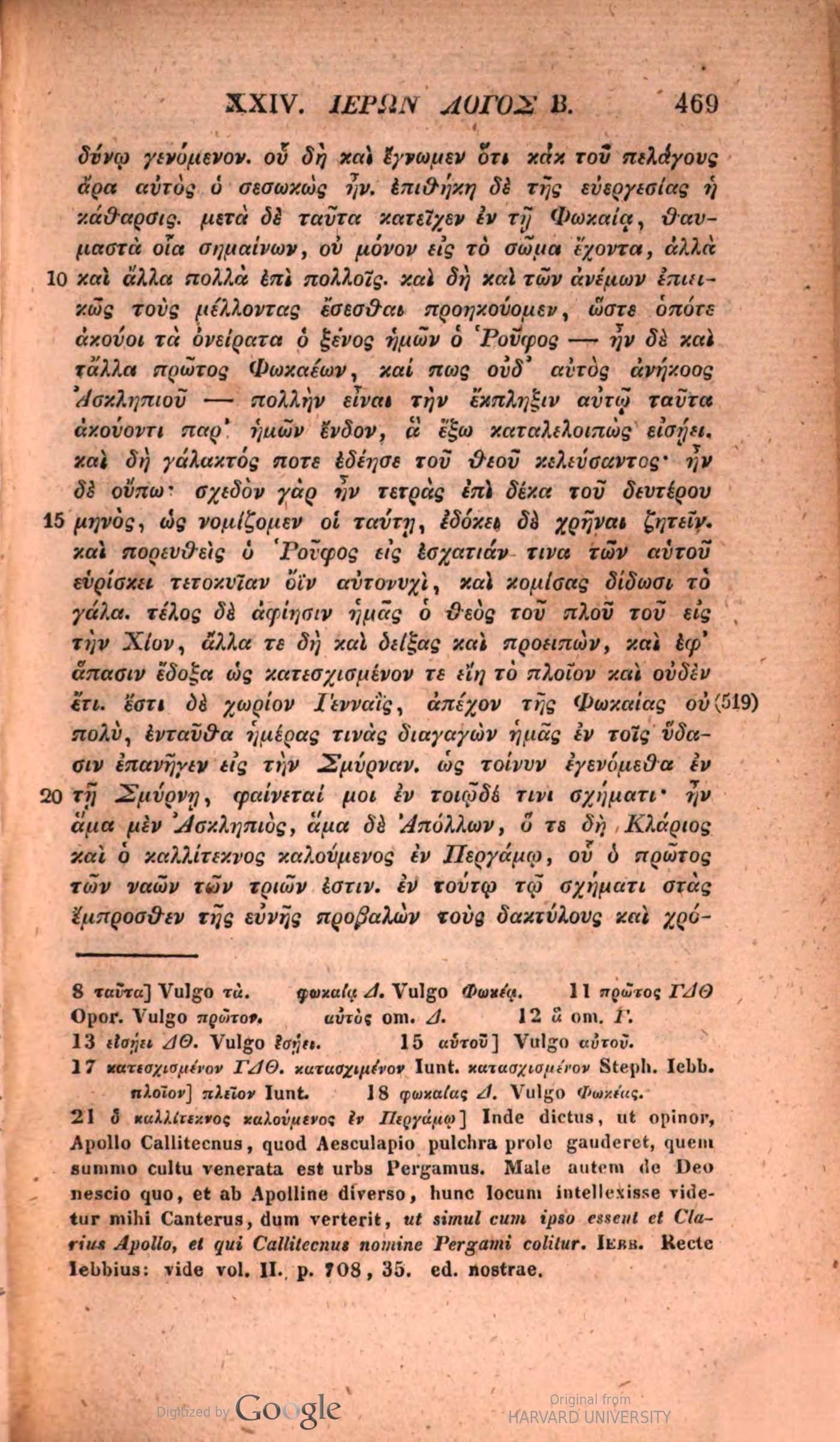
p. 469, section A begins 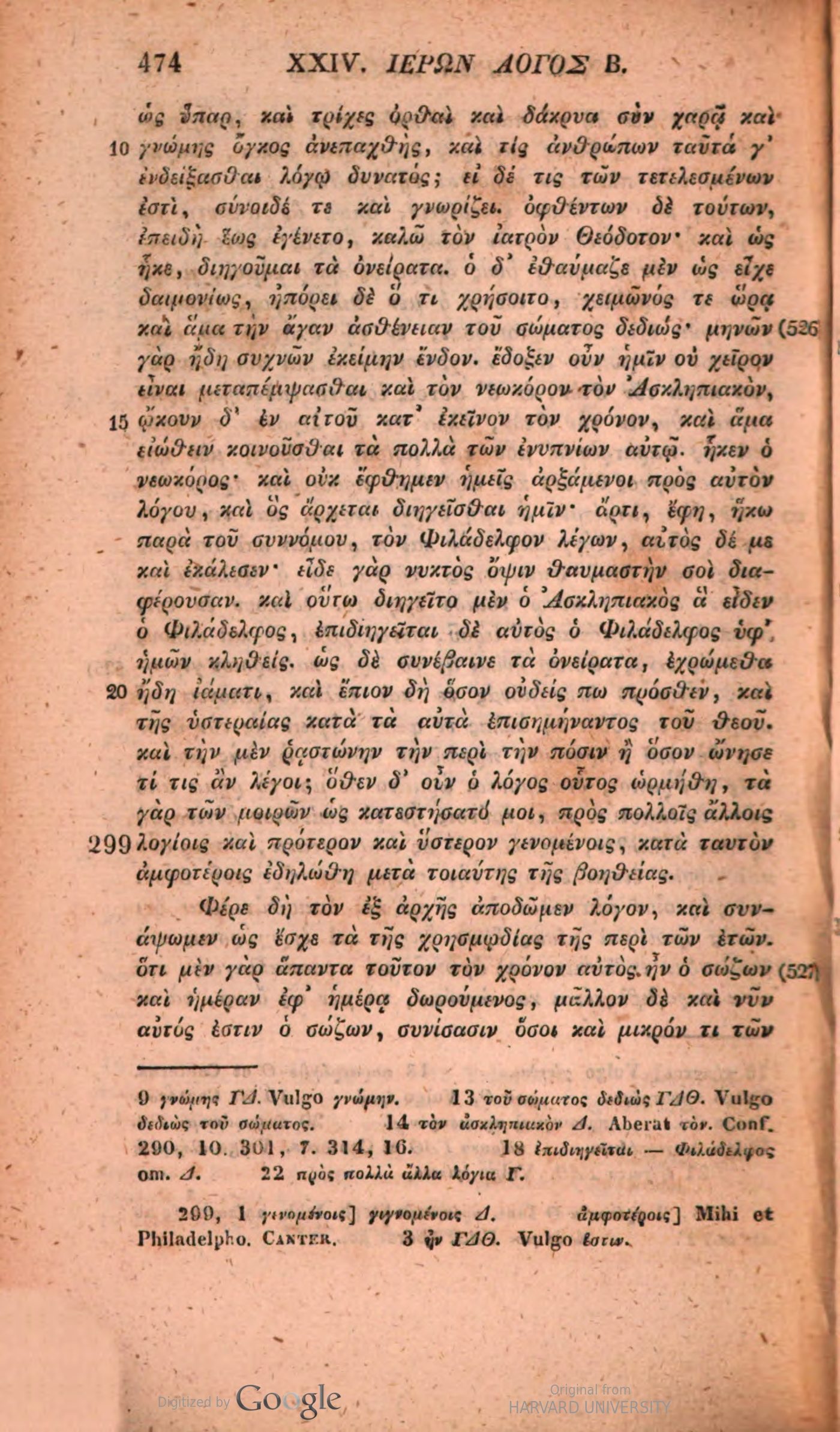
p. 474, section B begins 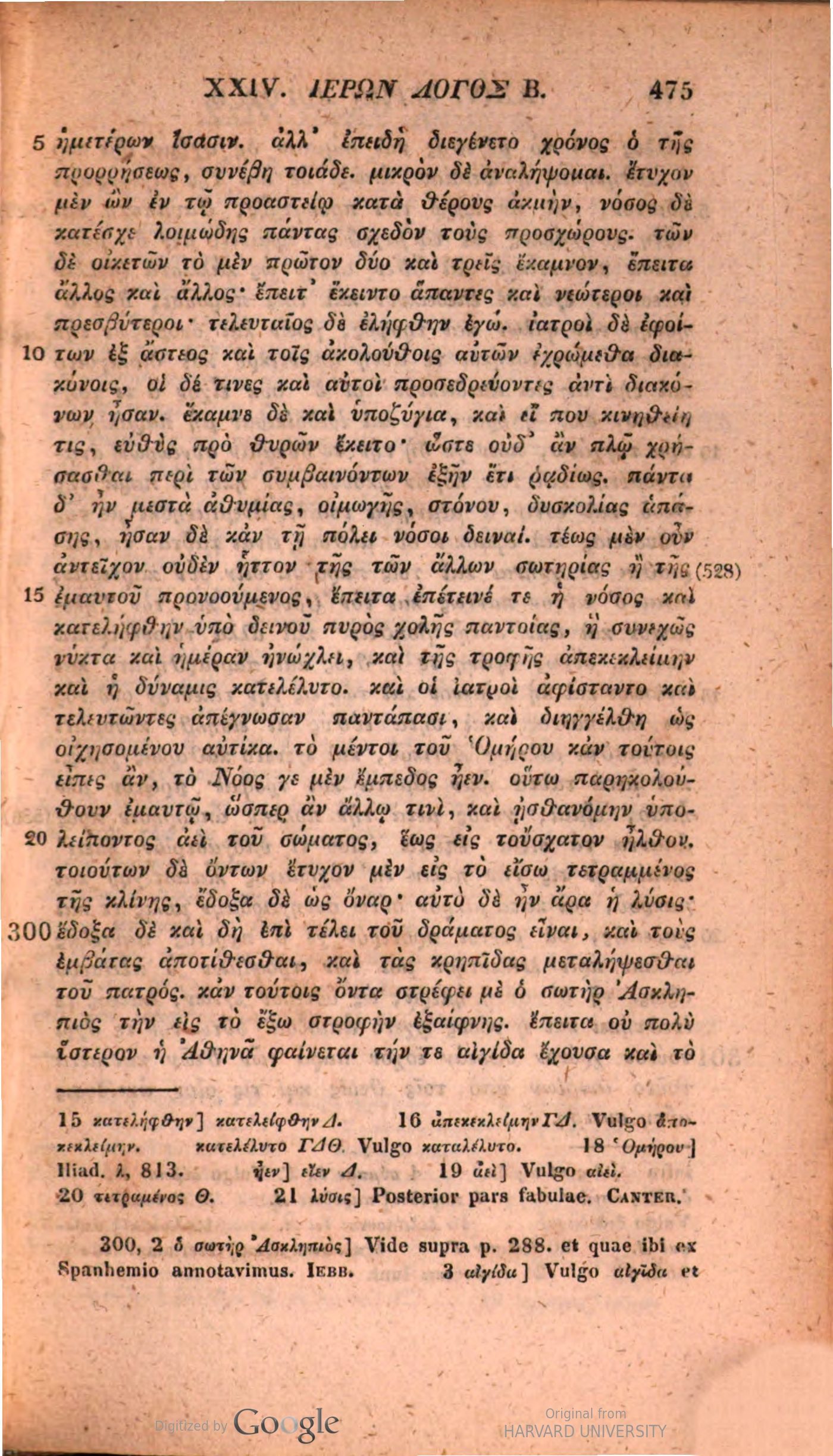
p. 475, the plague at the country house 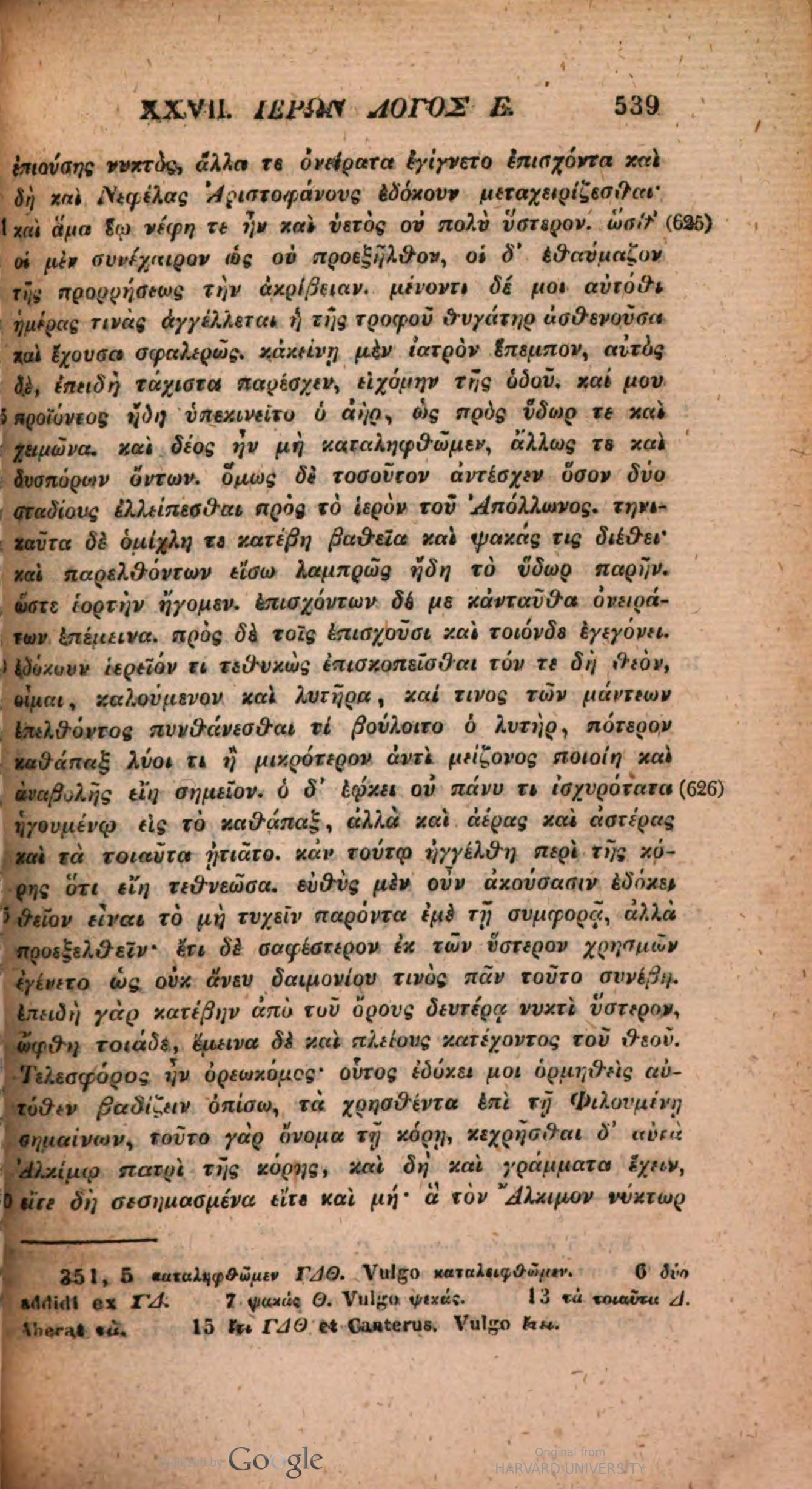
p. 539, section C begins
Other translations of this passage. Links go to copies that are free to read online.
Aelius Aristides and the Sacred Tales
C. A. Behr, 1968. English. In copyright; not free online.
The whole passage.
P. Aelius Aristides: The Complete Works, vol. 2
C. A. Behr, 1981. English. In copyright; not free online.
The whole passage.
Aelius Aristide, Discours sacrés
André-Jean Festugière, 1986. French. In copyright; not free online.
The whole passage.
Aelius Aristides, Heilige Berichte
Heinrich Otto Schröder, 1986. German. In copyright; not free online.
The whole passage.
Fits these units
- Explaining Disease Before Germs. How did people make sense of what they couldn't see?
- Faith and Catastrophe. How did religious believers respond, and did responses differ?
- Reading Sources Critically. How do we decide whom to believe?
Key vocabulary
- oracle
- a shrine where a god was believed to answer questions, or the answer given there
- seer
- a person who reads signs from the gods, such as an animal's organs
- aegis
- the magic goatskin cloak or shield of the goddess Athena
- humors
- the body fluids (later fixed as four, blood, phlegm, yellow bile, and black bile) that doctors believed had to stay in balance
- purge
- to empty the stomach or bowels on purpose, as a treatment
- foster-child
- a child raised in a household that is not the child's birth family
Questions
- Comprehension
List the steps of Aristides's illness and recovery, from the first sick slaves to his return to the city. Who helps him at each step?
- Analysis (reliability)
Aristides wrote this years later, to show how the gods cared for him, and he admits his friends feared he was raving when he saw Athena. Which parts of his account would you trust as a witness's report, and which would you treat as his interpretation? Why?
- Analysis
How does Aristides explain why he lived and Hermias and Philumene died? What does his explanation tell you about how he saw himself and the people around him?
- Connection
Thucydides (P01) also survived a plague. Compare how each writer explains the disease and his own survival. Which explanation would have been more comforting at the time, and which more useful to later readers?
Activity
Aristides tells the story of Hermias and Philumene only as it concerns him. Students write a short letter from their mother, Callityche, to Aristides after reading his account. Then compare letters: what does each student think she would have said, and what in the text supports it?
New translation from the Greek text of Wilhelm Dindorf's edition of Aristides (Leipzig, 1829), volume 1, pages 469–470, 474–476, and 539–540: the second and fifth Sacred Tales (Orations 48 and 51 in modern numbering). Section numbers follow Bruno Keil's edition (1898).
About 89 percent of the passages excerpted.
- Original
- Source text extracted by code from the named edition and collated against it. Edition: Wilhelm Dindorf, ed., Aristides, vol. 1 (Leipzig: Reimer, 1829), Orations 24 and 27 (Keil 48 and 51). Digital text: Perseus Digital Library, urn:cts:greekLit:tlg0284.tlg024.perseus-grc2 and tlg0284.tlg027.perseus-grc2 (canonical-greekLit, commit bcc5df0). Text only. Used in place of Keil 1898, which has no machine-readable text.
- Transliterated
- Machine transliteration (grc-romanized), generated by script, not reviewed
- Close English
- Working literal draft, machine-drafted, not edited for publication
- Simplified English
- Drafted by Claude (Anthropic) from the original and checked unit by unit against the original in a separate review, then compared with earlier translations and tested for borrowed wording.
- Editor’s review
- Not yet.
- Specialist review
- Not yet. Readings a specialist should confirm are listed for later review.
- Rights
- Original: public domain. Edition: public domain.
Sources for the notes
- Dindorf, Wilhelm, ed. Aristides. Vol. 1. Leipzig: Reimer, 1829. Source text.
- Behr, C. A. Aelius Aristides and the Sacred Tales. Amsterdam: Hakkert, 1968. For the family of Callityche, Hermias, and Philumene, the reading "foster-sister's daughter" (51.19), and Keil's section numbers.
- Forni, Diego, Cristian Molteni, Rachele Cagliani, Mario Clerici, and Manuela Sironi. "Analysis of Variola Virus Molecular Evolution Suggests an Old Origin of the Virus Consistent with Historical Records." Microbial Genomics 9, no. 1 (2023): mgen000932. Abstract (variola emerged earlier than about 3,800 years ago).
- Goeken, Johann. Review of Society, Medicine and Religion in the Sacred Tales of Aelius Aristides, by Ido Israelowich (Leiden: Brill, 2012). Bryn Mawr Classical Review 2013.07.40. For Aristides' dates, illness, and the writing of the Sacred Tales.
- Homer. Iliad 11.813. Greek text, Perseus Digital Library. For the line quoted in the excerpt.
- Homer. Odyssey 19.547. Greek text, Perseus Digital Library. For the phrase echoed at 48.18.
- Karasaridis, Anestis, and Aleš Chalupa. "Comparative SIR/SEIR Modeling of the Antonine Plague in Rome." PLOS ONE 20, no. 2 (2025): e0313684. For the smallpox and measles debate and the mortality estimates.
- Littman, R. J., and M. L. Littman. "Galen and the Antonine Plague." American Journal of Philology 94, no. 3 (1973): 243–255.
- Newfield, Timothy P., Ana T. Duggan, and Hendrik Poinar. "Smallpox's Antiquity in Doubt." Journal of Roman Archaeology 35, no. 2 (2022): 897–913. Abstract and conclusions (the case against smallpox in the Antonine Plague).
- Tozan, Murat. "Nature and Human Interaction in Aristeides' Testimonies on Smyrna: An Analysis of Environmental and Social Perspectives." Gephyra 31 (2026): 61–82. For the epidemic reaching Smyrna in the mid-160s and Aristides's houses in the city and its suburbs.