Once in a Lifetime, part 1
The Plague as a Test: A Bishop's Sermon at Carthage
- Written
- c. 252–253 (during the epidemic at Carthage)
- Place
- Carthage, Roman North Africa (modern Tunisia)
- Language
- Latin
- Kind of source
- sermon
- Reading time
- 11 minutes
- Difficulty
- Moderate
- Intensity
- Medium: a vivid list of symptoms; martyrdom and the deaths of children mentioned without graphic detail
"For us these are training exercises, not funerals." That is how Cyprian, bishop of Carthage, told his frightened congregation to see the epidemic that was killing their families and neighbors.
Thascius Caecilius Cyprianus came from a wealthy family in Carthage, the great Roman city on the coast of North Africa (modern Tunisia). He became a teacher of rhetoric, the art of persuasive speech, before he converted to Christianity around 246 CE. Within about two years he was chosen bishop. His church soon faced a terrible test. At the end of 249 or early in 250 the emperor Decius ordered everyone in the empire to sacrifice to the gods. Christians who refused were jailed, tortured, or killed, and many gave in. Cyprian went into hiding and led his church by letter, and critics, among them clergy at Rome, attacked him for it. Then, around 250, a new epidemic reached the empire. Cyprian wrote "On the Mortality" (De mortalitate) for his congregation while it was raging in Carthage, probably in 252 or 253. Five years later he was beheaded in another persecution, a martyr himself.
Romans of his day blamed epidemics on corrupted air or on angry gods, and some of his pagan neighbors blamed the Christians, who refused to honor those gods. Christians read their own Scriptures, in which Jesus foretold plagues before the end of the world, so many took the epidemic as a sign that the end was near and as a test of faith. What troubled Cyprian's people most was simpler. The plague killed Christians just as it killed everyone else. When Cyprian names the Jews alongside the pagans as people the plague punishes (section 15), he draws on a view he argued elsewhere. He taught that the Jews had lost God's favor and that the church had taken their place as God's people, and he collected passages of Scripture to argue it.
Cyprian is an eyewitness, writing in the middle of the epidemic for people who were living through it. But this is a sermon, not a report. He wanted to steady his congregation and stop them from fearing death, and every detail, including the symptoms and the dying bishop's vision, serves that purpose. He gives no numbers. His deacon Pontius, who later wrote Cyprian's life, says that while the sick and the dead lay in the streets, Cyprian urged Christians to help everyone, pagans as well as their own.
Watch how Cyprian answers the question his people kept asking, about why Christians die like everyone else. And notice his list in section 16 of what the plague tests. It also reads as a list of what he expected his congregation to do.
What we know now
No one knows what disease Cyprian saw. Historians call it the Plague of Cyprian. It struck the Roman Empire in waves for some twenty years, until about 270, reaching Rome, Carthage, Alexandria, and many other cities. Kyle Harper, as Sabine Huebner summarizes his work, held that it reached the empire from Ethiopia through Egypt around 249 and that its symptoms suggest a viral hemorrhagic fever like Ebola. Huebner herself traces its first appearance to the Balkan frontier on the Danube around 251, with armies carrying it to Mediterranean ports, and notes that only ancient DNA could settle what it was (Huebner 2021). Cyprian's symptom list is less help than it seems. He wrote to strengthen his congregation, not to make a medical record (Flemming 2023). No reliable death toll survives (Huebner 2021).
Read alongside
- The Plague at My Country House, and a Life for a Life
About eighty years earlier, Aelius Aristides told an epidemic as a story about himself alone, and he believed the gods had taken another life in exchange for his own. Compare his private bargain with the comfort Cyprian offers a whole congregation.
- The Plague at Constantinople
Writing of the plague at Constantinople in the 540s, Procopius noted that it struck every kind of person alike, the fact that troubled Cyprian's congregation. He records it as a historian, not a preacher, and draws no religious lesson from it.
The edited translation, in simplified modern English. Bracketed words were added for clarity; [...] marks a cut. Tap a note number to read the note. Point at or tap a phrase to see the original behind it. Phrase links checked in a separate review.
8But some people are troubled because the force of this disease strikes our people just as it strikes the pagans. As if a Christian had become a believer in order to enjoy the world and this life in happiness, safe from any touch of trouble! As if he were not meant to suffer every hardship here and so be kept for the joy to come! Some are troubled that this mortality1 falls on us and on everyone else alike. But what in this world do we not share with everyone else, as long as we still live in this flesh that we all share under the law of our first birth?2 While we remain here in the world, the flesh joins us to the rest of the human race; it is the spirit that sets us apart. So until this corruptible body puts on incorruption, and this mortal body receives immortality,3 and the spirit leads us home to God the Father, the troubles of the flesh are ours as much as anyone's.
When a barren harvest leaves the land hungry, famine spares no one. When an enemy invades and takes a city, captivity ruins everyone together. When clear skies hold back the rain, the drought is the same for all. When jagged rocks smash a ship, everyone on board shares the shipwreck, without exception. In the same way, sore eyes, attacks of fever, and sickness in every part of the body are ours as much as anyone's, as long as we carry this shared flesh through the world.
[...]
12Abraham pleased God in just this way:4 to please God, he did not fear to lose his son, and he did not refuse to kill him with his own hand. You cannot bear to lose a son to the law and lot that all mortals share. How would you act if you were ordered to kill him? The fear of God and faith should make you ready for anything.
You may lose your property. Disease may attack your body and torment it without rest, until it bleeds. Death may tear you away, in sorrow and mourning, from your wife, from your children, from the loved ones who leave you. Do not let these things be stumbling blocks for you; let them be battles. They should not weaken or break a Christian's faith. Instead they should show his courage in the struggle, since trust in the good things to come should make us scorn every injury from the evils of today.
Without a fight first, there can be no victory, and when the victory is won in the clash of battle, then the winners receive the crown as well. A pilot is known in a storm; a soldier proves himself on the battle line. Boasting is easy when there is no danger. When there is a struggle in hard times, then the truth is tested. A tree set firm on a deep root does not move when the winds beat against it. A ship built solid with strong joints is pounded by the waves, but they do not break through. And when grain is threshed on the threshing floor, the strong, heavy kernels scorn the wind, while the empty chaff is snatched up and carried away on the breeze.
13The apostle Paul, too, after shipwrecks, after whippings, after many cruel torments of flesh and body, says that hardships did not harm him but made him better, so that the harder he was struck, the more truly he was proven. "A thorn was given me in my flesh," he writes, "an angel of Satan to beat me, so that I would not become proud. Three times I begged the Lord to take it away from me, and he said to me, 'My grace is enough for you, for strength is made perfect in weakness.'" So when weakness and frailty and ruin of any kind rage among us, that is when our strength is made perfect, and when our faith, if it holds firm under testing, wins its crown, as Scripture says: "The furnace tests the potter's jars, and the trial of trouble tests the righteous."5
In the end, this is what separates us from the others, who do not know God. In hard times they complain and grumble. But hard times do not draw us away from true courage and faith; they prove us true in our pain.
14The bowels now loosen into a flux6 and drain the body of its strength. A fire that starts deep in the marrow boils up into sores in the throat. The guts are shaken by constant vomiting. The eyes burn red with the force of the blood. In some people the feet, or other parts of the limbs, are cut off by the contagion7 of the diseased rot. In others the body is so damaged and broken as the sickness bursts out that they are left lame, or deaf, or blind. All of this serves to prove our faith.
What greatness of heart it takes to meet so many attacks of ruin and death with a mind that does not waver! What nobility, to stand upright among the ruins of the human race, instead of lying flat on the ground beside those for whom there is no hope in God! Rather, we should rejoice and welcome the gift this time brings. The gift is this: by firmly showing our faith, bearing our hardships, and pressing on to Christ along Christ's narrow way, we may win the reward of his way and of our faith, with Christ himself as our judge.
Let him fear to die, by all means: the one who has not been born again of water and the spirit,8 and is handed to the fires of Gehenna. Let him fear to die who has not been counted as Christ's through his cross and suffering. Let him fear to die who will pass from this death to the second death.9 Let him fear to die whom the eternal flame will torture with endless punishments as soon as he leaves the world. Let him fear to die for whom a longer delay brings only this: his torment and his groaning are put off for a while.
15Many of our people are dying in this mortality. That is to say, many of our people are being set free from the world. This mortality is a plague to the Jews and the pagans and the enemies of Christ;10 to the servants of God it is a departure that brings salvation. It is true that the just die along with the unjust, with no distinction made within the human race. But that gives you no reason to think that the good and the wicked meet the same end. The just are called to refreshment; the unjust are dragged off to punishment. Protection comes sooner to those who keep faith, and punishment sooner to the faithless.
We are shortsighted and ungrateful for God's gifts, dearest brothers, and we do not see what is being given to us. Look: virgins are leaving this life in peace and safety, their glory whole, and with no need to fear the threats, the corruption, and the brothels of the coming Antichrist.11 Boys escape the dangers of their unsteady years and come happily to the reward of self-control and innocence. The delicate married woman no longer fears torture. By dying quickly, she has escaped the fear of persecution12 and the executioner's hands and torments.
Fear of the mortality and of these times sets the timid on fire, braces the slack, and wakes the lazy. Deserters are compelled to return; pagans are driven to believe. The faithful of long standing are called to their rest, while a fresh and plentiful army gathers for the battle line, stronger than before. Those who enlist during the mortality will go into battle unafraid of death when the fight comes.
16And then, dearest brothers, think what this means: how fitting it is, how necessary. This plague and pestilence, which seems so terrible and deadly, searches out the justice of each person and tests the minds of humankind. It asks whether the healthy serve the sick, whether relatives truly love their own family, and whether masters pity their sick slaves. It asks whether doctors stand by the sick who beg for their help, and whether the fierce hold back their violence. It asks whether the greedy, at least for fear of death, will put out the fire of their raging greed, which nothing ever satisfies. It asks whether the proud will bend their necks and the shameless will tame their boldness. And it asks whether the rich, at least now, as their loved ones die and they face death without heirs, will give something away.
Even if this mortality had done nothing else, it has done Christians and servants of God this great service: we have begun to seek martyrdom gladly, while we are learning not to fear death. For us these are training exercises, not funerals. They bring the mind the glory of courage, and by teaching us to scorn death they prepare us for the crown.
17But perhaps someone will object: "This is what grieves me in the present mortality. I was ready to make my confession.13 I had given myself with my whole heart and all my courage to enduring a martyr's suffering. Now death has come first, and I am robbed of my martyrdom." First of all, martyrdom does not lie in your power; it lies in God's gift. And you cannot say you have lost something when you do not know if you would have deserved to receive it. Then, too, God searches the heart and the inmost being; he sees and knows what is hidden. He sees you, and he praises and approves you. He sees that the courage was ready in you, and for that courage he pays the reward. [...] For what God seeks is not our blood but our faith.
[...]
19To make the signs of God's providence shine out still more clearly, and to show that the Lord, who knows the future, looks after his own and their true salvation, something happened to a colleague of ours, a fellow bishop.14 He was worn out by illness and anxious as death drew near, and he prayed to be granted a reprieve. As he prayed, already close to death, a young man stood beside him, awe-inspiring in honor and majesty, tall and shining to look at. Human eyes of flesh could hardly have looked at him standing there, except that the bishop, about to leave the world, could already see such a being. With some anger in his heart and his voice, the young man growled: "You are afraid to suffer. You do not want to leave. What am I to do with you?"
It was the voice of one who scolds and warns. Concerned about persecution and untroubled by the summons, he would not give in to the wish of the moment but looked to the future.15 Our brother and colleague heard, as he was about to die, what he was to tell the rest of us. He heard it as he was dying so that he could pass it on: he heard it for us, not for himself. After all, what was there for him to learn when he was already leaving? No, he learned it for those of us who remain, so that when we hear that a bishop who asked for a reprieve was scolded, we would understand what is good for us all.
20And to me, too, the least and lowest of all, how often this has been revealed! How often and how clearly God in his kindness has commanded me to bear witness constantly and to preach in public that our brothers whom the Lord's summons has set free from the world must not be mourned. For we know they are not lost; they are sent on ahead. In leaving us, they go before us. We should miss them as we miss travelers, or people who have set sail, but not wail over them. We should not put on black clothes here when they have already put on white robes there.16 We must not give the pagans good reason to blame us. They would be right and just to blame us if we mourned as dead and lost the very people we declare to be alive with God, and if the witness of our hearts did not prove the faith we profess with our words.
We betray our own hope and faith if what we say seems pretended, false, painted on. It does no good to show courage in words and destroy the truth with deeds.
Notes
- Cyprian's word mortalitas, "the dying" or "the mortality," is his name for the epidemic and the title of this sermon. Medieval writers later used the same word for the Black Death. back
- The first birth is natural birth, which makes every human being mortal. Christians called baptism a second birth, the start of a new life of the spirit. back
- Cyprian is quoting Paul's words on the resurrection of the body (1 Corinthians 15:53). back
- In Genesis 22, God commands Abraham to sacrifice his son Isaac, then stops him at the last moment. Christians read the story as the model of complete trust in God. back
- Paul's words are from 2 Corinthians 12:7–9. The saying about the furnace is from Sirach 27:5, a book of wisdom sayings in the Bible of Cyprian's church. back
- Flux: dysentery or severe diarrhea. back
- Here Cyprian's word means rot spreading through a limb until it is lost, not disease passing from person to person. back
- To be born again of water and the spirit is to be baptized (John 3:5). Gehenna, a valley outside Jerusalem, became the Jewish and Christian name for hell. back
- The second death is eternal punishment after the Last Judgment (Revelation 20:14), as opposed to the first death, the death of the body. back
- Divine punishment: the belief that God sent disease to punish wrongdoing or to test the faithful. Cyprian holds both ideas at once: the same plague tests Christians and punishes everyone else. back
- Many Christians expected a last great enemy of God, the Antichrist, to persecute the faithful before the end of the world. Roman courts sometimes sentenced Christian women to brothels. back
- In 250–251 the emperor Decius ordered everyone to sacrifice to the gods. Christians who refused were jailed, tortured, or killed; many who gave in, the "deserters" below, later asked to return to the church. back
- To make one's confession was to declare oneself a Christian before Roman officials, at the risk of torture or death. Those who died for it were martyrs, who Christians believed went straight to God. back
- Cyprian's word is consacerdos, "fellow priest." In his time sacerdos, "priest," usually meant a bishop. back
- The Latin is compressed. The young man seems to look ahead to a coming persecution, which a quick death would spare the bishop. Older printed editions make the worry about persecution belong to people in general instead. back
- In the Book of Revelation (7:9–14), the saved stand before God in white robes. Romans wore dark clothing in mourning. back
At enim quosdam mouet quod aequaliter cum gentilibus nostros morbi istius ualitudo corripiat: quasi ad hoc crediderit christianus, ut immunis a contactu malorum mundo et saeculo feliciter perfruatur et non hic omnia aduersa perpessus ad futuram laetitiam reseruetur.
But indeed it troubles some that the ill health [force?] of this disease seizes our people equally with the pagans: as if a Christian had believed for this purpose, that, immune from contact with evils, he might happily enjoy the world and the world [this age?], and not, having suffered all adversities here, be reserved for future joy.
But some people are troubled because the force of this disease strikes our people just as it strikes the pagans. As if a Christian had become a believer in order to enjoy the world and this life in happiness, safe from any touch of trouble! As if he were not meant to suffer every hardship here and so be kept for the joy to come!
But nevertheless it disturbs some that the power of this Disease attacks our people equally with the heathens, as if the Christian believed for this purpose, that he might have the enjoyment of the world and this life free from the contact of ills; and not as one who undergoes all adverse things here and is reserved for future joy.
mouet quosdam quod sit nobis cum ceteris mortalitas ista communis.
It troubles some that this mortality is common to us with the rest.
Some are troubled that this mortality falls on us and on everyone else alike.
It disturbs some that this mortality is common to us with others;
- Cyprian's word mortalitas, "the dying" or "the mortality," is his name for the epidemic and the title of this sermon. Medieval writers later used the same word for the Black Death.
quid enim nobis in hoc mundo non commune cum ceteris, quamdiu adhuc secundum legem primae natiuitatis manet caro ista communis?
For what in this world is not common to us with the rest, so long as this flesh, common according to the law of the first birth, still remains?
But what in this world do we not share with everyone else, as long as we still live in this flesh that we all share under the law of our first birth?
and yet what is there in this world which is not common to us with others, so long as this flesh of ours still remains, according to the law of our first birth, common to us with them?
- The first birth is natural birth, which makes every human being mortal. Christians called baptism a second birth, the start of a new life of the spirit.
quoadusque istic in mundo sumus, cum genere humano carnis aequalitate coniungimur, spiritu separamur.
As long as we are here in the world, we are joined with the human race by equality of the flesh; we are separated by the spirit.
While we remain here in the world, the flesh joins us to the rest of the human race; it is the spirit that sets us apart.
So long as we are here in the world, we are associated with the human race in fleshly equality, but are separated in spirit.
itaque donec corruptiuum istud induat incorruptionem, et mortale hoc accipiat inmortalitatem, et spiritus nos perducat ad Deum patrem, quaecumque sunt carnis incommoda sunt nobis cum humano genere communia.
And so, until this corruptible thing put on incorruption, and this mortal thing receive immortality, and the spirit lead us through to God the Father, whatever are the disadvantages of the flesh are common to us with the human race.
So until this corruptible body puts on incorruption, and this mortal body receives immortality, and the spirit leads us home to God the Father, the troubles of the flesh are ours as much as anyone's.
Therefore until this corruptible shall put on incorruption, and this mortal receive immortality, and the Spirit lead us to God the Father, whatsoever are the disadvantages of the flesh are common to us with the human race.
- Cyprian is quoting Paul's words on the resurrection of the body (1 Corinthians 15:53).
sic cum fetu sterili terra ieiuna est, neminem fames separat: sic cum inruptione hostili ciuitas aliqua possessa est, omnes simul captiuitas uastat, et quando imbrem nubila serena suspendunt, omnibus siccitas una est, et cum nauem scopulosa saxa confringunt, nauigantibus naufragium sine exceptione commune est, et oculorum dolor et impetus febrium et omnium ualitudo membrorum cum ceteris communis est nobis, quamdiu portatur in saeculo caro ista communis. ‖302‖
Thus, when the earth is hungry [barren?] with sterile produce, famine separates no one; thus, when some city has been seized by hostile invasion, captivity lays waste all together; and when the clear clouds [cloudless skies?] hold back the rain, the drought is one for all; and when rocky crags shatter a ship, shipwreck is common without exception to those sailing; and pain of the eyes and the attack of fevers and the ill health of all the limbs is common to us with the rest, so long as this common flesh is carried in the world.
When a barren harvest leaves the land hungry, famine spares no one. When an enemy invades and takes a city, captivity ruins everyone together. When clear skies hold back the rain, the drought is the same for all. When jagged rocks smash a ship, everyone on board shares the shipwreck, without exception. In the same way, sore eyes, attacks of fever, and sickness in every part of the body are ours as much as anyone's, as long as we carry this shared flesh through the world.
Thus, when the earth is barren with an unproductive harvest, famine makes no distinction; thus, when with the invasion of an enemy any city is taken, captivity at once desolates all; and when the serene clouds withhold the rain, the drought is alike to all; and when the jagged rocks rend the ship, the shipwreck is common without exception to all that sail in her; and the disease of the eyes, and the attack of fevers, and the feebleness of all the limbs is common to us with others, so long as this common flesh of ours is borne by us in the world.
Left out of this excerpt.
Left out of this excerpt.
Left out of this excerpt.
Left out of this excerpt.
Left out of this excerpt.
Left out of this excerpt.
Left out of this excerpt.
Left out of this excerpt.
Left out of this excerpt.
Left out of this excerpt.
Left out of this excerpt.
Left out of this excerpt.
Left out of this excerpt.
Left out of this excerpt.
Left out of this excerpt.
Left out of this excerpt.
Left out of this excerpt.
Sic Abraham Deo placuit, quia ut placeret Deo nec amittere filium timuit nec gerere parricidium recusauit.
Thus Abraham pleased God, because, in order to please God, he neither feared to lose his son nor refused to commit parricide [the killing of a kinsman?].
Abraham pleased God in just this way: to please God, he did not fear to lose his son, and he did not refuse to kill him with his own hand.
Thus Abraham pleased God, who, that he might please God, did not shrink even from losing his son, or from doing an act of parricide.
- In Genesis 22, God commands Abraham to sacrifice his son Isaac, then stops him at the last moment. Christians read the story as the model of complete trust in God.
qui filium non potes lege et sorte mortalitatis amittere, quid faceres, si filium iubereris occidere?
You who cannot lose a son by the law and lot of mortality, what would you do if you were ordered to kill your son?
You cannot bear to lose a son to the law and lot that all mortals share. How would you act if you were ordered to kill him?
You, who cannot endure to lose your son by the law and lot of mortality, what would you do if you were bidden to slay your son?
ad omnia te paratum facere timor Dei et fides debet.
The fear of God and faith ought to make you prepared for all things.
The fear of God and faith should make you ready for anything.
The fear and faith of God ought to make you prepared for everything,
sit licet rei familiaris amissio, sit de infestantibus morbis adsidua membrorum et cruenta uexatio, sit de uxore, de liberis, de excedentibus caris funebris et tristis auulsio: non sint tibi offendicula ista sed proelia, nec debilitent aut frangant christiani fidem, sed potius ostendant in conluctatione uirtutem, cum contemnenda sit omnis iniuria malorum praesentium fiducia futurorum bonorum.
Though there be loss of household property, though there be continual and bloody torment of the limbs from attacking diseases, though there be a funereal and sad tearing away from wife, from children, from dear ones departing: let these things be to you not stumbling blocks but battles, and let them not weaken or break the faith of the Christian, but rather show his strength [virtue?] in the struggle, since all injury from present evils is to be despised through confidence in future goods.
You may lose your property. Disease may attack your body and torment it without rest, until it bleeds. Death may tear you away, in sorrow and mourning, from your wife, from your children, from the loved ones who leave you. Do not let these things be stumbling blocks for you; let them be battles. They should not weaken or break a Christian's faith. Instead they should show his courage in the struggle, since trust in the good things to come should make us scorn every injury from the evils of today.
although it should be the loss of private estate, although the constant and cruel harassment of your limbs by agonizing disorders, although the deadly and mournful wrench from wife, from children, from departing dear ones; Let not these things be offences to you, but battles: nor let them weaken nor break the Christian’s faith, but rather show forth his strength in the struggle, since all the injury inflicted by present troubles is to be despised in the assurance of future blessings.
nisi praecesserit pugna, non potest esse uictoria, cum fuerit in pugnae congressione uictoria, tunc datur uincentibus et corona.
Unless a fight has gone before, there cannot be victory; when there has been victory in the encounter of the fight, then the crown also is given to the victors.
Without a fight first, there can be no victory, and when the victory is won in the clash of battle, then the winners receive the crown as well.
Unless the battle has preceded, there cannot be a victory: when there shall have been, in the onset of battle, the victory, then also the crown is given to the victors.
gubernator in tempestate dinoscitur, in acie miles probatur.
The helmsman is discerned in the storm; in the battle line the soldier is proved.
A pilot is known in a storm; a soldier proves himself on the battle line.
For the helmsman is recognised in the tempest; in the warfare the soldier is proved.
delicata iactatio est, cum periculum non est: cum est conflictatio in aduersis, probatio est ueritatis.
It is a soft [self-indulgent?] boasting when there is no danger: when there is struggle in adversities, there is the proof of truth.
Boasting is easy when there is no danger. When there is a struggle in hard times, then the truth is tested.
It is a wanton display when there is no danger. Struggle in adversity is the trial of the truth.
arbor quae alta radice fundata est uentis incumbentibus non mouetur et nauis quae forti conpage solidata est pulsatur fluctibus nec foratur, et quando area fruges terit, uentos grana fortia et robusta contemnunt inanes paleae flatu portante rapiuntur.
A tree which is founded on a deep root is not moved by the winds pressing upon it, and a ship which is made solid by strong joining is struck by the waves and is not pierced [breached?], and when the threshing floor threshes the crops, the strong and robust grains despise the winds, the empty chaff is snatched away by the blast carrying it.
A tree set firm on a deep root does not move when the winds beat against it. A ship built solid with strong joints is pounded by the waves, but they do not break through. And when grain is threshed on the threshing floor, the strong, heavy kernels scorn the wind, while the empty chaff is snatched up and carried away on the breeze.
The tree which is deeply founded in its root is not moved by the onset of winds, and the ship which is compacted of solid timbers is beaten by the waves and is not shattered; and when the threshing-floor brings out the corn, the strong and robust grains despise the winds, while the empty chaff is carried away by the blast that falls upon it.
Sic et apostolus Paulus post naufragia, post flagella, post carnis et corporis multa et grauia tormenta non uexari sed ‖305‖ emendari se dicit aduersis, ut dum grauius adfligitur uerius probaretur.
Thus also the apostle Paul, after shipwrecks, after scourgings, after many and grievous torments of the flesh and the body, says that he is not harassed but corrected [improved?] by adversities, so that while he was more grievously afflicted he might be more truly proved.
The apostle Paul, too, after shipwrecks, after whippings, after many cruel torments of flesh and body, says that hardships did not harm him but made him better, so that the harder he was struck, the more truly he was proven.
Thus, moreover, the Apostle Paul, after shipwrecks, after scourgings, after many and grievous tortures of the flesh and body, says that he is not grieved, but benefited by his adversity, in order that while he is sorely afflicted he might more truly be proved.
datus est mihi, inquit, stimulus carnis meae, angelus satanae qui me colafizet ut non extollar.
There was given to me, he says, a goad [thorn?] of my flesh, an angel of Satan, to buffet me, that I might not be exalted.
"A thorn was given me in my flesh," he writes, "an angel of Satan to beat me, so that I would not become proud.
“There was given to me,” he says, “a thorn in the flesh, the messenger of Satan to buffet me, that I should not be lifted up:
propter quod ter Dominum rogaui ut discederet a me, et dixit mihi: sufficit tibi gratia mea.
On account of which I asked the Lord three times that it might depart from me, and he said to me: My grace is sufficient for you.
Three times I begged the Lord to take it away from me, and he said to me, 'My grace is enough for you,
for which thing I besought the Lord thrice, that it might depart from me; and He said unto me, My grace is sufficient for thee,
uirtus enim in infirmitate perficitur.
For strength [virtue? power?] is perfected in weakness.
for strength is made perfect in weakness.'"
for strength is made perfect in weakness.”
quando ergo infirmitas et inbecillitas et uastitas aliqua grassatur, tunc uirtus nostra perficitur, tunc fides si temptata perstiterit coronatur, sicut scriptum est: uasa figuli probat fornax et homines iustos temptatio tribulationis.
When therefore weakness and feebleness and some devastation rages, then our strength is perfected, then faith, if, having been tempted [tested?], it has persisted, is crowned, as it is written: The furnace proves the vessels of the potter, and the trial of tribulation [temptation?] proves just men.
So when weakness and frailty and ruin of any kind rage among us, that is when our strength is made perfect, and when our faith, if it holds firm under testing, wins its crown, as Scripture says: "The furnace tests the potter's jars, and the trial of trouble tests the righteous."
When, therefore, weakness and inefficiency and any destruction seize us, then our strength is made perfect; then our faith, if when tried it shall stand fast, is crowned; as it is written, “The furnace trieth the vessels of the potter, and the trial of tribulation just men.”
- Paul's words are from 2 Corinthians 12:7–9. The saying about the furnace is from Sirach 27:5, a book of wisdom sayings in the Bible of Cyprian's church.
hoc denique inter nos et ceteros interest qui Deum nesciunt, quod illi in aduersis queruntur et murmurant, nos aduersa non auocant a uirtutis et fidei ueritate, sed conprobant in dolore.
This, finally, is the difference between us and the others who do not know God, that they in adversities complain and murmur; adversities do not call us away from the truth of strength [virtue?] and faith, but prove [confirm?] us in pain.
In the end, this is what separates us from the others, who do not know God. In hard times they complain and grumble. But hard times do not draw us away from true courage and faith; they prove us true in our pain.
This, in short, is the difference between us and others who know not God, that in misfortune they complain and murmur, while adversity does not call us away from the truth of virtue and faith, but strengthens us by its suffering.
Hoc quod nunc corporis uires solutus in fluxum uenter euiscerat, quod in faucium uulnera conceptus medullitus ignis exaestuat, quod adsiduo uomitu intestina quatiuntur, quod oculi ui sanguinis inardescunt, quod quorundam uel pedes uel aliquae membrorum partes contagio morbidae putredinis amputantur, quod per iacturas et damna corporum prorumpente languore uel debilitatur incessus uel auditus obstruitur uel caecatur aspectus, ad documentum proficit fidei.
This, that now the belly, loosened into a flux, drains [eviscerates?] the strength of the body; that a fire conceived in the marrow [deep within?] boils up into wounds [sores?] of the throat; that the intestines are shaken by continual vomiting; that the eyes burn with the force of blood; that the feet or some parts of the limbs of certain people are cut off by the contagion of diseased putrefaction; that, through the losses and damages of bodies, with weakness [sickness?] bursting forth, either the gait is weakened or the hearing is blocked or the sight is blinded: this serves for the proof [instruction?] of faith.
The bowels now loosen into a flux and drain the body of its strength. A fire that starts deep in the marrow boils up into sores in the throat. The guts are shaken by constant vomiting. The eyes burn red with the force of the blood. In some people the feet, or other parts of the limbs, are cut off by the contagion of the diseased rot. In others the body is so damaged and broken as the sickness bursts out that they are left lame, or deaf, or blind. All of this serves to prove our faith.
This trial, that now the bowels, relaxed into a constant flux, discharge the bodily strength; that a fire originated in the marrow ferments into wounds of the fauces; that the intestines are shaken with a continual vomiting; that the eyes are on fire with the injected blood; that in some cases the feet or some parts of the limbs are taken off by the contagion of diseased putrefaction; that from the weakness arising by the maiming and loss of the body, either the gait is enfeebled, or the hearing is obstructed, or the sight darkened;—is profitable as a proof of faith.
- Flux: dysentery or severe diarrhea.
- Here Cyprian's word means rot spreading through a limb until it is lost, not disease passing from person to person.
contra tot inpetus uastitatis et mortis inconcussis animi uirtutibus congredi quanta pectoris magnitudo est, quanta sublimitas in ruinis humani generis stare rectum nec cum eis quibus spes in Deum nulla est iacere prostratum et gratulari magis et temporis munus amplecti, quod dum nostram fidem firmiter promimus et labore tolerato ad ‖306‖ Christum per angustam Christi uiam pergimus, praemium uiae eius et fidei ipso iudicante capiamus.
To engage against so many onslaughts of devastation and death with unshaken strengths of mind, how great a greatness of heart it is; how great a loftiness, to stand upright amid the ruins of the human race, and not to lie prostrate with those for whom there is no hope in God, and rather to rejoice and to embrace the gift of the time [occasion?], that, while we firmly put forth [show?] our faith and, labour having been endured, proceed to Christ by the narrow way of Christ, we may receive the reward of his way and of faith, he himself judging.
What greatness of heart it takes to meet so many attacks of ruin and death with a mind that does not waver! What nobility, to stand upright among the ruins of the human race, instead of lying flat on the ground beside those for whom there is no hope in God! Rather, we should rejoice and welcome the gift this time brings. The gift is this: by firmly showing our faith, bearing our hardships, and pressing on to Christ along Christ's narrow way, we may win the reward of his way and of our faith, with Christ himself as our judge.
What a grandeur of spirit it is to struggle with all the powers of an unshaken mind against so many onsets of devastation and death! what sublimity, to stand erect amid the desolation of the human race, and not to lie prostrate with those who have no hope in God; but rather to rejoice, and to embrace the benefit of the occasion; that in thus bravely showing forth our faith, and by suffering endured, going forward to Christ by the narrow way that Christ trod, we may receive the reward of His life and faith according to His own judgment!
mori plane timeat, sed qui ex aqua et spiritu non renatus gehennae ignibus mancipatur.
Let him indeed fear to die, but [only?] he who, not reborn of water and the spirit, is handed over to the fires of Gehenna.
Let him fear to die, by all means: the one who has not been born again of water and the spirit, and is handed to the fires of Gehenna.
Assuredly he may fear to die, who, not being regenerated of water and the Spirit, is delivered over to the fires of Gehenna;
- To be born again of water and the spirit is to be baptized (John 3:5). Gehenna, a valley outside Jerusalem, became the Jewish and Christian name for hell.
mori timeat qui non Christi cruce et passione censetur.
Let him fear to die who is not counted [enrolled?] by the cross and passion of Christ.
Let him fear to die who has not been counted as Christ's through his cross and suffering.
he may fear to die who is not enrolled in the cross and passion of Christ;
mori timeat qui ad secundam mortem de hac morte transibit.
Let him fear to die who will pass from this death to the second death.
Let him fear to die who will pass from this death to the second death.
he may fear to die, who from this death shall pass over to a second death;
- The second death is eternal punishment after the Last Judgment (Revelation 20:14), as opposed to the first death, the death of the body.
mori timeat quem de saeculo recedentem perennibus poenis aeterna flamma torquebit.
Let him fear to die whom, as he leaves the world, the eternal flame will torture with everlasting punishments.
Let him fear to die whom the eternal flame will torture with endless punishments as soon as he leaves the world.
he may fear to die, whom on his departure from this world eternal flame shall torment with never-ending punishments;
mori timeat cui hoc mora longiore confertur, ut cruciatus eius et gemitus interim differatur.
Let him fear to die to whom this is granted by a longer delay, that his torment and groaning may meanwhile be put off.
Let him fear to die for whom a longer delay brings only this: his torment and his groaning are put off for a while.
he may fear to die who has this advantage in a lengthened delay, that in the meanwhile his groanings and his anguish are being postponed.
Multi ex nostris in hac mortalitate moriuntur, hoc est multi ex nostris de saeculo liberantur.
Many of ours are dying in this mortality, that is, many of ours are being freed from the world.
Many of our people are dying in this mortality. That is to say, many of our people are being set free from the world.
Many of our people die in this mortality, that is, many of our people are liberated from this world.
mortalitas ista Iudaeis et gentibus et Christi hostibus pestis est, Dei seruis salutaris excessus est.
This mortality is a plague to the Jews and the pagans and the enemies of Christ; to the servants of God it is a salutary [saving?] departure.
This mortality is a plague to the Jews and the pagans and the enemies of Christ; to the servants of God it is a departure that brings salvation.
This mortality, as it is a plague to Jews and Gentiles, and enemies of Christ, so it is a departure to salvation to God’s servants.
- Divine punishment: the belief that God sent disease to punish wrongdoing or to test the faithful. Cyprian holds both ideas at once: the same plague tests Christians and punishes everyone else.
hoc quod sine ullo discrimine generis humani cum iniustis moriuntur et iusti, non est quod putetis malis et bonis interitum esse communem.
The fact that, without any distinction of the human race, the just also die with the unjust, there is no reason that you should think that destruction is common to the evil and the good.
It is true that the just die along with the unjust, with no distinction made within the human race. But that gives you no reason to think that the good and the wicked meet the same end.
The fact that, without any difference made between one and another, the righteous die as well as the unrighteous, is no reason for you to suppose that it is a common death for the good and evil alike.
ad refrigerium iusti uocantur, ad supplicium rapiuntur iniusti: datur uelocius tutela fidentibus, perfidis poena.
The just are called to refreshment, the unjust are snatched away to punishment: protection is given more swiftly to the faithful, punishment to the faithless.
The just are called to refreshment; the unjust are dragged off to punishment. Protection comes sooner to those who keep faith, and punishment sooner to the faithless.
The righteous are called to their place of refreshing, the unrighteous are snatched away to punishment; safety is the more speedily given to the faithful, penalty to the unbelieving.
inprouidi et ingrati sumus, fratres dilectissimi, ad beneficia diuina nec quid nobis conferatur agnoscimus.
We are improvident and ungrateful, dearest brothers, toward the divine benefits, and we do not recognize what is conferred on us.
We are shortsighted and ungrateful for God's gifts, dearest brothers, and we do not see what is being given to us.
We are thoughtless and ungrateful, beloved brethren, for the divine benefits, and do not acknowledge what is conferred upon us.
excedunt ecce in pace tutae cum gloria sua uirgines uenientes antichristi minas et corruptelas et lupanaria non timentes.
Behold, virgins depart in peace, safe with their glory, not fearing the coming threats and corruptions and brothels of the Antichrist.
Look: virgins are leaving this life in peace and safety, their glory whole, and with no need to fear the threats, the corruption, and the brothels of the coming Antichrist.
Lo, virgins depart in peace, safe with their glory, not fearing the threats of the coming Antichrist, and his corruptions and his brothels.
- Many Christians expected a last great enemy of God, the Antichrist, to persecute the faithful before the end of the world. Roman courts sometimes sentenced Christian women to brothels.
pueri periculum lubricae aetatis euadunt, ad continentiae adque innocentiae praemium feliciter ueniunt.
Boys escape the danger of slippery [unstable?] age; they happily come to the reward of continence and innocence.
Boys escape the dangers of their unsteady years and come happily to the reward of self-control and innocence.
Boys escape the peril of their unstable age, and in happiness attain the reward of continence and innocence.
tormenta iam non timet delicata matrona metum persecutionis et manus cruciatusque carnificis moriendi celeritate lucrata.
The delicate matron no longer fears tortures, having been spared [having gained?] by the swiftness of dying the fear of persecution and the hands and tortures of the executioner.
The delicate married woman no longer fears torture. By dying quickly, she has escaped the fear of persecution and the executioner's hands and torments.
Now the delicate matron does not fear the tortures; for she has escaped by a rapid death the fear of persecution, and the hands and the torments of the executioner.
- In 250–251 the emperor Decius ordered everyone to sacrifice to the gods. Christians who refused were jailed, tortured, or killed; many who gave in, the "deserters" below, later asked to return to the church.
pauore mortalitatis et temporis accenduntur trepidi, constringuntur remissi, excitantur ignaui, desertores conpelluntur ut redeant, gentiles coguntur ut credant, uetus fidelium populus ad quietem uocatur, ad aciem recens et copiosus exercitus robore ‖307‖ fortiore colligitur pugnaturus sine metu mortis, cum proelium uenerit, qui ad militiam tempore mortalitatis accedit.
By the dread of the mortality and of the time the fearful are kindled, the slack are tightened [restrained?], the sluggish are roused, deserters are compelled to return, pagans are forced to believe, the old people of the faithful is called to rest, to the battle line a fresh and plentiful army is gathered with stronger strength, about to fight without fear of death when the battle comes, [an army] which comes to military service in the time of mortality.
Fear of the mortality and of these times sets the timid on fire, braces the slack, and wakes the lazy. Deserters are compelled to return; pagans are driven to believe. The faithful of long standing are called to their rest, while a fresh and plentiful army gathers for the battle line, stronger than before. Those who enlist during the mortality will go into battle unafraid of death when the fight comes.
By the dread of the mortality and of the time the lukewarm are inflamed, the slack are nerved up, the slothful are stimulated, the deserters are compelled to return, the heathens are constrained to believe, the ancient congregation of the faithful is called to rest, the new and abundant army is gathered to the battle with a braver vigour, to fight without fear of death when the battle shall come, because it comes to the warfare in the time of the mortality.
Quid deinde illud, fratres dilectissimi, quale est, quam pertinens, quam necessarium, quod pestis ista et lues quae horribilis et feralis uidetur explorat iustitiam singulorum et mentes humani generis examinat, an infirmis seruiant sani, an propinqui cognatos pie diligant, an misereantur seruorum languentium domini, an deprecantes aegros non deserant medici, an feroces uiolentiam suam conprimant, an rapaces auaritiae furentis insatiabilem semper ardorem uel metu mortis extinguant, an ceruicem flectant superbi, an audaciam leniant inprobi, an pereuntibus caris uel sic aliquid diuites largiantur et donent sine herede morituri.
What, then, of this, dearest brothers, what sort of thing is it, how pertinent, how necessary, that this plague and pestilence, which seems horrible and deadly, searches out the justice of each one and examines the minds of the human race: whether the healthy serve the sick, whether relatives love their kinsmen dutifully, whether masters pity their languishing servants [slaves?], whether physicians do not desert the sick who entreat them, whether the fierce suppress their violence, whether the rapacious extinguish, at least [even?] by fear of death, the ever insatiable ardor of raging avarice, whether the proud bend their neck, whether the wicked soften their audacity, whether, while their dear ones are perishing, the rich, at least [even?] in this way, bestow and give something, being about to die without an heir.
And then, dearest brothers, think what this means: how fitting it is, how necessary. This plague and pestilence, which seems so terrible and deadly, searches out the justice of each person and tests the minds of humankind. It asks whether the healthy serve the sick, whether relatives truly love their own family, and whether masters pity their sick slaves. It asks whether doctors stand by the sick who beg for their help, and whether the fierce hold back their violence. It asks whether the greedy, at least for fear of death, will put out the fire of their raging greed, which nothing ever satisfies. It asks whether the proud will bend their necks and the shameless will tame their boldness. And it asks whether the rich, at least now, as their loved ones die and they face death without heirs, will give something away.
And further, beloved brethren, what is it, what a great thing is it, how pertinent, how necessary, that pestilence and plague which seems horrible and deadly, searches out the righteousness of each one, and examines the minds of the human race, to see whether they who are in health tend the sick; whether relations affectionately love their kindred; whether masters pity their languishing servants; whether physicians do not forsake the beseeching patients; whether the fierce suppress their violence; whether the rapacious can quench the ever insatiable ardour of their raging avarice even by the fear of death; whether the haughty bend their neck; whether the wicked soften their boldness; whether, when their dear ones perish, the rich, even then bestow anything, and give, when they are to die without heirs.
ut nihil aliud mortalitas ista contulerit, hoc christianis et Dei seruis plurimum praestitit quod martyrium coepimus libenter adpetere, dum mortem discimus non timere.
Even if this mortality had conferred nothing else, it has furnished this very greatly to Christians and servants of God, that we have begun to seek martyrdom willingly, while we learn not to fear death.
Even if this mortality had done nothing else, it has done Christians and servants of God this great service: we have begun to seek martyrdom gladly, while we are learning not to fear death.
Even although this mortality conferred nothing else, it has done this benefit to Christians and to God’s servants, that we begin gladly to desire martyrdom as we learn not to fear death.
exercitia sunt nobis ista, non funera: dant animo fortitudinis gloriam, contemptu mortis praeparant ad coronam.
These are exercises for us, not funerals: they give to the mind the glory of fortitude; by contempt of death they prepare for the crown.
For us these are training exercises, not funerals. They bring the mind the glory of courage, and by teaching us to scorn death they prepare us for the crown.
These are trainings for us, not deaths: they give the mind the glory of fortitude; by contempt of death they prepare for the crown.
Sed fortasse aliquis opponat et dicat: ‘hoc me ergo in praesenti mortalitate contristat quod qui paratus ad confessionem fueram et ad tolerantiam passionis toto me corde et plena uirtute deuoueram martyrio meo priuor, dum morte praeuenior’.
But perhaps someone may object and say: 'This, then, saddens me in the present mortality, that I, who had been prepared for confession and had devoted myself with my whole heart and full courage [virtue?] to the endurance of suffering [the passion?], am deprived of my martyrdom, while I am forestalled by death.'
But perhaps someone will object: "This is what grieves me in the present mortality. I was ready to make my confession. I had given myself with my whole heart and all my courage to enduring a martyr's suffering. Now death has come first, and I am robbed of my martyrdom."
But perchance some one may object, and say, “It is this, then, that saddens me in the present mortality, that I, who had been prepared for confession, and had devoted myself to the endurance of suffering with my whole heart and with abundant courage, am deprived of martyrdom, in that I am anticipated by death.”
- To make one's confession was to declare oneself a Christian before Roman officials, at the risk of torture or death. Those who died for it were martyrs, who Christians believed went straight to God.
primo in loco non est in tua potestate sed in Dei dignatione martyrium, nec potes te dicere perdidisse quod nescis an merearis accipere.
In the first place, martyrdom is not in your power but in the condescension [favor?] of God, nor can you say that you have lost what you do not know whether you deserve to receive.
First of all, martyrdom does not lie in your power; it lies in God's gift. And you cannot say you have lost something when you do not know if you would have deserved to receive it.
In the first place, martyrdom is not in your power, but in the condescension of God; neither can you say that you have lost what you do not know whether you would deserve to receive.
tunc deinde Deus scrutator est renis et cordis et occultorum contemplator et cognitor, uidet et conlaudat te et conprobat et qui perspicit aput te paratam fuisse uirtutem reddit pro uirtute mercedem.
Then, next, God is the searcher of the kidneys [reins?] and of the heart, and the beholder and knower of hidden things; he sees and praises you and approves, and he who perceives that courage [virtue?] had been prepared in you renders a reward for courage [virtue?].
Then, too, God searches the heart and the inmost being; he sees and knows what is hidden. He sees you, and he praises and approves you. He sees that the courage was ready in you, and for that courage he pays the reward.
Then, besides, God the searcher of the reins and heart, and the investigator and knower of secret things, sees you, and praises and approves you; and He who sees that your virtue was ready in you, will give you a reward for your virtue.
Left out of this excerpt.
Left out of this excerpt.
Left out of this excerpt.
Left out of this excerpt.
Left out of this excerpt.
nec enim sanguinem Deus nostrum sed fidem quaerit.
For God seeks not our blood but faith.
For what God seeks is not our blood but our faith.
For God does not ask for our blood, but for our faith.
Left out of this excerpt.
Left out of this excerpt.
Left out of this excerpt.
Left out of this excerpt.
Left out of this excerpt.
Left out of this excerpt.
Left out of this excerpt.
Denique ut manifestius diuinae prouidentiae indicia clarescerent quod Dominus praescius futurorum suis consulat ad ueram salutem, cum quidam de collegis et consacerdotibus nostris ‖309‖ infirmitate defessus et de adpropinquante morte sollicitus commeatum sibi precaretur, adstitit deprecanti et iam paene morienti iuuenis honore et maiestate uenerabilis, statu celsus et clarus aspectu et quem adsistentem sibi uix possit humanus aspectus oculis carnalibus intueri, nisi quod talem uidere iam poterat de saeculo recessurus.
Finally, so that the indications of divine providence might shine forth more manifestly, that the Lord, foreknowing future things, takes counsel for his own toward true salvation, when a certain one of our colleagues and fellow bishops, worn out by infirmity and anxious about approaching death, was praying for a leave [reprieve?] for himself, there stood by him as he was praying and already almost dying a young man venerable in honor and majesty, lofty in stature and bright in appearance, and whom, standing by him, human sight could scarcely look upon with fleshly eyes, except that, being about to leave the world, he was already able to see such a one.
To make the signs of God's providence shine out still more clearly, and to show that the Lord, who knows the future, looks after his own and their true salvation, something happened to a colleague of ours, a fellow bishop. He was worn out by illness and anxious as death drew near, and he prayed to be granted a reprieve. As he prayed, already close to death, a young man stood beside him, awe-inspiring in honor and majesty, tall and shining to look at. Human eyes of flesh could hardly have looked at him standing there, except that the bishop, about to leave the world, could already see such a being.
Besides, that the indications of the divine providence may be more evidently manifest, proving that the Lord, prescient of the future, takes counsel for the true salvation of His people, when one of our colleagues and fellow-priests, wearied out with infirmity, and anxious about the present approach of death, prayed for a respite to himself; there stood by him as he prayed, and when he was now at the point of death, a youth, venerable in honour and majesty, lofty in stature and shining in aspect, and on whom, as he stood by him, the human glance could scarcely look with fleshly eyes, except that he who was about to depart from the world could already behold such a one.
- Cyprian's word is consacerdos, "fellow priest." In his time sacerdos, "priest," usually meant a bishop.
adque ille non sine quadam animi et uocis indignatione infremuit et dixit: ‘pati timetis, exire non uultis, quid faciam uobis?’
And he, not without a certain indignation of mind and voice, roared and said: 'You fear to suffer, you do not wish to go out [depart?], what shall I do with you [to you?]?'
With some anger in his heart and his voice, the young man growled: "You are afraid to suffer. You do not want to leave. What am I to do with you?"
And he, not without a certain indignation of mind and voice, rebuked him, and said, You fear to suffer, you do not wish to depart; what shall I do to you?
increpantis uox et monentis, qui de persecutione sollicitus, de arcessitione securus non consentit ad praesens desiderium sed consulit in futurum.
The voice of one rebuking and warning, who, anxious about persecution, secure about the summons, does not consent to present desire but takes counsel for the future.
It was the voice of one who scolds and warns. Concerned about persecution and untroubled by the summons, he would not give in to the wish of the moment but looked to the future.
It was the word of one rebuking and warning, one who, when men are anxious about persecution, and indifferent concerning their summons, consents not to their present desire, but consults for the future.
- The Latin is compressed. The young man seems to look ahead to a coming persecution, which a quick death would spare the bishop. Older printed editions make the worry about persecution belong to people in general instead.
audiuit frater noster et collega moriturus quod ceteris diceret.
Our brother and colleague, about to die, heard what he should tell to the others.
Our brother and colleague heard, as he was about to die, what he was to tell the rest of us.
Our dying brother and colleague heard what he was to say to others.
nam qui moriturus audiuit, ad hoc audiuit ut diceret: audiuit non sibi ille sed nobis.
For he who heard, being about to die, heard for this, that he might tell: he heard not for himself but for us.
He heard it as he was dying so that he could pass it on: he heard it for us, not for himself.
For he who heard when he was dying, heard for the very purpose that he might tell it; he heard not for himself, but for us.
nam quid disceret iam recessurus?
For what would he learn, already about to depart?
After all, what was there for him to learn when he was already leaving?
For what could he, who was already on the eve of departure, learn for himself?
didicit immo remanentibus, ut dum sacerdotem qui commeatum petebat increpitum esse conperimus, quid cunctis expediat nosceremus.
Rather, he learned for those remaining, so that, while we learn that the bishop who was seeking leave [reprieve?] had been rebuked, we might know what is expedient for all.
No, he learned it for those of us who remain, so that when we hear that a bishop who asked for a reprieve was scolded, we would understand what is good for us all.
Yea, doubtless, he learnt it for us who remain, in order that, when we find the priest who sought for delay rebuked, we might acknowledge what is beneficial for all.
Nobis quoque ipsis minimis et extremis quotiens reuelatum est, quam frequenter adque manifeste de Dei dignatione praeceptum est, ut contestarer adsidue, ut publice praedicarem fratres nostros non esse lugendos arcessitione dominica de saeculo liberatos, cum sciamus non amitti sed praemitti, recedentes praecedere, ut proficiscentes, ut nauigantes solent, desiderari eos debere, non plangi nec accipiendas esse hic atras uestes, quando illi ibi indumenta alba iam sumpserint, occasionem dandam non esse gentilibus, ut nos merito ac iure reprehendant, quod quos uiuere aput Deum dicimus ut extinctos et perditos lugeamus et fidem quam sermone et uoce depromimus cordis et pectoris testimonio non probemus.
To us ourselves also, the least and last, how often has it been revealed, how frequently and manifestly has it been commanded by the condescension [favor?] of God, that I should bear witness constantly, that I should publicly preach that our brothers who have been freed from the world by the Lord's summons are not to be mourned, since we know that they are not lost but sent ahead, that departing they go before, that, as travelers, as sailors are accustomed [to be], they ought to be longed for, not lamented, nor ought black garments to be taken up here, when they there have already put on white garments, that occasion must not be given to the pagans that they should rightly and justly reproach us, because those whom we say live with God we mourn as extinguished and lost, and the faith which we bring forth in speech and voice we do not prove by the testimony of heart and breast.
And to me, too, the least and lowest of all, how often this has been revealed! How often and how clearly God in his kindness has commanded me to bear witness constantly and to preach in public that our brothers whom the Lord's summons has set free from the world must not be mourned. For we know they are not lost; they are sent on ahead. In leaving us, they go before us. We should miss them as we miss travelers, or people who have set sail, but not wail over them. We should not put on black clothes here when they have already put on white robes there. We must not give the pagans good reason to blame us. They would be right and just to blame us if we mourned as dead and lost the very people we declare to be alive with God, and if the witness of our hearts did not prove the faith we profess with our words.
To myself also, the very least and last, how often has it been revealed, how frequently and manifestly has it been commanded by the condescension of God, that I should diligently bear witness and publicly declare that our brethren who are freed from this world by the Lord’s summons are not to be lamented, since we know that they are not lost, but sent before; that, departing from us, they precede us as travellers, as navigators are accustomed to do; that they should be desired, but not bewailed; that the black garments should not be taken upon us here, when they have already taken upon them white raiment there; that occasion should not be given to the Gentiles for them deservedly and rightly to reprehend us, that we mourn for those, who, we say, are alive with God, as if they were extinct and lost; and that we do not approve with the testimony of the heart and breast the faith which we express with speech and word.
- In the Book of Revelation (7:9–14), the saved stand before God in white robes. Romans wore dark clothing in mourning.
spei nostrae et fidei ‖310‖ praeuaricatores sumus, si simulata, si ficta, si fucata uidentur esse quae dicimus.
We are betrayers [prevaricators?] of our hope and faith, if the things which we say appear to be pretended, if fictitious, if counterfeit [painted over?].
We betray our own hope and faith if what we say seems pretended, false, painted on.
We are prevaricators of our hope and faith: what we say appears to be simulated, feigned, counterfeit.
nihil prodest uerbis praeferre uirtutem et factis destruere ueritatem.
It profits nothing to display [put forward?] virtue [courage?] in words and to destroy truth in deeds.
It does no good to show courage in words and destroy the truth with deeds.
There is no advantage in setting forth virtue by our words, and destroying the truth by our deeds.
Questions a reader might ask, with short answers and the sections they rest on. Not yet checked.
What happens
What was troubling Cyprian's congregation?
The plague was killing Christians just as it killed pagans. Some felt that believers should have been spared.
How does Cyprian answer them?
As long as Christians live in the same flesh as everyone else, they share its troubles, just as famine, war, drought and shipwreck strike all alike. It is the spirit, not the body, that sets them apart.
What symptoms does Cyprian describe?
Diarrhea that drains the body, sores in the throat, constant vomiting and red, burning eyes. Some lost feet or parts of limbs to rot, and others were left lame, deaf or blind.
Read section 14.1
What does Cyprian mean by "training exercises, not funerals"?
He says the plague teaches Christians not to fear death, which prepares them to face martyrdom gladly. So the deaths are practice for courage, not only occasions for grief.
Thinking further
What does the plague test, according to Cyprian?
Whether the healthy serve the sick, relatives love their families, masters pity sick slaves, doctors stay with patients, and the greedy, proud and rich change their ways. The list also suggests what he hoped his people would do.
Read section 16.1
Is Cyprian's list of symptoms good medical evidence?
Only partly. He was an eyewitness writing during the epidemic, but this is a sermon meant to steady his people, and he ends the list by saying all of it serves to prove their faith.
Read section 14.1
How does Cyprian see the plague differently for Christians and for others?
He calls it a punishment for Jews, pagans and the enemies of Christ, but a release into salvation for God's servants. He holds both ideas at once, test and punishment, as many believers of his time did.
Why does Cyprian talk so much about martyrdom?
The emperor Decius had recently persecuted Christians who refused to sacrifice to the gods, and more persecution was feared. Cyprian says a quick death spares people torture, and that God rewards the courage that was ready even if martyrdom never came.
Who and what this source names, in the original. Each name links to every source in the library that mentions it. Not yet checked.
Ideas
- burial and the dead How the dead were buried, or could not be, during an epidemic. Sections 20.1.
- divine punishment and testing The belief that God or the gods sent disease to punish wrongdoing or to test the faithful. Sections 13.5, 14.1, 16.1.
- doctors and their limits What the writers say doctors could and could not do against the epidemic. Sections 16.1.
- epidemic, plague, pestilence The words the writers themselves used for an epidemic: Greek loimos and nosos, Latin pestis, pestilentia and mortalitas, Chinese 疫 yi, Japanese 疫瘡 "epidemic sores". Sections 8.2, 15.1, 15.2, 15.9, 16.1, 16.2, 17.1.
- fear and flight How people reacted with fear, despair, or by fleeing. Sections 15.9, 16.2, 19.2.
- relief for the sick and poor Help given by rulers, churches or neighbors: food, medicine, tax relief, care. Sections 16.1.
- rich and poor Whether the epidemic struck rich and poor alike. Sections 16.1.
People
- Abraham Ancestor of Israel in the book of Genesis, whom God tested by commanding him to sacrifice his son Isaac. Sections 12.1.
- God The one God worshiped by Jews, Christians and Muslims. Sections 8.5, 12.1, 12.3, 13.6, 14.2, 15.2, 16.2, 17.2, 17.3, 17.9, 20.1.
- Jesus Christ Jesus of Nazareth, whom Christians worship as the Son of God. Sections 14.2, 14.4, 15.2.
- Paul the Apostle Early Christian missionary whose letters are part of the New Testament. Sections 13.1.
Page images of the original object or of the printed edition, from the libraries and archives that hold them. The pages shown are copied here where the holder marks them public domain; titles link to the holder's own viewer. Click a page to see it full size.
Cypriani Opera omnia, ed. W. Hartel, CSEL 3.1, Vienna 1868
Internet Archive (Trinity College, University of Toronto copy). pp. 301–310 (De mortalitate pp. 297–314). Not in copyright (Internet Archive).
The printed edition our text follows.
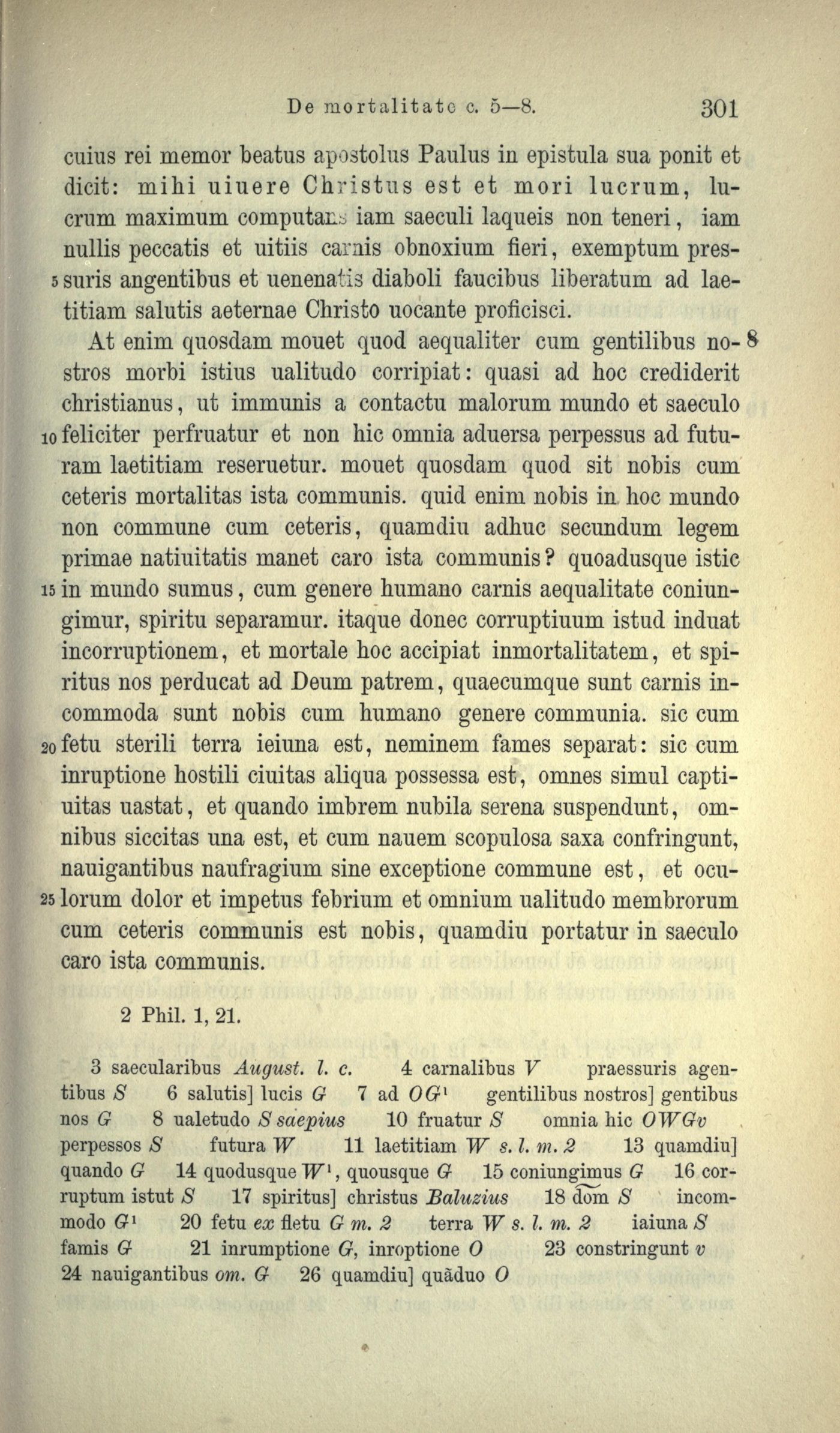
p. 301, section 8 begins 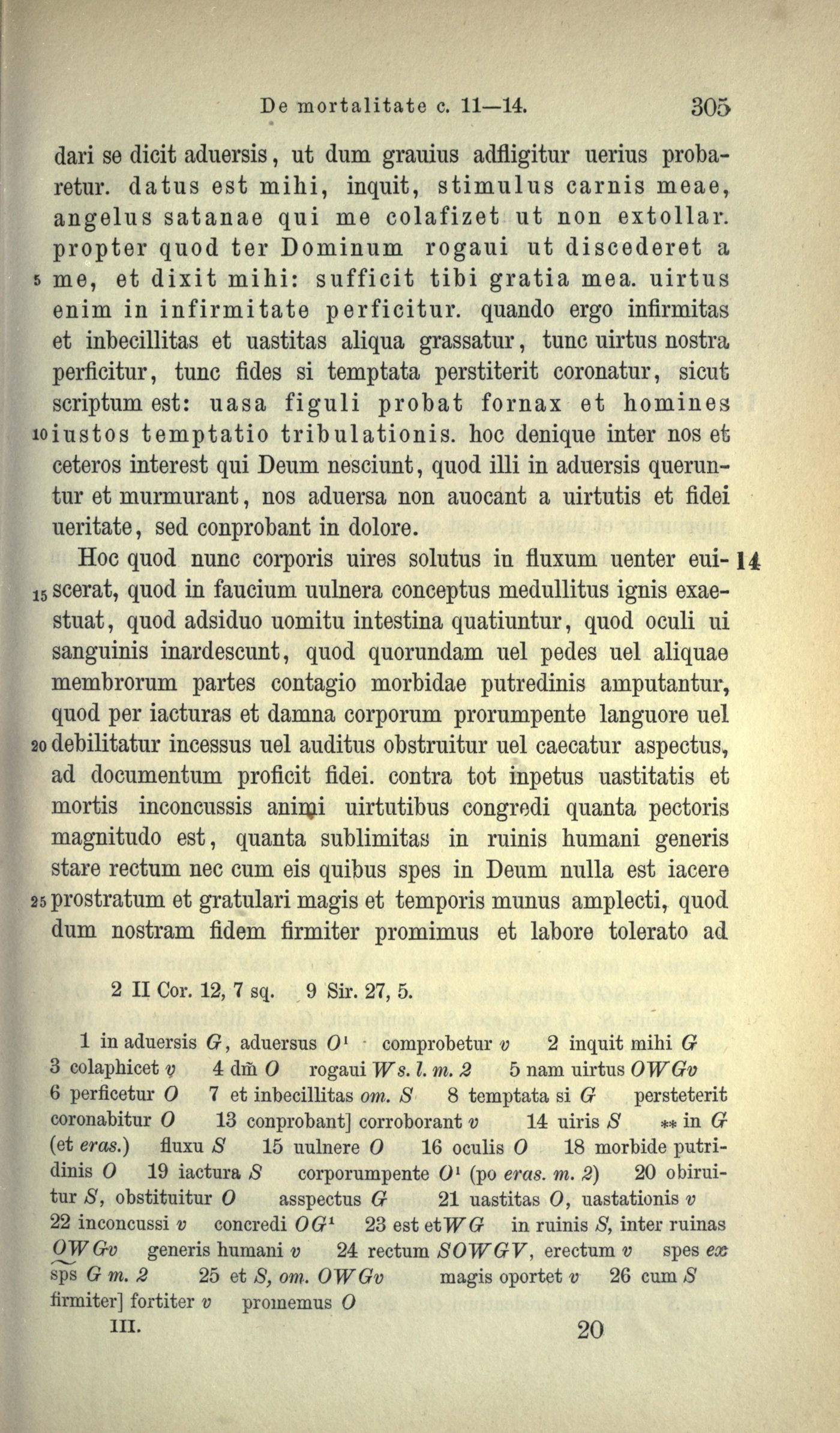
p. 305, section 14, the symptoms 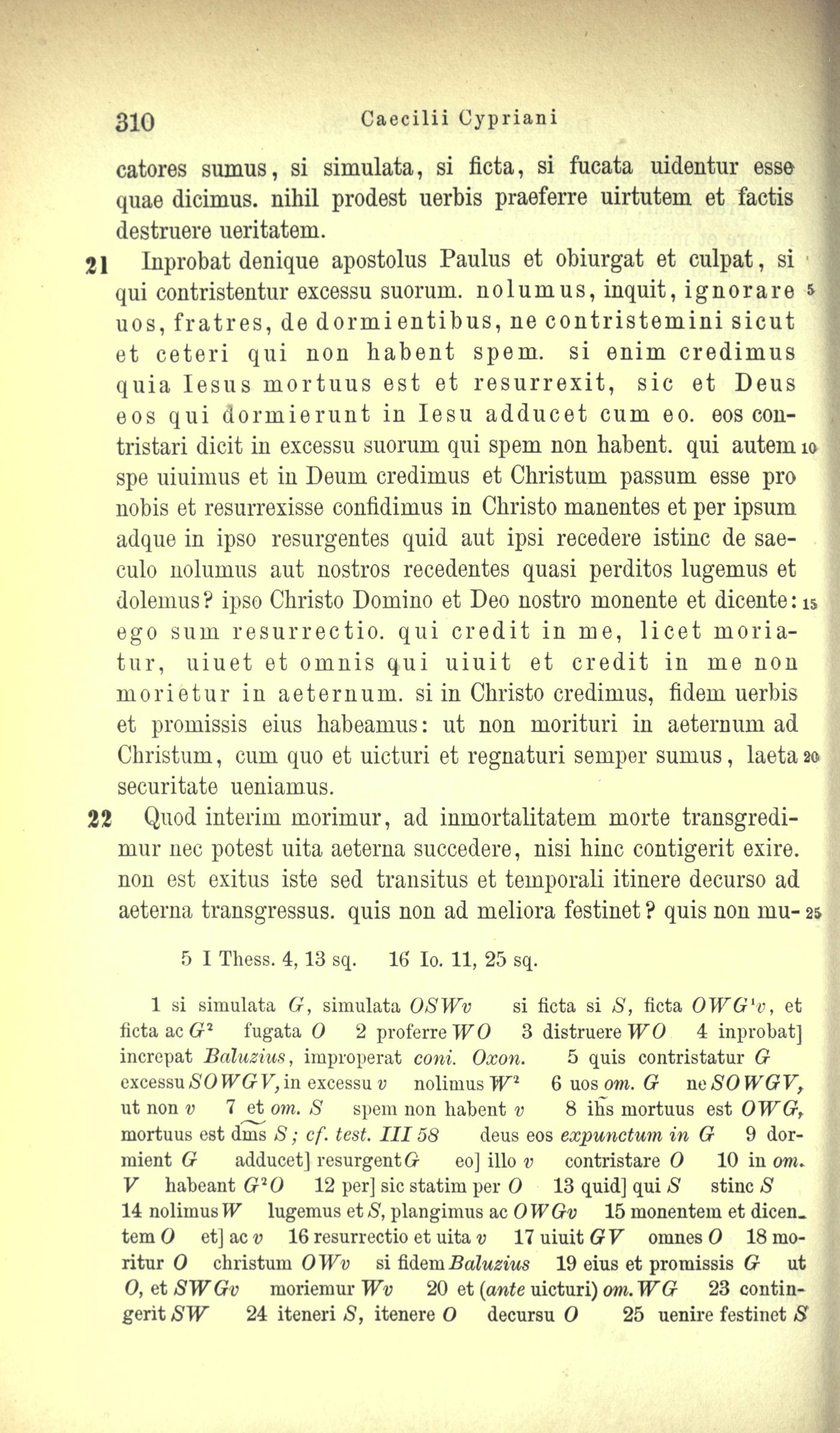
p. 310, where the passage ends Cypriani Opera omnia, ed. W. Hartel, Vienna 1868–1871 (all parts)
HathiTrust (Michigan, Colorado, Harvard and Cornell copies). pt. 1, pp. 301–310. Full view (public domain).
Other scans of the same edition; choose Pt.1.
Other translations of this passage. Links go to copies that are free to read online.
On the Mortality (Ante-Nicene Fathers, vol. 5)
Robert Ernest Wallis, 1868. English. Public domain.
The whole passage. Also at CCEL: https://ccel.org/ccel/schaff/anf05.iv.v.vii.html
Saint Cyprian, Treatises (Fathers of the Church 36)
Roy J. Deferrari, 1958. English. In copyright; not free online.
The whole passage.
Difficulty: Moderate, plain words; the Scripture, the persecution, and Cyprian's purpose need context.
Fits these units
- Faith and Catastrophe. How did religious believers respond, and did responses differ?
- The Healer's Burden. What does an epidemic ask of those who care for the sick?
- Reading Sources Critically. How do we decide whom to believe?
Key vocabulary
- bishop
- the leader of the Christian church in a city and its region
- pagan
- a follower of the traditional Roman gods, as Christians called them
- persecution
- cruel treatment of a group, such as Christians, by the authorities because of their beliefs
- martyr
- a person killed for refusing to give up their faith
- confession
- in Cyprian's church, declaring oneself a Christian before Roman officials, at the risk of death
- Antichrist
- a last great enemy of God whom many Christians expected before the end of the world
- flux
- dysentery or severe diarrhea
- rhetoric
- the art of persuasive speech, taught in Roman schools
Questions
- Comprehension
What troubled some of Cyprian's listeners about who was dying? Give three of his answers.
- Analysis (reliability)
Cyprian was an eyewitness writing during the epidemic, but he wrote a sermon to steady his congregation. How might that purpose shape his list of symptoms in section 14 and his story of the dying bishop's vision in section 19? What other kind of source would you want to check him against?
- Analysis
In section 16 Cyprian says the plague tests people. List what it tests. What does the list suggest about how people in Carthage were actually behaving?
- Connection
Aelius Aristides (P02) also explains a plague through his faith. Compare whom each writer thinks the plague is about, and what each thinks a believer should feel when others die.
Activity
Write a short letter from a pagan neighbor in Carthage who has just heard Cyprian's sermon and wants to answer it. Then trade letters with a classmate and write Cyprian's reply, using only arguments he makes in the excerpt.
New translation from the Latin text of De mortalitate, edited by Wilhelm von Hartel, Corpus Scriptorum Ecclesiasticorum Latinorum 3.1 (Vienna, 1868), sections 8–20.
About 65 percent of the original passage.
- Original
- Source text extracted by code from the named edition and collated against it. Edition: Wilhelm von Hartel, ed., S. Thasci Caecili Cypriani Opera omnia, pars 1, Corpus Scriptorum Ecclesiasticorum Latinorum 3.1 (Vienna: C. Gerold, 1868), De mortalitate, pp. 297–314 (this passage pp. 301–310). Digital text: Open Greek and Latin csel-dev (University of Leipzig, CC BY-SA 4.0), urn:cts:latinLit:stoa0104a.stoa008.opp-lat1, commit 2813e3a; every kept unit collated against the Internet Archive page images. Text only; Hartel's apparatus not used.
- Transliterated
- Not needed: the original is in the Latin alphabet
- Close English
- Working literal draft, machine-drafted, not edited for publication
- Simplified English
- Drafted by Claude (Anthropic) from the original and checked unit by unit against the original in a separate review, then compared with earlier translations and tested for borrowed wording.
- Editor’s review
- Not yet.
- Specialist review
- Not yet. Readings a specialist should confirm are listed for later review.
- Rights
- Original: public domain. Edition: public domain.
Sources for the notes
- Cyprian. De mortalitate. In S. Thasci Caecili Cypriani Opera omnia, part 1, edited by Wilhelm von Hartel, 297–314. Corpus Scriptorum Ecclesiasticorum Latinorum 3.1. Vienna: C. Gerold, 1868.
- Cyprian. "On the Mortality." Translated by Robert Ernest Wallis (1868). In Ante-Nicene Fathers, vol. 5, edited by Alexander Roberts, James Donaldson, and A. Cleveland Coxe, 469–475. Buffalo: Christian Literature, 1886. Consulted for comparison.
- Brent, Allen. Cyprian and Roman Carthage. Cambridge: Cambridge University Press, 2010. (Introduction: Cyprian's family, his teaching of rhetoric, his conversion and election, and his years as bishop.)
- Cyprian. Ad Demetrianum, 2–5. In Hartel, Opera omnia, part 1, 351–370. (Pagan claims that the Christians caused the plague.)
- Cyprian. Ad Quirinum (Testimonia), preface to book 1. In Hartel, Opera omnia, part 1, 35–36. (His argument that the church had taken the place of the Jews.)
- Flemming, Rebecca. "Pandemics in the Ancient Mediterranean World." Isis 114, no. S1 (2023): S288–S312.
- Hartel, Wilhelm von, ed. S. Thasci Caecili Cypriani Opera omnia. 3 parts. Corpus Scriptorum Ecclesiasticorum Latinorum 3. Vienna: C. Gerold, 1868–1871.
- Huebner, Sabine R. "The 'Plague of Cyprian': A Revised View of the Origin and Spread of a 3rd-c. CE Pandemic." Journal of Roman Archaeology 34 (2021): 151–174.
- Pontius. Vita Caecilii Cypriani. In Hartel, Opera omnia, part 3 (Vienna, 1871), xc–cx. (Sections 5 and 7–8 on his election and his withdrawal; 9–10 on the plague; 18 on his execution.)
- Rives, James B. "The Decree of Decius and the Religion of Empire." Journal of Roman Studies 89 (1999): 135–154. (Abstract, and the article's footnote on the date of the decree.)