Once in a Lifetime, part 1
The Plague at Constantinople
- Written
- c. 550 (events of 542; Books 1–7 made public in 551 at the earliest)
- Place
- Constantinople (Byzantium)
- Language
- Ancient Greek (literary Attic)
- Kind of source
- history
- Reading time
- 14 minutes
- Difficulty
- Moderate
- Intensity
- High: detailed symptoms and deaths, including pregnant women and newborns; bodies piled in towers and dumped at sea
Plague of Justinian (from 541)Plague (Yersinia pestis)Doctors and medical ideasRulers and courtsDeath and burial
Once in a Lifetime themes: Unknowns, Fear, Exhaustion, Tensions, Aftermath
In the spring of 542 a disease reached Constantinople (modern Istanbul) that, in the words of a man who watched it arrive, came close to wiping out the whole human race. Before it was over, the city's dead were being stacked inside the towers of a wall.
Procopius was born around 500 in Caesarea, a port city in Palestine, and trained in the law. From 527 he served as legal adviser and secretary to Belisarius, the leading general of the emperor Justinian, and followed him to wars against the Persians in the east, the Vandals in North Africa, and the Goths in Italy. In 542 he was back in Constantinople, the Greek-speaking capital of the Roman Empire, which he calls by its old Greek name, Byzantium. He wrote his History of the Wars in Greek and completed the first seven books around 550. The plague interrupts his account of the Persian war in Book 2. He also wrote the Secret History, a savage attack on the same Justinian, which was not published in his lifetime.
Procopius took Thucydides, who had described the plague at Athens nearly a thousand years earlier, as his model, and he often borrows Thucydides's phrases and habits. He lived in a Christian empire, and most historians think he was a Christian himself, but he writes in the old classical style, which makes his own beliefs hard to pin down. He even says "holy places" where he means churches. Many believed that demons spread illness, and the best doctors were baffled. Procopius does not pretend to explain it. Its cause, he says, lies with God alone, and he draws no religious lesson from who lived and who died.
Procopius is an eyewitness who says plainly that he was in the city. His symptoms are careful and specific, and they match what doctors see in plague today. But he wrote some years later. When he complains that the survivors are now worse than ever, he slips into the present tense. His daily death tolls are round numbers, not exact counts, and historians treat them with caution. And because he followed Thucydides so closely, historians ask which details he saw for himself and which he borrowed. The swellings in the groin and armpit, which Thucydides never mentions, are his own.
As you read, notice how often Procopius says that something happened for no visible reason. Then watch what the plague does to burial, to work, and to the emperor's own city.
What we know now
The disease Procopius describes was plague, caused by the bacterium Yersinia pestis, which lives in small mammals and their fleas (WHO 2026). Bacterial DNA from sixth-century graves in Bavaria, in southern Germany, confirmed this in 2013 (Harbeck et al. 2013), and the bacterium's genome was reconstructed the next year (Wagner et al. 2014). The buboes Procopius saw are swollen lymph nodes, the mark of bubonic plague, its most common form. Left untreated, it kills 30 to 60 percent of those who catch it (WHO 2026). Historians call this outbreak the Plague of Justinian. It returned in waves for some two hundred years, until about 750. How many it killed is fiercely debated. Some historians have estimated tens of millions of deaths; a 2019 study of laws, coins, papyri, and pollen argued that its effects were far smaller (Mordechai et al. 2019).
Read alongside
- The Plague at Athens, and Pericles Answers the Athenians
Thucydides's account of the plague at Athens in 430 BCE was Procopius's model, and he borrowed its shape and some of its words. Notice where Procopius's disease is not the one Thucydides saw, from the swellings in the groin and armpit to whether it spread to the people caring for the sick.
- The Plague as a Test: A Bishop's Sermon at Carthage
Cyprian, bishop of Carthage, preached to his congregation during a Roman epidemic nearly three centuries earlier. He told them the plague tested whether the healthy would serve the sick (section 16). Compare what Procopius records about the nurses of Byzantium, who were pitied as much as the sick.
The edited translation, in simplified modern English. Bracketed words were added for clarity; [...] marks a cut. Tap a note number to read the note. Point at or tap a phrase to see the original behind it. Phrase links checked in a separate review.
22.1Around this time a plague broke out that came close to wiping out the whole human race. Now, for every disaster sent from heaven, bold men may perhaps offer some account of its cause. People who are clever at such things love to dream up causes that no human being could ever grasp, and to invent far-fetched theories about nature. They know perfectly well that nothing they say is sound. But they think it is enough if they can fool a few of the people they meet and win them over with their arguments.
2For this calamity, though, there is no way at all to put a cause into words, or even to work one out in the mind, except by tracing it back to God.1
3It did not strike only one part of the earth or only certain people, and it did not keep to one season of the year. If it had, someone might at least come up with a clever explanation of its cause. Instead, it wrapped itself around the whole earth and ruined the lives of every kind of people, however different those lives were from one another. It spared no one, whatever their nature or their age.
4People differ from one another in where they live, in their way of life, in temperament, in their occupations, and in every other way that one person can differ from another. But in this disease alone, none of those differences did anyone any good.
5It attacked some people in summer, some in winter, and others in the other seasons. So let every sophist and every student of the heavens give his own opinion on these matters.2 I will go on to tell where this disease began and how it destroyed people.
6It began among the Egyptians who live in Pelusium.3 From there it split in two. One branch moved toward Alexandria and the other parts of Egypt, while the other came to the Palestinians, Egypt's neighbors. From there it took hold of the whole earth, always moving forward along its road and traveling at its appointed times.
7It seemed to travel by fixed agreement and to stay for a set length of time in each land. It went easy on no people at all. Instead, it spread in both directions, out to the farthest ends of the inhabited world, as if afraid that some hidden corner of the earth might slip past it.
8It passed over no island, no cave, and no mountaintop where people lived. If it ever did pass by some land, either not touching the people there or touching them only lightly, it came back to that place later. This time it left the neighbors alone, though it had struck them most bitterly before. But it did not leave that land until it had paid out, fairly and in full, its measure of the dead: just as many as had died among the neighbors the first time.
9The disease always started on the coast and moved from there up into the inland country. It reached Byzantium in the second year, in the middle of spring,4 10and I happened to be living there at the time.
This is how it came. Many people saw apparitions of demons in every kind of human shape.5 Those who met them believed that the man they had run into struck them, on whatever part of the body it happened to be. The moment they saw this apparition, they caught the disease.
11At first, the people who met these figures tried to turn them away. They spoke the holiest names aloud and used other holy rites to drive them off, each as best he could. But it did no good at all, since most of them died even in the holy places where they had fled for safety.6
12Later, they would not even answer when their friends called. They locked themselves in their rooms and pretended not to hear, even while their doors were being pounded, plainly afraid that whoever was calling might be one of the demons.
13For some, though, the plague did not come this way. Instead, they had a dream in which they seemed to suffer this same thing from a figure standing over them. Or in the dream they seemed to hear a voice telling them ahead of time that their names had been written down among those who were going to die.
14But most people had no warning of what was coming, either in a waking vision or in a dream, before they caught the disease.
15This is how it took them. They suddenly came down with a fever, some just after waking from sleep, some while out walking, and some in the middle of whatever else they were doing.
16The body did not change from its usual color. It was not hot, as you would expect when a fever strikes, and there was no inflammation either. From the start until evening the fever was so mild that it gave no hint of danger, either to the sick themselves or to a doctor who touched them.
17In fact, it did not seem that any of those who caught it would die of it. But then a bubo swelled up, on the same day for some, on the next day for others, and a few days later for the rest.7 It appeared in the groin, the part of the body below the belly that is itself called the boubōn. But it also appeared in the armpit, and for some people beside the ears or anywhere on the thighs.
18Until this point, nearly the same things happened to everyone who caught the disease. From here on, I cannot say whether the differences in what happened came from differences in their bodies, or from whatever pleased the one who brought the disease upon them.
19Some fell into a deep coma, and others into a violent delirium, and each group suffered the symptoms that go with its form of the disease. Those in a coma forgot everything once familiar to them, and they seemed to sleep without end.
20If someone took care of them, they would eat even while in this state, but some who were neglected died at once for lack of food.
21Those seized by delirium could not sleep and saw many wild visions. Suspecting that people were coming to kill them, they would panic, scream terribly, and rush off to escape.
22The people who nursed them were worn out by endless toil and went on suffering things beyond all remedy.
23So everyone pitied the nurses as much as the sick. It was not that the nurses caught the plague by coming near the sick. (No doctor or anyone else caught this disease by touching the sick or the dead.8 Many people who kept burying or nursing even strangers held out in that work against all expectation. Meanwhile, many others fell sick for no visible reason and died at once.) People pitied the nurses because of the great hardship they endured.
24When the sick fell out of bed and rolled around on the floor, the nurses put them back again. When the sick tried to hurl themselves out of their houses, the nurses had to push and drag them back by force.
25If the sick came upon water, they wanted to plunge into it, not so much from thirst (most of them ran for the sea) as because of the sickness in their minds.
26Eating was a great struggle for them as well, since they would not easily take food. Many died because they had no one to care for them, either worn down by hunger 27or by throwing themselves from a height.
Those who fell into neither a coma nor delirium saw the bubo turn gangrenous, and they died when they could no longer bear the pain.
28One could reasonably conclude that the same thing happened to all the others too. But since they were completely out of their senses, they could not feel the pain at all, because the sickness in their minds had taken away all feeling.
29Some of the doctors were baffled, because they did not understand what was happening. Thinking that the heart of the disease lay in the buboes, they decided to examine the bodies of the dead.9 When they cut open some of the buboes, they found a dreadful carbuncle growing inside.10
30Some died at once, others many days later. In some, the body broke out in black blisters the size of lentils. These people did not live even one more day, but died, every one of them, at once.
31Many others were carried off at once by a vomiting of blood that came on for no apparent reason.
32This much, however, I can say for certain. The most respected doctors foretold the death of many people who, soon afterward and against all expectation, were completely free of their troubles. And they promised that many would recover who were in fact about to die almost at once.
33So this disease had no cause that human reason could grasp. For everyone, as a rule, things turned out in ways no one could account for. Baths, for instance, helped some patients and harmed others just as much.
34Many who were left untended died, while many others survived against all reason. Treatment, too, worked both ways for those who tried it. In short, no one found any way to save himself, either by taking precautions so as not to fall sick or by overcoming the disaster once it struck. Falling sick came without any visible cause, and recovery came of its own accord.
35For pregnant women who caught the disease, death was a certainty. Some miscarried and died, and others died in childbirth together with their newborn babies.
36They do say, though, that three women survived childbirth even though their babies died, and that one mother died as she gave birth, yet her baby was born and lived.
37Those whose bubo grew larger and filled with pus came through and were rid of the disease, plainly because the full force of the carbuncle had eased in them at that point. In most cases this was a sign of returning health. But those whose bubo stayed as it had first appeared met the troubles I have just described.
38Some of them were left with a withered thigh, when the bubo had risen there without filling with pus.
39Others survived with their tongues damaged. For the rest of their lives they either stammered or spoke only with great effort, in sounds that were hard to make out.
23.1In Byzantium the disease lasted four months, and it was at its height for about three.
2At first only a few more people died than usual. Then the disaster grew worse, and the number of dead reached five thousand a day, and after that ten thousand and even more.11
3At first each person took charge of burying the dead of his own household. Some even threw their dead into other families' tombs, either secretly or by force. But after that, everything everywhere fell into chaos.
4Slaves were left without masters. Men who had once been very rich lost the service of their household servants, who had fallen sick or died. Many houses were left completely empty of people.
5Because of this, some prominent people lay unburied for many days, since there was no one to bury them. The task of dealing with the problem fell to the emperor,12 6as was only natural. He assigned soldiers from the palace and money, and he ordered Theodore to take charge of the work. Theodore was in charge of the emperor's replies: he always brought the requests of petitioners to the emperor and then told them in turn what the emperor wished. The Romans call this office by a Latin name, referendarius.13
7Those whose households had not yet been completely emptied buried their own relatives themselves.
8Theodore, handing out the emperor's money and spending his own as well, buried the dead whom no one had cared for.
9When all the existing tombs were full, people dug up every spot around the city, one after another, laid the dead there as best they could, and went away. Later, though, the men digging these trenches could no longer keep pace with all the dying. So they climbed up into the towers of the wall at Sycae.14 10They tore off the roofs and threw the bodies inside in no order at all. They piled them up any which way and filled nearly every tower with corpses, 11and then they put the roofs back on.
From there a foul smell drifted into the city and made its people even more miserable, especially whenever the wind blew from that direction.
12All the usual burial rites were ignored at that time. The dead were not escorted in a procession, as custom required, or sung over with the usual psalms.15 It was enough if someone carried a dead person on his shoulders to the part of the city by the sea and threw the body down there. From there the bodies were tossed into boats in heaps, to be carried off wherever chance might take them.
13At that time, too, the people who had been members of the factions put aside their hatred for one another.16 Together they saw to the rites owed to the dead, and with their own hands they carried and buried bodies that were nothing to them.
14More than that, people who had once given themselves to shameful and wicked deeds, and enjoyed them, shook off the lawlessness of their old way of life and practiced their religion strictly. It was not that they had learned self-control, or had suddenly fallen in love with goodness.
15For whatever is fixed in people by nature, or by long training, cannot be changed so easily, unless some divine goodness breathes upon them. But at that time nearly everyone was stunned by what was happening and expected to die at any moment. So, naturally enough, sheer necessity taught them decent behavior for the time being.
16That is why, as soon as they had recovered from the disease and survived, they quickly changed their minds again, this time for the worse. By then they believed they were safe, since the calamity had moved on to other people. Now they show how outrageous their ways are even more than before, outdoing themselves in wickedness and every other kind of lawlessness. Indeed, one could say firmly, and not be lying, that this disease, whether by some chance or by providence, picked out the very wickedest people with great care and let them go. But all this has come to light only since then.
17At that time it was not easy to see anyone shopping in the market, at least in Byzantium. Everyone who happened to be in good health stayed at home, either caring for the sick or mourning their dead.
18If you did manage to meet someone out in the street, he was carrying a dead body. All work stopped. Craftsmen gave up all their crafts, and everyone dropped whatever other work they had in hand.
19And so, in a city overflowing with every good thing, a real famine ran wild. Having enough bread, or anything else, seemed hard and something worth talking about. So it seemed that some of the sick died before their time for lack of the bare necessities.
20In short, you could not see a single person in Byzantium wearing the official's cloak, especially once the emperor fell sick (for a bubo rose on him too).17 Instead, in a city that held the imperial power over the whole Roman Empire, everyone dressed like a private citizen and lived quietly.
21That, roughly, is how things went with the plague in the rest of the Roman land and in Byzantium. But it also struck the Persians' land, and all the other barbarians.18
Notes
- Many people believed that God or the gods sent disease to punish wrongdoing or to test the faithful. Procopius says only that the cause lies with God, beyond human reasoning. back
- Many ancient scholars blamed epidemics on the positions of the stars and planets. This sentence echoes Thucydides's account of the plague at Athens (History 2.48), which Procopius took as his model. back
- Pelusium was a port at the eastern mouth of the Nile, near modern Port Said in Egypt. back
- Byzantium is the old Greek name for Constantinople (modern Istanbul), the capital of the Roman Empire in Procopius's day. The second year is 542; the plague had reached Egypt in 541. back
- Many Christians of Procopius's time believed that demons, evil spirits, could cause illness and could appear in human form. back
- The holiest names were probably the names of God and Christ, spoken aloud to drive off evil spirits. The holy places were churches, where people sought protection. back
- The Greek word boubōn meant the groin and also a swelling there. From it comes "bubo," the swollen gland that gives bubonic plague its name. back
- Contagion is the idea that disease passed from person to person by touch, breath, or objects, long before anyone knew about germs. Procopius saw no sign of it here. back
- Opening human bodies was very rare in ancient and Byzantine medicine, so the doctors' step was an unusual one. back
- A carbuncle (Greek anthrax, "coal") was a hard, dark, inflamed lump. The same Greek word later gave its name to a different disease, anthrax. back
- No reliable counts survive, and historians treat these daily figures with caution. back
- The emperor was Justinian, who ruled from 527 to 565. back
- The referendarius carried petitions to the emperor and brought back his replies. Procopius and his people called themselves Romans, and their government kept many Latin titles, though most of them spoke Greek. back
- Sycae, across the Golden Horn from the city (today's Galata district of Istanbul), had its own wall and towers. back
- A Christian funeral included a procession to the grave and the singing of psalms. back
- The factions, the Blues and the Greens, were rival clubs of chariot-racing fans. Their riot in 532 had nearly driven Justinian from his throne. back
- The official's cloak was the chlamys, a long cloak pinned at the right shoulder and worn by imperial officials. Justinian recovered. back
- The Persian Empire, ruled by the Sasanian kings, was Rome's great rival to the east. "Barbarians" was Procopius's word for peoples outside the Roman world. back
Sections 2.22.1–2.22.9
Ὑπὸ δὲ τοὺς χρόνους τούτους λοιμὸς γέγονεν, ἐξ οὗ δὴ ἅπαντα ὀλίγου ἐδέησε τὰ ἀνθρώπεια ἐξίτηλα εἶναι. ἅπασι μὲν οὖν τοῖς ἐξ οὐρανοῦ ἐπισκήπτουσιν ἴσως ἂν καὶ λέγοιτό τις ὑπ’ ἀνδρῶν τολμητῶν αἰτίου λόγος, οἷα πολλὰ φιλοῦσιν οἱ ταῦτα δεινοὶ αἰτίας τερατεύεσθαι οὐδαμῆ ἀνθρώπῳ καταληπτὰς οὔσας, φυσιολογίας τε ἀναπλάσσειν ὑπερορίους, ἐξεπιστάμενοι μὲν ὡς λέγουσιν οὐδὲν ὑγιές, ἀποχρῆν δὲ ἡγούμενοι σφίσιν, ἤν γε τῶν ἐντυγχανόντων τινὰς τῷ λόγῳ ἐξαπατήσαντες πείσωσι.
During these times a plague came about, by which indeed all human things came within a little of being wiped out. Now for all the things that strike from heaven perhaps some account of a cause might also be spoken by daring men, such as the many causes which those clever in these matters love to conjure up [tell as marvels?], causes in no way comprehensible to man, and to fabricate outlandish [far-fetched?] theories of nature, knowing well that they say nothing sound, but considering it sufficient for themselves if they persuade some of those who come upon them [their readers?], having deceived them by their argument.
Around this time a plague broke out that came close to wiping out the whole human race. Now, for every disaster sent from heaven, bold men may perhaps offer some account of its cause. People who are clever at such things love to dream up causes that no human being could ever grasp, and to invent far-fetched theories about nature. They know perfectly well that nothing they say is sound. But they think it is enough if they can fool a few of the people they meet and win them over with their arguments.
During these times there was a pestilence, by which the whole human race came near to being annihilated. Now in the case of all other scourges sent from Heaven some explanation of a cause might be given by daring men, such as the many theories propounded by those who are clever in these matters; for they love to conjure up causes which are absolutely incomprehensible to man, and to fabricate outlandish theories of natural philosophy, knowing well that they are saying nothing sound, but considering it sufficient for them, if they completely deceive by their argument some of those whom they meet and persuade them to their view.
τούτῳ μέντοι τῷ κακῷ πρόφασίν τινα ἢ λόγῳ εἰπεῖν ἢ διανοίᾳ λογίσασθαι μηχανή τις οὐδεμία ἐστί, πλήν γε δὴ ὅσα ἐς τὸν θεὸν ἀναφέρεσθαι.
For this disaster, however, there is no means at all either to state any cause [pretext?] in word or to reckon one out in thought, except indeed so far as to refer it to God.
For this calamity, though, there is no way at all to put a cause into words, or even to work one out in the mind, except by tracing it back to God.
But for this calamity it is quite impossible either to express in words or to conceive in thought any explanation, except indeed to refer it to God.
- Many people believed that God or the gods sent disease to punish wrongdoing or to test the faithful. Procopius says only that the cause lies with God, beyond human reasoning.
οὐ γὰρ ἐπὶ μέρους τῆς γῆς οὐδὲ ἀνθρώπων τισὶ γέγονεν οὐδέ τινα ὥραν τοῦ ἔτους ἔσχεν, ὅθεν ἂν καὶ σοφίσματα αἰτίας εὑρέσθαι δυνατὰ εἴη, ἀλλὰ περιεβάλλετο μὲν τὴν γῆν ξύμπασαν, βίους δὲ ἀνθρώπων ἅπαντας ἔβλαψε, καίπερ ἀλλήλων ἐς τοὐναντίον παρὰ πολὺ διαλλάσσοντας, οὔτε φύσεώς τινος οὔτε ἡλικίας φεισάμενον.
For it did not come about in a part of the earth nor upon certain of men, nor did it keep to any season of the year, from which it might also be possible to find subtle explanations of a cause, but it encompassed the whole earth, and harmed all the lives of men, although these differ from one another very greatly in the opposite direction, sparing neither any nature [sex?] nor age.
It did not strike only one part of the earth or only certain people, and it did not keep to one season of the year. If it had, someone might at least come up with a clever explanation of its cause. Instead, it wrapped itself around the whole earth and ruined the lives of every kind of people, however different those lives were from one another. It spared no one, whatever their nature or their age.
For it did not come in a part of the world nor upon certain men, nor did it confine itself to any season of the year, so that from such circumstances it might be possible to find subtle explanations of a cause, but it embraced the entire world, and blighted the lives of all men, though differing from one another in the most marked degree, respecting neither sex nor age.
εἴτε γὰρ χωρίων ἐνοικήσει εἴτε νόμῳ διαίτης, ἢ φύσεως τρόπῳ, ἢ ἐπιτηδεύμασιν, ἢ ἄλλῳ ὅτῳ ἀνθρώπων ἄνθρωποι διαφέρουσιν, ἐν ταύτῃ δὴ μόνῃ τῇ νόσῳ τὸ διαλλάσσον οὐδὲν ὤνησεν.
For whether in dwelling-place of lands or in custom of diet, or in manner of nature, or in pursuits, or in whatever else men differ from men, in this disease alone the difference profited nothing.
People differ from one another in where they live, in their way of life, in temperament, in their occupations, and in every other way that one person can differ from another. But in this disease alone, none of those differences did anyone any good.
For much as men differ with regard to places in which they live, or in the law of their daily life, or in natural bent, or in active pursuits, or in whatever else man differs from man, in the case of this disease alone the difference availed naught.
ἐπέσκηψε δὲ τοῖς μὲν ὥρᾳ θέρους, τοῖς δὲ χειμῶνι, τοῖς δὲ κατὰ τοὺς ἄλλους καιρούς. λεγέτω μὲν οὖν ὥς πη ἕκαστος περὶ αὐτῶν γινώσκει καὶ σοφιστὴς καὶ μετεωρολόγος, ἐγὼ δὲ ὅθεν τε ἤρξατο ἡ νόσος ἥδε καὶ τρόπῳ δὴ ὅτῳ τοὺς ἀνθρώπους διέφθειρεν ἐρῶν ἔρχομαι.
And it struck some in the season of summer, others in winter, others during the other seasons. Now let both sophist and astronomer [speculator on things in the sky?] each say about these things how he somehow understands them, but I am going to tell both whence this disease began and in what manner indeed it destroyed men.
It attacked some people in summer, some in winter, and others in the other seasons. So let every sophist and every student of the heavens give his own opinion on these matters. I will go on to tell where this disease began and how it destroyed people.
And it attacked some in the summer season, others in the winter, and still others at the other times of the year. Now let each one express his own judgment concerning the matter, both sophist and astrologer, but as for me, I shall proceed to tell where this disease originated and the manner in which it destroyed men.
- Many ancient scholars blamed epidemics on the positions of the stars and planets. This sentence echoes Thucydides's account of the plague at Athens (History 2.48), which Procopius took as his model.
Ἤρξατο μὲν ἐξ Αἰγυπτίων οἳ ᾤκηνται ἐν Πηλουσίῳ. γενομένη δὲ δίχα πὴ μὲν ἐπί τε Ἀλεξανδρείας καὶ τῆς ἄλλης Αἰγύπτου ἐχώρησε, πὴ δὲ ἐπὶ Παλαιστίνους τοὺς Αἰγυπτίοις ὁμόρους ἦλθεν, ἐντεῦθέν τε κατέλαβε τὴν γῆν σύμπασαν, ὁδῷ τε ἀεὶ προϊοῦσα καὶ χρόνοις βαδίζουσα τοῖς καθήκουσιν.
It began from the Egyptians who dwell in Pelusium. And having become divided in two, in one direction it went toward both Alexandria and the rest of Egypt, and in the other it came upon the Palestinians bordering on the Egyptians, and from there it seized the whole earth, always advancing along a road [steadily?] and travelling at the appointed [proper?] times.
It began among the Egyptians who live in Pelusium. From there it split in two. One branch moved toward Alexandria and the other parts of Egypt, while the other came to the Palestinians, Egypt's neighbors. From there it took hold of the whole earth, always moving forward along its road and traveling at its appointed times.
It started from the Aegyptians who dwell in Pelusium. Then it divided and moved in one direction towards Alexandria and the rest of Aegypt, and in the other direction it came to Palestine on the borders of Aegypt; and from there it spread over the whole world, always moving forward and travelling at times favourable to it.
- Pelusium was a port at the eastern mouth of the Nile, near modern Port Said in Egypt.
ἐπὶ ῥητοῖς γὰρ ἐδόκει χωρεῖν καὶ χρόνον τακτὸν ἐν χώρᾳ ἑκάστῃ διατριβὴν ἔχειν, ἐς οὐδένας μὲν ἀνθρώπων παρέργως τῷ φθόρῳ χρωμένη, σκεδαννυμένη δὲ ἐφ’ ἑκάτερα μέχρι ἐς τὰς τῆς οἰκουμένης ἐσχατιάς, ὥσπερ δεδοικυῖα μή τις αὐτὴν τῆς γῆς διαλάθοι μυχός.
For it seemed to move on fixed terms and to have a stay of appointed time in each country, using its destruction casually [lightly?] upon no men, but scattering in both directions as far as the extremities of the inhabited world, as though fearing lest some recess of the earth should escape its notice.
It seemed to travel by fixed agreement and to stay for a set length of time in each land. It went easy on no people at all. Instead, it spread in both directions, out to the farthest ends of the inhabited world, as if afraid that some hidden corner of the earth might slip past it.
For it seemed to move by fixed arrangement, and to tarry for a specified time in each country, casting its blight slightingly upon none, but spreading in either direction right out to the ends of the world, as if fearing lest some corner of the earth might escape it.
οὔτε γὰρ νῆσόν τινα ἢ σπήλαιον ἢ ἀκρώρειαν ἐλίπετο ἀνθρώπους οἰκήτορας ἔχουσαν· ἢν δέ πού τινα καὶ παρήλασε χώραν, ἢ μὴ ψαύσασα τῶν ταύτῃ ἀνθρώπων ἢ ἀμωσγέπως αὐτῶν ἁψαμένη, ἀλλὰ χρόνῳ τῷ ὑστέρῳ αὖθις ἐνταῦθα ἐπανιοῦσα τῶν μὲν περιοίκων, οἷς δὴ πικρότατα ἐπέσκηψε πρότερον, οὐδαμῶς ἥψατο, τῆς δὲ χώρας ἐκείνης οὐ πρότερον ἀπέστη ἕως τὸ μέτρον ὀρθῶς καὶ δικαίως τῶν τετελευτηκότων ἀπέδωκεν, ὅπερ καὶ τοῖς ἀμφ’ αὐτὴν ᾠκημένοις χρόνῳ τῷ προτέρῳ διεφθάρθαι τετύχηκεν.
For it left neither any island nor cave nor mountain ridge having men as inhabitants; and if somewhere it also passed by some land, either not touching the men there or laying hold of them in some way or other, yet at a later time, returning there again, it in no way touched those dwelling round about, upon whom indeed it had fallen most bitterly before, but it did not depart from that land until it had paid back rightly and justly the measure of those who had died, such as had also happened to have been destroyed among those dwelling around it in the earlier time.
It passed over no island, no cave, and no mountaintop where people lived. If it ever did pass by some land, either not touching the people there or touching them only lightly, it came back to that place later. This time it left the neighbors alone, though it had struck them most bitterly before. But it did not leave that land until it had paid out, fairly and in full, its measure of the dead: just as many as had died among the neighbors the first time.
For it left neither island nor cave nor mountain ridge which had human inhabitants; and if it had passed by any land, either not affecting the men there or touching them in indifferent fashion, still at a later time it came back; then those who dwelt round about this land, whom formerly it had afflicted most sorely, it did not touch at all, but it did not remove from the place in question until it had given up its just and proper tale of dead, so as to correspond exactly to the number destroyed at the earlier time among those who dwelt round about.
ἀρξαμένη δὲ ἀεὶ ἐκ τῆς παραλίας ἡ νόσος ἥδε, οὕτω δὴ ἐς τὴν μεσόγειον ἀνέβαινε χώραν. δευτέρῳ δὲ ἔτει ἐς Βυζάντιον μεσοῦντος τοῦ ἦρος ἀφίκετο,
And this disease, always beginning from the coast, thus indeed went up into the inland country. And in the second year it arrived at Byzantium when spring was at its middle,
The disease always started on the coast and moved from there up into the inland country. It reached Byzantium in the second year, in the middle of spring,
And this disease always took its start from the coast, and from there went up to the interior. And in the second year it reached Byzantium in the middle of spring,
- Byzantium is the old Greek name for Constantinople (modern Istanbul), the capital of the Roman Empire in Procopius's day. The second year is 542; the plague had reached Egypt in 541.
Sections 2.22.10–2.22.22
ἔνθα καὶ ἐμοὶ ἐπιδημεῖν τηνικαῦτα ξυνέβη. ἐγίνετο δὲ ὧδε. φάσματα δαιμόνων πολλοῖς ἐς πᾶσαν ἀνθρώπου ἰδέαν ὤφθη, ὅσοι τε αὐτοῖς παραπίπτοιεν, παίεσθαι ᾤοντο πρὸς τοῦ ἐντυχόντος ἀνδρὸς ὅπη παρατύχοι τοῦ σώματος, ἅμα τε τὸ φάσμα τοῦτο ἑώρων καὶ τῇ νόσῳ αὐτίκα ἡλίσκοντο.
There it happened that I too was staying [residing?] at that time. And it came about thus. Apparitions of demons in every form of a human being were seen by many, and as many as encountered them thought that they were struck by the man who met them, wherever on the body it chanced, and at the same time they saw this apparition and were straightway seized by the disease.
and I happened to be living there at the time. This is how it came. Many people saw apparitions of demons in every kind of human shape. Those who met them believed that the man they had run into struck them, on whatever part of the body it happened to be. The moment they saw this apparition, they caught the disease.
where it happened that I was staying at that time. And it came as follows. Apparitions of supernatural beings in human guise of every description were seen by many persons, and those who encountered them thought that they were struck by the man they had met in this or that part of the body, as it happened, and immediately upon seeing this apparition they were seized also by the disease.
- Many Christians of Procopius's time believed that demons, evil spirits, could cause illness and could appear in human form.
κατ’ ἀρχὰς μὲν οὖν οἱ παραπεπτωκότες ἀποτρέπεσθαι αὐτὰ ἐπειρῶντο, τῶν τε ὀνομάτων ἀποστοματίζοντες τὰ θειότατα καὶ τὰ ἄλλα ἐξοσιούμενοι, ὡς ἕκαστός πη ἐδύνατο, ἤνυον μέντοι τὸ παράπαν οὐδέν, ἐπεὶ κἀν τοῖς ἱεροῖς οἱ πλεῖστοι καταφεύγοντες διεφθείροντο.
At the beginning, then, those who had encountered them tried to turn them away, both uttering by mouth the most holy of the names and performing the other rites of purification [expiations?], as each was in some way able; they accomplished, however, nothing at all, since even in the sanctuaries [churches?] most, taking refuge there, were perishing.
At first, the people who met these figures tried to turn them away. They spoke the holiest names aloud and used other holy rites to drive them off, each as best he could. But it did no good at all, since most of them died even in the holy places where they had fled for safety.
Now at first those who met these creatures tried to turn them aside by uttering the holiest of names and exorcising them in other ways as well as each one could, but they accomplished absolutely nothing, for even in the sanctuaries where the most of them fled for refuge they were dying constantly.
- The holiest names were probably the names of God and Christ, spoken aloud to drive off evil spirits. The holy places were churches, where people sought protection.
ὕστερον δὲ οὐδὲ τοῖς φίλοις καλοῦσιν ἐπακούειν ἠξίουν, ἀλλὰ καθείρξαντες αὑτοὺς ἐν τοῖς δωματίοις, ὅτι δὴ οὐκ ἐπαΐοιεν προσεποιοῦντο, καίπερ ἀρασσομένων αὐτοῖς τῶν θυρῶν, δειμαίνοντες δηλονότι μὴ δαιμόνων τις ὁ καλῶν εἴη.
And later they did not even deign to listen to their friends when they called, but, having shut themselves up in their rooms, they pretended that they did not hear, although their doors were being beaten, fearing, evidently, lest the one calling might be one of the demons.
Later, they would not even answer when their friends called. They locked themselves in their rooms and pretended not to hear, even while their doors were being pounded, plainly afraid that whoever was calling might be one of the demons.
But later on they were unwilling even to give heed to their friends when they called to them, and they shut themselves up in their rooms and pretended that they did not hear, although their doors were being beaten down, fearing, obviously, that he who was calling was one of those demons.
τισὶ δὲ οὐχ οὕτως ὁ λοιμὸς ἐπεγίνετο, ἀλλ’ ὄψιν ὀνείρου ἰδόντες ταὐτὸ τοῦτο πρὸς τοῦ ἐπιστάντος πάσχειν ἐδόκουν, ἢ λόγου ἀκούειν προλέγοντος σφίσιν ὅτι δὴ ἐς τῶν τεθνηξομένων τὸν ἀριθμὸν ἀνάγραπτοι εἶεν.
But to some the plague did not come on thus, but, having seen a vision of a dream, they thought that they suffered this same thing from the one standing over them, or that they heard a voice [word?] foretelling to them that they had been inscribed in the number of those who were going to die.
For some, though, the plague did not come this way. Instead, they had a dream in which they seemed to suffer this same thing from a figure standing over them. Or in the dream they seemed to hear a voice telling them ahead of time that their names had been written down among those who were going to die.
But in the case of some the pestilence did not come on in this way, but they saw a vision in a dream and seemed to suffer the very same thing at the hands of the creature who stood over them, or else to hear a voice foretelling to them that they were written down in the number of those who were to die.
τοῖς δὲ πλείστοις οὔτε ὕπαρ οὔτε ὄναρ αἰσθομένοις τοῦ ἐσομένου εἶτα τῇ νόσῳ ξυνέβη ἁλῶναι.
But to most, perceiving what was going to be neither in a waking vision nor in a dream, it then happened that they were seized by the disease.
But most people had no warning of what was coming, either in a waking vision or in a dream, before they caught the disease.
But with the majority it came about that they were seized by the disease without becoming aware of what was coming either through a waking vision or a dream.
ἡλίσκοντο δὲ τρόπῳ τοιῷδε. ἐπύρεσσον ἄφνω, οἱ μὲν ἐξ ὕπνου ἐγηγερμένοι, οἱ δὲ περιπάτους ποιούμενοι, οἱ δὲ ἄλλο ὅ τι δὴ πράσσοντες.
And they were seized in the following manner. They became feverish suddenly, some having been awakened from sleep, others taking walks, others doing whatever else.
This is how it took them. They suddenly came down with a fever, some just after waking from sleep, some while out walking, and some in the middle of whatever else they were doing.
And they were taken in the following manner. They had a sudden fever, some when just roused from sleep, others while walking about, and others while otherwise engaged, without any regard to what they were doing.
καὶ τὸ μὲν σῶμα οὔτε τι διήλλασσε τῆς προτέρας χροιᾶς οὔτε θερμὸν ἦν, ἅτε πυρετοῦ ἐπιπεσόντος, οὐ μὴν οὐδὲ φλόγωσις ἐπεγίνετο, ἀλλ’ οὕτως ἀβληχρός τις ἐξ ἀρχῆς τε καὶ ἄχρις ἑσπέρας ὁ πυρετὸς ἦν ὥστε μήτε τοῖς νοσοῦσιν αὐτοῖς μήτε ἰατρῷ ἁπτομένῳ δόκησιν κινδύνου παρέχεσθαι.
And the body neither changed at all from its former color nor was hot, as would be with a fever having fallen upon it, nor indeed did inflammation come on, but the fever was so languid [mild?] both from the beginning and until evening that it afforded an impression of danger neither to the sick themselves nor to a doctor touching them.
The body did not change from its usual color. It was not hot, as you would expect when a fever strikes, and there was no inflammation either. From the start until evening the fever was so mild that it gave no hint of danger, either to the sick themselves or to a doctor who touched them.
And the body shewed no change from its previous colour, nor was it hot as might be expected when attacked by a fever, nor indeed did any inflammation set in, but the fever was of such a languid sort from its commencement and up till evening that neither to the sick themselves nor to a physician who touched them would it afford any suspicion of danger.
οὐ γὰρ οὖν οὐδέ τις τελευτᾶν τῶν περιπεπτωκότων ἀπ’ αὐτοῦ ἔδοξεν. ἡμέρᾳ δὲ τοῖς μὲν τῇ αὐτῇ, τοῖς δὲ τῇ ἐπιγενομένῃ, ἑτέροις δὲ οὐ πολλαῖς ὕστερον βουβὼν ἐπῆρτο, οὐκ ἐνταῦθα μόνον, ἔνθα καὶ τὸ τοῦ σώματος μόριον, ὃ δὴ τοῦ ἤτρου ἔνερθέν ἐστι, βουβὼν κέκληται, ἀλλὰ καὶ τῆς μάλης ἐντός, ἐνίοις δὲ καὶ παρὰ τὰ ὦτα καὶ ὅπου ποτὲ τῶν μηρῶν ἔτυχε.
For indeed not even anyone of those who had fallen into it seemed likely [expected?] to die from it. And on a day, for some on the same one, for others on the following one, for others not many days later, a bubo rose up, not only there, where also the part of the body which is below the lower belly is called bubo [groin?], but also inside the armpit, and in some also beside the ears and wherever on the thighs it happened.
In fact, it did not seem that any of those who caught it would die of it. But then a bubo swelled up, on the same day for some, on the next day for others, and a few days later for the rest. It appeared in the groin, the part of the body below the belly that is itself called the boubōn. But it also appeared in the armpit, and for some people beside the ears or anywhere on the thighs.
It was natural, therefore, that not one of those who had contracted the disease expected to die from it. But on the same day in some cases, in others on the following day, and in the rest not many days later, a bubonic swelling developed; and this took place not only in the particular part of the body which is called "boubon," that is, below the abdomen, but also inside the armpit, and in some cases also beside the ears, and at different points on the thighs.
- The Greek word boubōn meant the groin and also a swelling there. From it comes "bubo," the swollen gland that gives bubonic plague its name.
Τὰ μὲν οὖν ἄχρι τοῦδε πᾶσιν ὁμοίως σχεδόν τι τοῖς τῇ νόσῳ ἁλισκομένοις ξυνέβαινε· τὰ δὲ ἐνθένδε οὐκ ἔχω εἰπεῖν πότερον ἐν τῷ διαλλάσσοντι τῶν σωμάτων καὶ ἡ διαφορὰ τῶν ξυμπιπτόντων ἐγίνετο, ἢ ὅπη ποτὲ βουλομένῳ εἴη τῷ τὴν νόσον ἐπαγαγόντι.
Now the things up to this point befell nearly all alike who were seized by the disease; but the things from here on I am not able to say whether in the difference of the bodies the difference also of the things that befell came about, or in whatever way it might be the will of the one who brought on the disease.
Until this point, nearly the same things happened to everyone who caught the disease. From here on, I cannot say whether the differences in what happened came from differences in their bodies, or from whatever pleased the one who brought the disease upon them.
Up to this point, then, everything went in about the same way with all who had taken the disease. But from then on very marked differences developed; and I am unable to say whether the cause of this diversity of symptoms was to be found in the difference in bodies, or in the fact that it followed the wish of Him who brought the disease into the world.
ἐπεγίνετο γὰρ τοῖς μὲν κῶμα βαθύ, τοῖς δὲ παραφροσύνη ὀξεῖα, ἑκάτεροί τε τὰ πρὸς τὴν νόσον ἐπιτηδείως ἔχοντα ἔπασχον· οἷς μὲν γὰρ τὸ κῶμα ἐπέκειτο, πάντων ἐπιλελησμένοι τῶν εἰωθότων σφίσιν ἐς ἀεὶ καθεύδειν ἐδόκουν.
For there came upon some a deep coma, upon others an acute delirium, and each group suffered the things suitably belonging to the disease [the symptoms proper to the disease?]; for those upon whom the coma lay, having forgotten all the things customary to them, seemed to sleep continually [forever?].
Some fell into a deep coma, and others into a violent delirium, and each group suffered the symptoms that go with its form of the disease. Those in a coma forgot everything once familiar to them, and they seemed to sleep without end.
For there ensued with some a deep coma, with others a violent delirium, and in either case they suffered the characteristic symptoms of the disease. For those who were under the spell of the coma forgot all those who were familiar to them and seemed to be sleeping constantly.
καὶ εἰ μέν τις αὐτῶν ἐπιμελοῖτο, μεταξὺ ἤσθιον, τινὲς δὲ καὶ ἀπημελημένοι ἀπορίᾳ τροφῆς εὐθὺς ἔθνησκον.
And if someone took care of them, they would eat in the meantime, but some also, being neglected, through lack of food straightway died.
If someone took care of them, they would eat even while in this state, but some who were neglected died at once for lack of food.
And if anyone cared for them, they would eat without waking, but some also were neglected, and these would die directly through lack of sustenance.
οἱ μέντοι τῷ τῆς παραφροσύνης ἁλόντες κακῷ ἀγρυπνίᾳ τε καὶ φαντασίᾳ πολλῇ εἴχοντο, καί τινας ὑποπτεύοντες ἐπιέναι σφίσιν ὡς δὴ ἀπολοῦντας, ἐς ταραχήν τε καθίσταντο καὶ ἀναβοῶντες ἐξαίσιον οἷον ἐς φυγὴν ὥρμηντο.
Those, however, who were seized by the affliction [evil?] of delirium were held by sleeplessness and much imagining [many phantasms?], and, suspecting that some were coming upon them as intending to destroy them, they were thrown into confusion and, crying out in an extraordinary way, rushed to flight.
Those seized by delirium could not sleep and saw many wild visions. Suspecting that people were coming to kill them, they would panic, scream terribly, and rush off to escape.
But those who were seized with delirium suffered from insomnia and were victims of a distorted imagination; for they suspected that men were coming upon them to destroy them, and they would become excited and rush off in flight, crying out at the top of their voices.
οἵ τε αὐτοὺς θεραπεύοντες καμάτῳ ἀπαύστῳ ἐχόμενοι τὰ ἀνήκεστα ἐς ἀεὶ ἔπασχον.
And those tending them, being held by unceasing toil, suffered continually things beyond remedy [unbearable?].
The people who nursed them were worn out by endless toil and went on suffering things beyond all remedy.
And those who were attending them were in a state of constant exhaustion and had a most difficult time of it throughout.
Sections 2.22.23–2.22.39
διὸ δὴ ἅπαντες αὐτοὺς οὐχ ἧσσον ἢ τοὺς πονουμένους ᾠκτίζοντο, οὐχ ὅτι τῷ λοιμῷ ἐπιέζοντο ἐκ τοῦ προσιέναι (οὔτε γὰρ ἰατρῷ οὔτε ἰδιώτῃ μεταλαχεῖν τοῦ κακοῦ τοῦδε τῶν νοσούντων ἢ τῶν τετελευτηκότων ἁπτομένῳ ξυνέβη, ἐπεὶ πολλοὶ μὲν ἀεὶ καὶ τοὺς οὐδὲν σφίσι προσήκοντας ἢ θάπτοντες ἢ θεραπεύοντες ταύτῃ δὴ τῇ ὑπουργίᾳ παρὰ δόξαν ἀντεῖχον, πολλοὶ δὲ τῆς νόσου ἀπροφασίστως αὐτοῖς ἐπιπεσούσης εὐθὺς ἔθνησκον), ἀλλ’ ὅτι ταλαιπωρίᾳ πολλῇ εἴχοντο.
For this reason indeed all pitied them no less than those who were suffering, not because they were oppressed by the plague from approaching (for it did not happen to either doctor or private person [layman?] to get a share of this disaster by touching the sick or the dead, since many, who were constantly burying or tending even those in no way related to them, held out in this very service contrary to expectation, while many, the disease falling upon them without apparent cause [without warning?], died at once), but because they were held fast by great hardship.
So everyone pitied the nurses as much as the sick. It was not that the nurses caught the plague by coming near the sick. (No doctor or anyone else caught this disease by touching the sick or the dead. Many people who kept burying or nursing even strangers held out in that work against all expectation. Meanwhile, many others fell sick for no visible reason and died at once.) People pitied the nurses because of the great hardship they endured.
For this reason everybody pitied them no less than the sufferers, not because they were threatened by the pestilence in going near it (for neither physicians nor other persons were found to contract this malady through contact with the sick or with the dead, for many who were constantly engaged either in burying or in attending those in no way connected with them held out in the performance of this service beyond all expectation, while with many others the disease came on without warning and they died straightway); but they pitied them because of the great hardships which they were undergoing.
- Contagion is the idea that disease passed from person to person by touch, breath, or objects, long before anyone knew about germs. Procopius saw no sign of it here.
ἔκ τε γὰρ τῶν στρωμάτων ἐκπίπτοντας καὶ καλινδουμένους ἐς τὸ ἔδαφος ἀντικαθίστων αὖθις, καὶ ῥιπτεῖν σφᾶς αὐτοὺς ἐκ τῶν οἰκημάτων ἐφιεμένους ὠθοῦντές τε καὶ ἀνθέλκοντες ἐβιάζοντο.
For both when they fell out of their beds and rolled about on the floor they set them back again, and when they were eager to throw themselves out of the houses, pushing and pulling them back, they forced them [struggled with them?].
When the sick fell out of bed and rolled around on the floor, the nurses put them back again. When the sick tried to hurl themselves out of their houses, the nurses had to push and drag them back by force.
For when the patients fell from their beds and lay rolling upon the floor, they, kept patting them back in place, and when they were struggling to rush headlong out of their houses, they would force them back by shoving and pulling against them.
ὕδωρ τε οἷς παρατύχοι, ἐμπεσεῖν ἤθελον, οὐ δὴ οὐχ ὅσον τοῦ ποτοῦ ἐπιθυμίᾳ (ἐς γὰρ θάλασσαν οἱ πολλοὶ ὥρμηντο), ἀλλ’ αἴτιον ἦν μάλιστα ἡ τῶν φρενῶν νόσος.
And those whom water happened to be near wished to fall into it, not indeed merely from desire of drink (for most of them rushed into the sea), but the cause was chiefly the disease of the mind.
If the sick came upon water, they wanted to plunge into it, not so much from thirst (most of them ran for the sea) as because of the sickness in their minds.
And when water chanced to be near, they wished to fall into it, not so much because of a desire for drink (for the most of them rushed into the sea), but the cause was to be found chiefly in the diseased state of their minds.
πολὺς δὲ αὐτοῖς καὶ περὶ τὰς βρώσεις ἐγένετο πόνος. οὐ γὰρ εὐπετῶς προσίεντο ταύτας. πολλοί τε ἀπορίᾳ τοῦ θεραπεύοντος διεφθάρησαν, ἢ λιμῷ πιεζόμενοι,
And great labour [trouble?] also arose for them concerning their food. For they did not readily accept it. And many perished through lack of anyone to tend them, either being oppressed by hunger,
Eating was a great struggle for them as well, since they would not easily take food. Many died because they had no one to care for them, either worn down by hunger
They had also great difficulty in the matter of eating, for they could not easily take food. And many perished through lack of any man to care for them, for they were either overcome by hunger,
ἢ ἀφ’ ὑψηλοῦ καθιέντες τὸ σῶμα. ὅσοις δὲ οὔτε κῶμα οὔτε παραφροσύνη ἐνέπεσε, τούτοις δὴ ὅ τε βουβὼν ἐσφακέλιζε καὶ αὐτοὶ ταῖς ὀδύναις οὐκέτι ἀντέχοντες ἔθνησκον.
or letting their body down [hurling their body?] from a height. But for as many as neither coma nor delirium fell upon, for these indeed the bubo mortified [became gangrenous?], and they themselves, no longer holding out against the pains, died.
or by throwing themselves from a height. Those who fell into neither a coma nor delirium saw the bubo turn gangrenous, and they died when they could no longer bear the pain.
or threw themselves down from a height. And in those cases where neither coma nor delirium came on, the bubonic swelling became mortified and the sufferer, no longer able to endure the pain, died.
τεκμηριώσειε δ’ ἄν τις καὶ τοῖς ἄλλοις ἅπασι κατὰ ταὐτὰ ξυμβῆναι, ἀλλ’ ἐπεὶ ἐν αὑτοῖς ὡς ἥκιστα ἦσαν, ξυνεῖναι τῆς ὀδύνης οὐδαμῆ εἶχον, τοῦ πάθους αὐτοῖς τοῦ ἀμφὶ τὰς φρένας παραιρουμένου τὴν αἴσθησιν.
And one might infer that the same things happened in the case of all the others too, but since they were least of all in themselves [in their senses?], they were in no way able to perceive the pain, the affliction concerning the mind taking away from them the perception.
One could reasonably conclude that the same thing happened to all the others too. But since they were completely out of their senses, they could not feel the pain at all, because the sickness in their minds had taken away all feeling.
And one would suppose that in all cases the same thing would have been true, but since they were not at all in their senses, some were quite unable to feel the pain; for owing to the troubled condition of their minds they lost all sense of feeling.
Ἀπορούμενοι γοῦν τῶν τινες ἰατρῶν τῇ τῶν ξυμπιπτόντων ἀγνοίᾳ τό τε τῆς νόσου κεφάλαιον ἐν τοῖς βουβῶσιν ἀποκεκρίσθαι οἰόμενοι, διερευνᾶσθαι τῶν τετελευτηκότων τὰ σώματα ἔγνωσαν. καὶ διελόντες τῶν βουβώνων τινάς, ἄνθρακος δεινόν τι χρῆμα ἐμπεφυκὸς εὗρον.
At any rate some of the doctors, being at a loss through ignorance of what was occurring, and thinking that the chief point [main seat?] of the disease had been separated off in the buboes, decided to examine the bodies of the dead. And having cut open some of the buboes, they found a terrible sort of carbuncle grown within.
Some of the doctors were baffled, because they did not understand what was happening. Thinking that the heart of the disease lay in the buboes, they decided to examine the bodies of the dead. When they cut open some of the buboes, they found a dreadful carbuncle growing inside.
Now some of the physicians who were at a loss because the symptoms were not understood, supposing that the disease centred in the bubonic swellings, decided to investigate the bodies of the dead. And upon opening some of the swellings, they found a strange sort of carbuncle that had grown inside them.
- Opening human bodies was very rare in ancient and Byzantine medicine, so the doctors' step was an unusual one.
- A carbuncle (Greek anthrax, "coal") was a hard, dark, inflamed lump. The same Greek word later gave its name to a different disease, anthrax.
Ἔθνησκον δὲ οἱ μὲν αὐτίκα, οἱ δὲ ἡμέραις πολλαῖς ὕστερον, τισί τε φλυκταίναις μελαίναις ὅσον φακοῦ μέγεθος ἐξήνθει τὸ σῶμα, οἳ οὐδὲ μίαν ἐπεβίων ἡμέραν, ἀλλ’ εὐθυωρὸν ἅπαντες ἔθνησκον.
And some died immediately, others many days later, and for some the body broke out [blossomed?] with black blisters about the size of a lentil, who did not survive even one day, but all died forthwith.
Some died at once, others many days later. In some, the body broke out in black blisters the size of lentils. These people did not live even one more day, but died, every one of them, at once.
Death came in some cases immediately, in others after many days; and with some the body broke out with black pustules about as large as a lentil and these did not survive even one day, but all succumbed immediately.
πολλοὺς δὲ καί τις αὐτόματος αἵματος ἐπιγινόμενος ἔμετος εὐθὺς διεχρήσατο.
And many also a certain spontaneous vomiting of blood, coming on, at once destroyed.
Many others were carried off at once by a vomiting of blood that came on for no apparent reason.
With many also a vomiting of blood ensued without visible cause and straightway brought death.
ἐκεῖνο μέντοι ἀποφήνασθαι ἔχω, ὡς τῶν ἰατρῶν οἱ δοκιμώτατοι πολλοὺς μὲν τεθνήξεσθαι προηγόρευον, οἳ δὴ κακῶν ἀπαθεῖς ὀλίγῳ ὕστερον παρὰ δόξαν ἐγίνοντο, πολλοὺς δὲ ὅτι σωθήσονται ἰσχυρίζοντο, οἳ δὴ διαφθαρήσεσθαι ἔμελλον αὐτίκα δὴ μάλα.
This, however, I am able to declare, that the most esteemed of the doctors predicted that many would die who indeed a little later became, contrary to expectation, free from ills, and they maintained that many would be saved who indeed were about to be destroyed very soon.
This much, however, I can say for certain. The most respected doctors foretold the death of many people who, soon afterward and against all expectation, were completely free of their troubles. And they promised that many would recover who were in fact about to die almost at once.
Moreover I am able to declare this, that the most illustrious physicians predicted that many would die, who unexpectedly escaped entirely from suffering shortly afterwards, and that they declared that many would be saved, who were destined to be carried off almost immediately.
οὕτως αἰτία τις ἦν οὐδεμία ἐν ταύτῃ τῇ νόσῳ ἐς ἀνθρώπου λογισμὸν φέρουσα· πᾶσι γάρ τις ἀλόγιστος ἀπόβασις ἐπὶ πλεῖστον ἐφέρετο, καὶ τὰ λουτρὰ τοὺς μὲν ὤνησε, τοὺς δὲ οὐδέν τι ἧσσον κατέβλαψεν.
Thus there was no cause in this disease that came within the reckoning of a man; for in all cases some unaccountable outcome resulted for the most part, and the baths benefited some, but harmed others no less.
So this disease had no cause that human reason could grasp. For everyone, as a rule, things turned out in ways no one could account for. Baths, for instance, helped some patients and harmed others just as much.
So it was that in this disease there was no cause which came within the province of human reasoning; for in all cases the issue tended to be something unaccountable. For example, while some were helped by bathing, others were harmed in no less degree.
ἀμελούμενοί τε πολλοὶ ἔθνησκον, πολλοὶ δὲ παρὰ λόγον ἐσώζοντο. καὶ πάλιν αὖ τὰ τῆς θεραπείας ἐφ’ ἑκάτερα τοῖς χρωμένοις ἐχώρει· καὶ τὸ ξύμπαν εἰπεῖν οὐδεμία μηχανὴ ἀνθρώπῳ ἐς τὴν σωτηρίαν ἐξεύρητο, οὔτε προφυλαξαμένῳ μὴ πεπονθέναι οὔτε τοῦ κακοῦ ἐπιπεσόντος περιγενέσθαι, ἀλλὰ καὶ τὸ παθεῖν ἀπροφάσιστον ἦν καὶ τὸ περιεῖναι αὐτόματον.
And many, being neglected, died, but many were saved contrary to reason. And again in turn the methods of treatment went to either result for those who used them; and, to speak in sum, no means had been found by man for safety, neither to escape suffering by taking precautions beforehand nor, when the disaster had fallen upon him, to survive; but both the suffering was without apparent cause and the surviving spontaneous [by chance?].
Many who were left untended died, while many others survived against all reason. Treatment, too, worked both ways for those who tried it. In short, no one found any way to save himself, either by taking precautions so as not to fall sick or by overcoming the disaster once it struck. Falling sick came without any visible cause, and recovery came of its own accord.
And of those who received no care many died, but others, contrary to reason, were saved. And again, methods of treatment shewed different results with different patients. Indeed the whole matter may be stated thus, that no device was discovered by man to save himself, so that either by taking precautions he should not suffer, or that when the malady had assailed him he should get the better of it; but suffering came without warning and recovery was due to no external cause.
Καὶ γυναιξὶ δὲ ὅσαι ἐκύουν προὖπτος ἐγίνετο τῇ νόσῳ ἁλισκομέναις ὁ θάνατος. αἱ μὲν γὰρ ἀμβλίσκουσαι ἔθνησκον, αἱ δὲ τίκτουσαι ξὺν αὐτοῖς εὐθὺς τοῖς τικτομένοις ἐφθείροντο.
And for women also, as many as were pregnant, death became foreseen [certain?] when they were caught by the disease. For some died miscarrying, while others, giving birth, perished at once together with the very children being born.
For pregnant women who caught the disease, death was a certainty. Some miscarried and died, and others died in childbirth together with their newborn babies.
And in the case of women who were pregnant death could be certainly foreseen if they were taken with the disease. For some died through miscarriage, but others perished immediately at the time of birth with the infants they bore.
τρεῖς μέντοι λεχοῦς λέγουσι τῶν παίδων σφίσιν ἀπολομένων περιγενέσθαι, καὶ μιᾶς ἤδη ἐν τῷ τοκετῷ ἀποθανούσης τετέχθαι τε καὶ περιεῖναι τῷ παιδίῳ ξυμβῆναι.
Three women in childbed, however, they say survived, their children having perished, and that, when one woman had already died in childbirth, it happened that the child was born and survived.
They do say, though, that three women survived childbirth even though their babies died, and that one mother died as she gave birth, yet her baby was born and lived.
However, they say that three women in confinement survived though their children perished, and that one woman died at the very time of child-birth but that the child was born and survived.
Ὅσοις μὲν οὖν μείζων τε ὁ βουβὼν ᾔρετο καὶ ἐς πύον ἀφῖκτο, τούτοις δὴ περιεῖναι τῆς νόσου ἀπαλλασσομένοις ξυνέβαινεν, ἐπεὶ δῆλον ὅτι αὐτοῖς ἡ ἀκμὴ ἐς τοῦτο ἐλελωφήκει τοῦ ἄνθρακος, γνώρισμά τε τῆς ὑγείας τοῦτο ἐκ τοῦ ἐπὶ πλεῖστον ἐγίνετο· οἷς δὲ ὁ βουβὼν ἐπὶ τῆς προτέρας ἰδέας διέμεινε, τούτοις περιειστήκει τὰ κακὰ ὧν ἄρτι ἐμνήσθην.
For those, then, in whom the bubo rose larger and came to pus, for these indeed it came about that they survived, being freed from the disease, since clearly in them the acme [violence?] of the carbuncle had abated to this point, and this became a sign of health for the most part; but those for whom the bubo remained in its former appearance, upon these had come round the ills [troubles?] which I have just mentioned.
Those whose bubo grew larger and filled with pus came through and were rid of the disease, plainly because the full force of the carbuncle had eased in them at that point. In most cases this was a sign of returning health. But those whose bubo stayed as it had first appeared met the troubles I have just described.
Now in those cases where the swelling rose to an unusual size and a discharge of pus had set in, it came about that they escaped from the disease and survived, for clearly the acute condition of the carbuncle had found relief in this direction, and this proved to be in general an indication of returning health; but in cases where the swelling preserved its former appearance there ensued those troubles which I have just mentioned.
τισὶ δὲ αὐτῶν καὶ τὸν μηρὸν ἀποξηρανθῆναι ξυνέβη, ἐφ’ οὗ ὁ βουβὼν ἐπαρθεὶς ὡς ἥκιστα ἔμπυος γέγονεν.
And for some of them it happened also that the thigh withered, on which the bubo, having risen, became suppurated least of all [not at all?].
Some of them were left with a withered thigh, when the bubo had risen there without filling with pus.
And with some of them it came about that the thigh was withered, in which case, though the swelling was there, it did not develop the least suppuration.
ἄλλοις τε οὐκ ἐπ’ ἀκεραίῳ τῇ γλώσσῃ περιγενέσθαι τετύχηκεν, ἀλλ’ ἢ τραυλίζουσιν, ἢ μόλις τε καὶ ἄσημα φθεγγομένοις βιῶναι.
And for others it has fallen out that they survived not with the tongue unimpaired, but that they lived either lisping [stammering?] or uttering with difficulty and indistinct sounds.
Others survived with their tongues damaged. For the rest of their lives they either stammered or spoke only with great effort, in sounds that were hard to make out.
With others who survived the tongue did not remain unaffected, and they lived on either lisping or speaking incoherently and with difficulty.
Sections 2.23.1–2.23.12
Ἡ μὲν οὖν νόσος ἐν Βυζαντίῳ ἐς τέσσαρας διῆλθε μῆνας, ἤκμασε δὲ ἐν τρισὶ μάλιστα.
Now the disease in Byzantium went on for four months, and it was at its peak in about three [chiefly in three?].
In Byzantium the disease lasted four months, and it was at its height for about three.
Now the disease in Byzantium ran a course of four months, and its greatest virulence lasted about three.
καὶ κατ’ ἀρχὰς μὲν ἔθνησκον τῶν εἰωθότων ὀλίγῳ πλείους, εἶτα ἔτι μᾶλλον τὸ κακὸν ᾔρετο, μετὰ δὲ ἐς πεντακισχιλίους ἡμέρᾳ ἑκάστῃ ἐξικνεῖτο τὸ τῶν νεκρῶν μέτρον, καὶ αὖ πάλιν ἐς μυρίους τε καὶ τούτων ἔτι πλείους ἦλθε.
And at the beginning those dying were a little more than the usual [number], then the disaster rose still more, and afterwards the tally of the dead reached to five thousand each day, and again in turn it came to ten thousand and still more than these.
At first only a few more people died than usual. Then the disaster grew worse, and the number of dead reached five thousand a day, and after that ten thousand and even more.
And at first the deaths were a little more than the normal, then the mortality rose still higher, and afterwards the tale of dead reached five thousand each day, and again it even came to ten thousand and still more than that.
- No reliable counts survive, and historians treat these daily figures with caution.
τὰ μὲν οὖν πρῶτα τῆς ταφῆς αὐτὸς ἕκαστος ἐπεμελεῖτο τῶν κατὰ τὴν οἰκίαν νεκρῶν, οὓς δὴ καὶ ἐς ἀλλοτρίας θήκας ἐρρίπτουν ἢ λανθάνοντες ἢ βιαζόμενοι· ἔπειτα δὲ πάντα ἐν ἅπασι ξυνεταράχθη.
Now at first each man himself attended to the burial of the dead of his household, whom indeed they also threw into the tombs of others, either escaping notice or using force; but then everything was thrown into confusion in every respect [among all?].
At first each person took charge of burying the dead of his own household. Some even threw their dead into other families' tombs, either secretly or by force. But after that, everything everywhere fell into chaos.
Now in the beginning each man attended to the burial of the dead of his own house, and these they threw even into the tombs of others, either escaping detection or using violence; but afterwards confusion and disorder everywhere became complete.
δοῦλοί τε γὰρ ἔμειναν δεσποτῶν ἔρημοι, ἄνδρες τε τὰ πρότερα λίαν εὐδαίμονες τῆς τῶν οἰκετῶν ὑπουργίας ἢ νοσούντων ἢ τετελευτηκότων ἐστέρηντο, πολλαί τε οἰκίαι παντάπασιν ἔρημοι ἀνθρώπων ἐγένοντο.
For slaves remained bereft of masters, and men who in former times were very prosperous were deprived of the service of their domestics, who were either sick or dead, and many houses became entirely empty of people.
Slaves were left without masters. Men who had once been very rich lost the service of their household servants, who had fallen sick or died. Many houses were left completely empty of people.
For slaves remained destitute of masters, and men who in former times were very prosperous were deprived of the service of their domestics who were either sick or dead, and many houses became completely destitute of human inhabitants.
διὸ δὴ ξυνέβη τισὶ τῶν γνωρίμων τῇ ἀπορίᾳ ἡμέρας πολλὰς ἀτάφοις εἶναι. Ἔς τε βασιλέα ἡ τοῦ πράγματος πρόνοια,
For this reason indeed it happened that some of the notable people [acquaintances?], through the lack [of means?], were unburied for many days. And to the emperor the care of the matter,
Because of this, some prominent people lay unburied for many days, since there was no one to bury them. The task of dealing with the problem fell to the emperor,
For this reason it came about that some of the notable men of the city because of the universal destitution remained unburied for many days. And it fell to the lot of the emperor,
- The emperor was Justinian, who ruled from 527 to 565.
ὡς τὸ εἰκός, ἦλθε. στρατιώτας οὖν ἐκ παλατίου καὶ χρήματα νείμας Θεόδωρον ἐκέλευε τοῦ ἔργου τούτου ἐπιμελεῖσθαι, ὃς δὴ ἀποκρίσεσι ταῖς βασιλικαῖς ἐφειστήκει, ἀεὶ τῷ βασιλεῖ τὰς τῶν ἱκετῶν δεήσεις ἀγγέλλων, σημαίνων τε αὖθις ὅσα ἂν αὐτῷ βουλομένῳ εἴη. ῥεφερενδάριον τῇ Λατίνων φωνῇ τὴν τιμὴν ταύτην καλοῦσι Ῥωμαῖοι.
as was natural, came. So, having assigned soldiers from the palace and money, he ordered Theodorus to take charge of this work, who indeed was in charge of the imperial responses, always reporting to the emperor the requests of the petitioners, and in turn signifying whatever might be his wish. The Romans call this office, in the language of the Latins, referendarius.
as was only natural. He assigned soldiers from the palace and money, and he ordered Theodore to take charge of the work. Theodore was in charge of the emperor's replies: he always brought the requests of petitioners to the emperor and then told them in turn what the emperor wished. The Romans call this office by a Latin name, referendarius.
as was natural, to make provision for the trouble. He therefore detailed soldiers from the palace and distributed money, commanding Theodorus to take charge of this work; this man held the position of announcer of imperial messages, always announcing to the emperor the petitions of his clients, and declaring to them in turn whatever his wish was. In the Latin tongue the Romans designate this office by the term "referendarius."
- The referendarius carried petitions to the emperor and brought back his replies. Procopius and his people called themselves Romans, and their government kept many Latin titles, though most of them spoke Greek.
οἷς μὲν οὖν οὔπω παντάπασιν ἐς ἐρημίαν ἐμπεπτωκότα τὰ κατὰ τὴν οἰκίαν ἐτύγχανεν, αὐτοὶ ἕκαστοι τὰς τῶν προσηκόντων ἐποιοῦντο ταφάς.
Now those whose household affairs had not yet fallen entirely into desolation each themselves performed the burials of their kin.
Those whose households had not yet been completely emptied buried their own relatives themselves.
So those who had not as yet fallen into complete destitution in their domestic affairs attended individually to the burial of those connected with them.
Θεόδωρος δὲ τά τε βασιλέως διδοὺς χρήματα καὶ τὰ οἰκεῖα προσαναλίσκων τοὺς ἀπημελημένους τῶν νεκρῶν ἔθαπτεν.
But Theodorus, both giving the emperor's money and spending his own in addition, buried those of the dead who had been neglected.
Theodore, handing out the emperor's money and spending his own as well, buried the dead whom no one had cared for.
But Theodorus, by giving out the emperor's money and by making further expenditures from his own purse, kept burying the bodies which were not cared for.
ἐπεὶ δὲ τὰς θήκας ἁπάσας αἳ πρότερον ἦσαν ἐμπίπλασθαι τῶν νεκρῶν ἔτυχεν, οἱ δὲ ὀρύσσοντες ἅπαντα ἐφεξῆς τὰ ἀμφὶ τὴν πόλιν χωρία, ἐνταῦθά τε τοὺς θνήσκοντας κατατιθέμενοι, ὡς ἕκαστός πη ἐδύνατο, ἀπηλλάσσοντο, ἔπειτα δὲ οἱ τὰς κατώρυχας ταύτας ποιούμενοι πρὸς τῶν ἀποθνησκόντων τὸ μέτρον οὐκέτι ἀντέχοντες, ἐς τοὺς πύργους τοῦ περιβόλου ἀνέβαινον ὃς ἐν Συκαῖς ἐστι·
And when it happened that all the tombs which existed before were filled with the dead, they, digging up all the places around the city one after another and laying down those dying [the dead?] there, each as he somehow could, went away; but then those making these trenches, no longer holding out against the number of those dying, went up into the towers of the circuit wall which is at Sycae;
When all the existing tombs were full, people dug up every spot around the city, one after another, laid the dead there as best they could, and went away. Later, though, the men digging these trenches could no longer keep pace with all the dying. So they climbed up into the towers of the wall at Sycae.
And when it came about that all the tombs which had existed previously were filled with the dead, then they dug up all the places about the city one after the other, laid the dead there, each one as he could, and departed; but later on those who were making these trenches, no longer able to keep up with the number of the dying, mounted the towers of the fortifications in Sycae,
- Sycae, across the Golden Horn from the city (today's Galata district of Istanbul), had its own wall and towers.
τάς τε ὀροφὰς περιελόντες ἐνταῦθα ἐρρίπτουν τὰ σώματα οὐδενὶ κόσμῳ, καὶ ξυννήσαντες, ὥς πη ἑκάστῳ παρέτυχεν, ἐμπλησάμενοί τε τῶν νεκρῶν ὡς εἰπεῖν ἅπαντας,
and having taken off the roofs, they threw the bodies in there in no order, and having piled them together, as it somehow chanced for each, and having filled, so to speak, all [the towers] with the dead,
They tore off the roofs and threw the bodies inside in no order at all. They piled them up any which way and filled nearly every tower with corpses,
and tearing off the roofs threw the bodies in there in complete disorder; and they piled them up just as each one happened to fall, and filled practically all the towers with corpses,
εἶτα ταῖς ὀροφαῖς αὖθις ἐκάλυπτον. καὶ ἀπ’ αὐτοῦ πνεῦμα δυσῶδες ἐς τὴν πόλιν ἰὸν ἔτι μᾶλλον ἐλύπει τοὺς ταύτῃ ἀνθρώπους, ἄλλως τε ἢν καὶ ἄνεμός τις ἐκεῖθεν ἐπίφορος ἐπιπνεύσειε.
then they covered them again with the roofs. And from it a foul-smelling breath [stench?], going into the city, distressed still more the people there, especially if also some wind blowing toward it from there should blow upon [the city].
and then they put the roofs back on. From there a foul smell drifted into the city and made its people even more miserable, especially whenever the wind blew from that direction.
and then covered them again with their roofs. As a result of this an evil stench pervaded the city and distressed the inhabitants still more, and especially whenever the wind blew fresh from that quarter.
Πάντα τε ὑπερώφθη τότε τὰ περὶ τὰς ταφὰς νόμιμα. οὔτε γὰρ παραπεμπόμενοι ᾗ νενόμισται οἱ νεκροὶ ἐκομίζοντο οὔτε καταψαλλόμενοι ἧπερ εἰώθει, ἀλλ’ ἱκανὸν ἦν, εἰ φέρων τις ἐπὶ τῶν ὤμων τῶν τετελευτηκότων τινὰ ἔς τε τῆς πόλεως τὰ ἐπιθαλάσσια ἐλθὼν ἔρριψεν, οὗ δὴ ταῖς ἀκάτοις ἐμβαλλόμενοι σωρηδὸν ἔμελλον ὅπη παρατύχοι κομίζεσθαι.
And all the customary rites concerning burials were then disregarded. For neither were the dead carried out escorted in the way that is customary, nor sung over as was usual, but it was enough if someone, carrying one of the dead on his shoulders and coming to the seaward parts of the city, threw him down, where indeed, thrown into the boats in heaps, they were to be conveyed wherever it might chance.
All the usual burial rites were ignored at that time. The dead were not escorted in a procession, as custom required, or sung over with the usual psalms. It was enough if someone carried a dead person on his shoulders to the part of the city by the sea and threw the body down there. From there the bodies were tossed into boats in heaps, to be carried off wherever chance might take them.
At that time all the customary rites of burial were overlooked. For the dead were not carried out escorted by a procession in the customary manner, nor were the usual chants sung over them, but it was sufficient if one carried on his shoulders the body of one of the dead to the parts of the city which bordered on the sea and flung him down; and there the corpses would be thrown upon skiffs in a heap, to be conveyed wherever it might chance.
- A Christian funeral included a procession to the grave and the singing of psalms.
Sections 2.23.13–2.23.21
τότε καὶ τοῦ δήμου ὅσοι στασιῶται πρότερον ἦσαν, ἔχθους τοῦ ἐς ἀλλήλους ἀφέμενοι τῆς τε ὁσίας τῶν τετελευτηκότων κοινῇ ἐπεμέλοντο καὶ φέροντες αὐτοὶ τοὺς οὐ προσήκοντας σφίσι νεκροὺς ἔθαπτον.
At that time also, of the populace, as many as had formerly been members of the factions, having let go of their enmity toward one another, both attended in common to the due rites [honours?] of those who had died and, carrying them themselves, buried the corpses not belonging to them.
At that time, too, the people who had been members of the factions put aside their hatred for one another. Together they saw to the rites owed to the dead, and with their own hands they carried and buried bodies that were nothing to them.
At that time, too, those of the population who had formerly been members of the factions laid aside their mutual enmity and in common they attended to the burial rites of the dead, and they carried with their own hands the bodies of those who were no connections of theirs and buried them.
- The factions, the Blues and the Greens, were rival clubs of chariot-racing fans. Their riot in 532 had nearly driven Justinian from his throne.
ἀλλὰ καὶ ὅσοι πράγμασι τὰ πρότερα παριστάμενοι αἰσχροῖς τε καὶ πονηροῖς ἔχαιρον, οἵδε τὴν ἐς τὴν δίαιταν ἀποσεισάμενοι παρανομίαν τὴν εὐσέβειαν ἀκριβῶς ἤσκουν, οὐ τὴν σωφροσύνην μεταμαθόντες οὐδὲ τῆς ἀρετῆς ἐρασταί τινες ἐκ τοῦ αἰφνιδίου γεγενημένοι·
But also as many as, devoting themselves in former times to deeds both shameful and wicked, had taken delight [in them], these, having shaken off the lawlessness in their way of life, practised piety scrupulously, not as having learned self-control in its place [anew?], nor as having become, from a sudden change, lovers of virtue of any sort;
More than that, people who had once given themselves to shameful and wicked deeds, and enjoyed them, shook off the lawlessness of their old way of life and practiced their religion strictly. It was not that they had learned self-control, or had suddenly fallen in love with goodness.
Nay, more, those who in times past used to take delight in devoting themselves to pursuits both shameful and base, shook off the unrighteousness of their daily lives and practised the duties of religion with diligence, not so much because they had learned wisdom at last nor because they had become all of a sudden lovers of virtue, as it were—
ἐπεὶ τοῖς ἀνθρώποις ὅσα ἐμπέπηγε φύσει ἢ χρόνου μακροῦ διδασκαλίᾳ ῥᾷστα δὴ οὕτω μεταβάλλεσθαι ἀδύνατά ἐστιν, ὅτι μὴ θείου τινὸς ἀγαθοῦ ἐπιπνεύσαντος· ἀλλὰ τότε ὡς εἰπεῖν ἅπαντες καταπεπληγμένοι μὲν τοῖς ξυμπίπτουσι, τεθνήξεσθαι δὲ αὐτίκα δὴ μάλα οἰόμενοι, ἀνάγκῃ, ὡς τὸ εἰκός, πάσῃ τὴν ἐπιείκειαν ἐπὶ καιροῦ μετεμάνθανον.
since for men, whatever things have been fixed in [them] by nature or by the teaching of a long time, it is impossible for these to be changed thus very easily, except if some divine good [some blessing from God?] has breathed upon [them]; but at that time, so to speak, all, being stricken on the one hand by the things that were befalling, and supposing on the other hand that they would die very soon indeed, under every necessity, as is likely, learned decency [reasonableness?] in its place for the occasion [for the moment?].
For whatever is fixed in people by nature, or by long training, cannot be changed so easily, unless some divine goodness breathes upon them. But at that time nearly everyone was stunned by what was happening and expected to die at any moment. So, naturally enough, sheer necessity taught them decent behavior for the time being.
for when qualities have become fixed in men by nature or by the training of a long period of time, it is impossible for them to lay them aside thus lightly, except, indeed, some divine influence for good has breathed upon them—but then all, so to speak, being thoroughly terrified by the things which were happening, and supposing that they would die immediately, did, as was natural, learn respectability for a season by sheer necessity.
ταῦτά τοι, ἐπειδὴ τάχιστα τῆς νόσου ἀπαλλαγέντες ἐσώθησαν ἔν τε τῷ ἀσφαλεῖ γεγενῆσθαι ἤδη ὑπετόπασαν, ἅτε τοῦ κακοῦ ἐπ’ ἄλλους ἀνθρώπων τινὰς κεχωρηκότος, ἀγχίστροφον αὖθις τῆς γνώμης τὴν μεταβολὴν ἐπὶ τὰ χείρω πεποιημένοι, μᾶλλον ἢ πρότερον τὴν τῶν ἐπιτηδευμάτων ἀτοπίαν ἐνδείκνυνται, σφᾶς αὐτοὺς μάλιστα τῇ τε πονηρίᾳ καὶ τῇ ἄλλῃ παρανομίᾳ νενικηκότες· ἐπεὶ καὶ ἀπισχυρισάμενος ἄν τις οὐ τὰ ψευδῆ εἴποι ὡς ἡ νόσος ἥδε εἴτε τύχῃ τινὶ εἴτε προνοίᾳ ἐς τὸ ἀκριβὲς ἀπολεξαμένη τοὺς πονηροτάτους ἀφῆκεν. ἀλλὰ ταῦτα μὲν τῷ ὑστέρῳ ἀποδέδεικται χρόνῳ.
Accordingly, as soon as, having been freed from the sickness, they were saved and supposed that they had already come to be in safety, inasmuch as the disaster had moved on to certain other people, having made again a quick-turning change of their mind toward the worse, they display more than before the strangeness [perversity?] of their practices, having surpassed themselves most of all both in wickedness and in the rest of lawlessness; since one would also, affirming it strongly, not speak falsehoods [in saying] that this sickness, whether by some chance or by providence, having picked out with exactness the most wicked, let [them] go [spared them?]. But these things have been shown at the later time.
That is why, as soon as they had recovered from the disease and survived, they quickly changed their minds again, this time for the worse. By then they believed they were safe, since the calamity had moved on to other people. Now they show how outrageous their ways are even more than before, outdoing themselves in wickedness and every other kind of lawlessness. Indeed, one could say firmly, and not be lying, that this disease, whether by some chance or by providence, picked out the very wickedest people with great care and let them go. But all this has come to light only since then.
Therefore as soon as they were rid of the disease and were saved, and already supposed that they were in security, since the curse had moved on to other peoples, then they turned sharply about and reverted once more to their baseness of heart, and now, more than before, they make a display of the inconsistency of their conduct, altogether surpassing themselves in villainy and in lawlessness of every sort. For one could insist emphatically without falsehood that this disease, whether by chance or by some providence, chose out with exactitude the worst men and let them go free. But these things were displayed to the world in later times.
Τότε δὲ ἀγοράζοντά τινα οὐκ εὐπετὲς ἐδόκει εἶναι ἔν γε Βυζαντίῳ ἰδεῖν, ἀλλ’ οἴκοι καθήμενοι ἅπαντες ὅσοις ξυνέβαινε τὸ σῶμα ἐρρῶσθαι, ἢ τοὺς νοσοῦντας ἐθεράπευον, ἢ τοὺς τετελευτηκότας ἐθρήνουν.
But at that time it did not seem to be easy to see anyone going about the market [buying?], at least in Byzantium, but sitting at home, all for whom it happened that the body was in health either tended those who were sick or mourned those who had died.
At that time it was not easy to see anyone shopping in the market, at least in Byzantium. Everyone who happened to be in good health stayed at home, either caring for the sick or mourning their dead.
During that time it seemed no easy thing to see any man in the streets of Byzantium, but all who had the good fortune to be in health were sitting in their houses, either attending the sick or mourning the dead.
ἢν δέ τις καὶ προϊόντι τινὶ ἐντυχεῖν ἴσχυσεν, ὅδε τῶν τινα νεκρῶν ἔφερεν. ἐργασία τε ξύμπασα ἤργει, καὶ τὰς τέχνας οἱ τεχνῖται μεθῆκαν ἁπάσας, ἔργα τε ἄλλα ὅσα δὴ ἕκαστοι ἐν χερσὶν εἶχον.
And if anyone was able even to meet someone going out, this one was carrying one of the dead. And all work was idle, and the craftsmen let go all their crafts, and the other works, whatever each had in hand.
If you did manage to meet someone out in the street, he was carrying a dead body. All work stopped. Craftsmen gave up all their crafts, and everyone dropped whatever other work they had in hand.
And if one did succeed in meeting a man going out, he was carrying one of the dead. And work of every description ceased, and all the trades were abandoned by the artisans, and all other work as well, such as each had in hand.
ἐν πόλει γοῦν ἀγαθοῖς ἅπασιν ἀτεχνῶς εὐθηνούσῃ λιμός τις ἀκριβὴς ἐπεκώμαζεν. ἄρτον ἀμέλει ἢ ἄλλο ὁτιοῦν διαρκῶς ἔχειν χαλεπόν τε ἐδόκει καὶ λόγου πολλοῦ ἄξιον εἶναι· ὥστε καὶ τῶν νοσούντων τισὶν ἄωρον ξυμβῆναι δοκεῖν ἀπορίᾳ τῶν ἀναγκαίων τὴν τοῦ βίου καταστροφήν.
At any rate, in a city simply abounding in all good things a famine, a severe [real?] one, was rioting [came revelling in?]. Indeed, to have bread or anything else whatever in sufficiency seemed both difficult and to be worth much account; so that for some also of those who were sick the ending of life seemed to have come about untimely through lack of necessities.
And so, in a city overflowing with every good thing, a real famine ran wild. Having enough bread, or anything else, seemed hard and something worth talking about. So it seemed that some of the sick died before their time for lack of the bare necessities.
Indeed in a city which was simply abounding in all good things starvation almost absolute was running riot. Certainly it seemed a difficult and very notable thing to have a sufficiency of bread or of anything else; so that with some of the sick it appeared that the end of life came about sooner than it should have come by reason of the lack of the necessities of life.
καὶ τὸ ξύμπαν εἰπεῖν, χλαμύδα οὐκ ἦν ἐνδιδυσκόμενόν τινα ἐν Βυζαντίῳ τὸ παράπαν ἰδεῖν, ἄλλως τε ἡνίκα βασιλεῖ νοσῆσαι ξυνέβη (καὶ αὐτῷ γὰρ ξυνέπεσε βουβῶνα ἐπῆρθαι), ἀλλ’ ἐν πόλει βασιλείαν ἐχούσῃ ξυμπάσης τῆς Ῥωμαίων ἀρχῆς ἱμάτια ἐν ἰδιωτῶν λόγῳ ἅπαντες ἀμπεχόμενοι ἡσυχῆ ἔμενον.
And to speak of the whole, it was not possible to see anyone at all in Byzantium putting on the official's cloak (chlamys), especially when it happened that the emperor fell sick (for it befell him also that a bubo [the groin?] had swollen up), but in a city holding the imperial rule [kingship?] of the whole dominion of the Romans all, wearing garments in the manner of private persons, remained quietly.
In short, you could not see a single person in Byzantium wearing the official's cloak, especially once the emperor fell sick (for a bubo rose on him too). Instead, in a city that held the imperial power over the whole Roman Empire, everyone dressed like a private citizen and lived quietly.
And, to put all in a word, it was not possible to see a single man in Byzantium clad in the chlamys, and especially when the emperor became ill (for he too had a swelling of the groin), but in a city which held dominion over the whole Roman empire every man was wearing clothes befitting private station and remaining quietly at home.
- The official's cloak was the chlamys, a long cloak pinned at the right shoulder and worn by imperial officials. Justinian recovered.
τὰ μὲν οὖν ἀμφὶ τῷ λοιμῷ ἔν τε τῇ ἄλλῃ Ῥωμαίων γῇ καὶ ἐν Βυζαντίῳ ταύτῃ πη ἔσχεν. ἐπέσκηψε δὲ καὶ ἐς τὴν Περσῶν γῆν καὶ ἐς βαρβάρους τοὺς ἄλλους ἅπαντας.
The matters, then, concerning the plague, both in the rest of the land of the Romans and in Byzantium, went in some such way. And it fell also upon the land of the Persians and upon all the other barbarians.
That, roughly, is how things went with the plague in the rest of the Roman land and in Byzantium. But it also struck the Persians' land, and all the other barbarians.
Such was the course of the pestilence in the Roman empire at large as well as in Byzantium. And it fell also upon the land of the Persians and visited all the other barbarians besides.
- The Persian Empire, ruled by the Sasanian kings, was Rome's great rival to the east. "Barbarians" was Procopius's word for peoples outside the Roman world.
Questions a reader might ask, with short answers and the sections they rest on. Not yet checked.
What happens
Where did the plague begin, and how did it reach Constantinople?
It began at Pelusium in Egypt and spread toward Alexandria and Palestine, always starting on the coast and moving inland. It reached Byzantium, as Procopius calls Constantinople, in the middle of spring 542.
Was Procopius there?
Yes. He says he happened to be living in Byzantium when the plague arrived, though he wrote his account some years later.
Read section 2.22.10
What were the first signs of the disease?
A sudden, mild fever that seemed harmless. Then a bubo, a swelling, rose in the groin, the armpit, beside the ears or on the thighs, within a day or a few days.
What sign gave a sick person hope of recovery?
A bubo that grew larger and filled with pus. Those people usually came through, though some were left with a withered thigh or a damaged tongue.
How was the city's dead buried when the tombs were full?
The emperor gave money and palace soldiers, and put Theodore in charge. Trenches were dug around the city, and when they could not keep pace, bodies were piled inside the towers of the wall at Sycae or thrown into boats.
Thinking further
Did Procopius think the disease spread from person to person?
No. He says no doctor or anyone else caught it by touching the sick or the dead, while others fell sick for no visible reason. We now know plague is carried by fleas from small mammals, which helps explain why he saw no contagion.
Read section 2.22.23
How does Procopius explain the cause of the plague?
He says no human reason can find a cause except by tracing it back to God, and he mocks clever men who invent theories about nature. Many people around him blamed demons seen in human shape.
Did the plague make people better?
Only for a while. Old enemies in the factions buried the dead together, and wicked people turned to religion, but Procopius says survivors soon became worse than ever.
How does Procopius's account compare with Thucydides's?
Procopius used Thucydides as his model and echoes him, for instance in leaving causes to others. But his disease differs, with swellings in the groin and armpit and no spread to the people caring for the sick.
Who and what this source names, in the original. Each name links to every source in the library that mentions it. Not yet checked.
Ideas
- burial and the dead How the dead were buried, or could not be, during an epidemic. Sections 2.22.23, 2.23.3, 2.23.5, 2.23.7, 2.23.8, 2.23.9, 2.23.12, 2.23.13.
- contagion The idea that disease passed from person to person by touch, breath, or objects, long before anyone knew about germs. Sections 2.22.23.
- demons Many people in the ancient and medieval worlds believed that evil spirits could cause illness. Sections 2.22.10, 2.22.12.
- divine punishment and testing The belief that God or the gods sent disease to punish wrongdoing or to test the faithful. Sections 2.22.2.
- doctors and their limits What the writers say doctors could and could not do against the epidemic. Sections 2.22.16, 2.22.23, 2.22.29, 2.22.32.
- epidemic, plague, pestilence The words the writers themselves used for an epidemic: Greek loimos and nosos, Latin pestis, pestilentia and mortalitas, Chinese 疫 yi, Japanese 疫瘡 "epidemic sores". Sections 2.22.1, 2.22.4, 2.22.5, 2.22.9, 2.22.13, 2.22.23, 2.23.1, 2.23.21.
- fear and flight How people reacted with fear, despair, or by fleeing. Sections 2.22.12.
- relief for the sick and poor Help given by rulers, churches or neighbors: food, medicine, tax relief, care. Sections 2.23.6.
- rich and poor Whether the epidemic struck rich and poor alike. Sections 2.23.4.
People
- Justinian I Roman emperor at Constantinople from 527 to 565; he caught the plague in 542 and survived. Sections 2.23.5, 2.23.8, 2.23.20.
- Theodore the referendarius Justinian's official for petitions, whom the emperor put in charge of burying the dead during the plague. Sections 2.23.6, 2.23.8.
Places
- Alexandria The great port city of Egypt, founded by Alexander the Great. Sections 2.22.6.
- Constantinople (Byzantium) Capital of the Roman Empire in the east, founded by Constantine on the site of Greek Byzantium. Sections 2.22.9, 2.23.1, 2.23.17, 2.23.20, 2.23.21.
- Egypt The land of the lower Nile. Sections 2.22.6.
- Palestine The Roman provinces along the eastern Mediterranean coast north-east of Egypt. Sections 2.22.6.
- Pelusium A city at the easternmost mouth of the Nile, on the road between Egypt and Palestine. Sections 2.22.6.
- Persia The Persian Empire, ruled by the Achaemenid kings in Thucydides' day and by the Sasanian kings in Procopius'. Sections 2.23.21.
- Sycae A walled suburb of Constantinople across the Golden Horn. Sections 2.23.9.
Dates
Page images of the original object or of the printed edition, from the libraries and archives that hold them. The pages shown are copied here where the holder marks them public domain; titles link to the holder's own viewer. Click a page to see it full size.
Procopius, History of the Wars, vol. 1, ed. and trans. H. B. Dewing, Loeb 1914
Internet Archive (University of Toronto copy). pp. 450–472. Not in copyright (Internet Archive).
The printing our Greek text follows, Haury's text with Dewing's English facing.
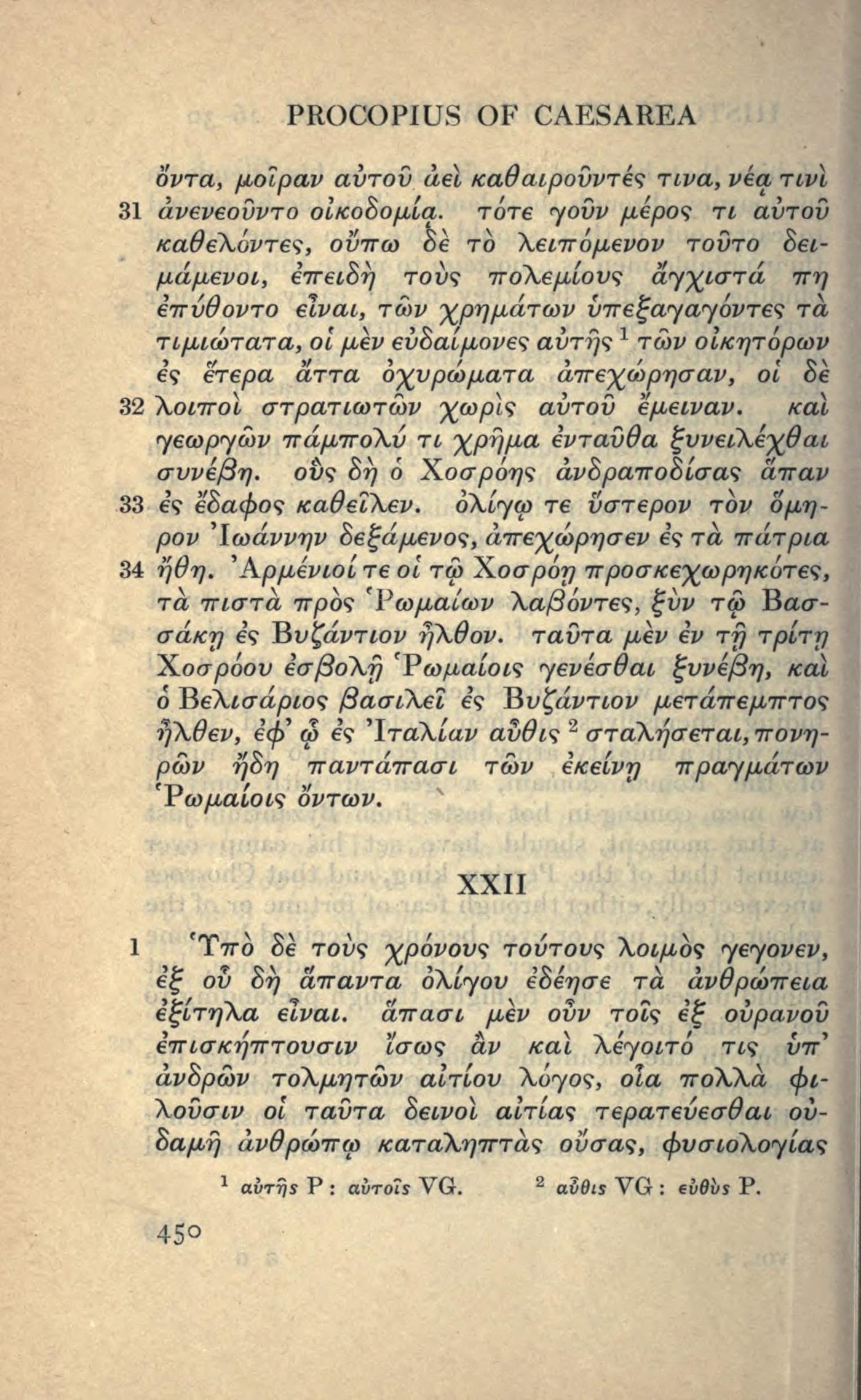
p. 450, chapter 22 begins 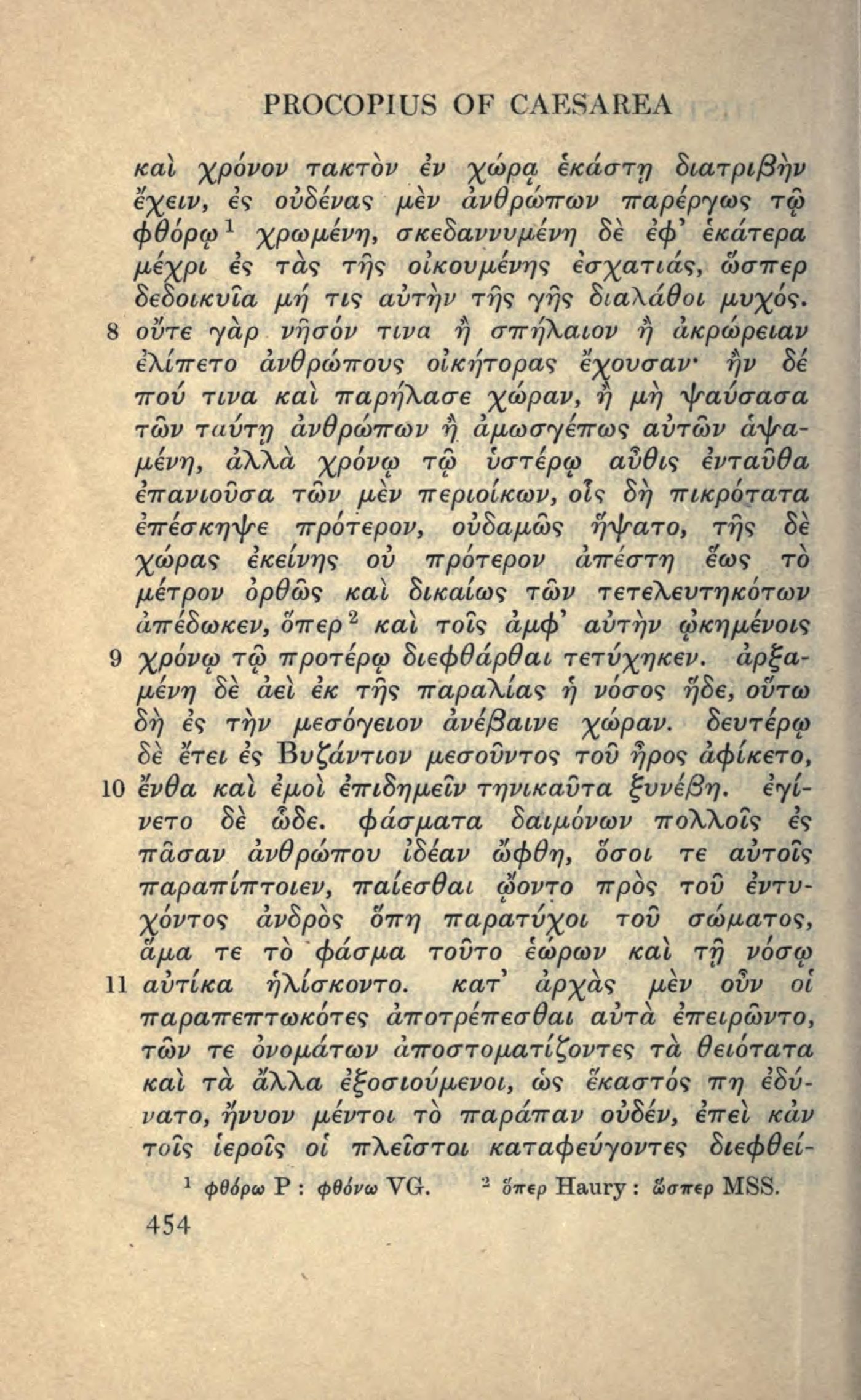
p. 454, the plague reaches Byzantium 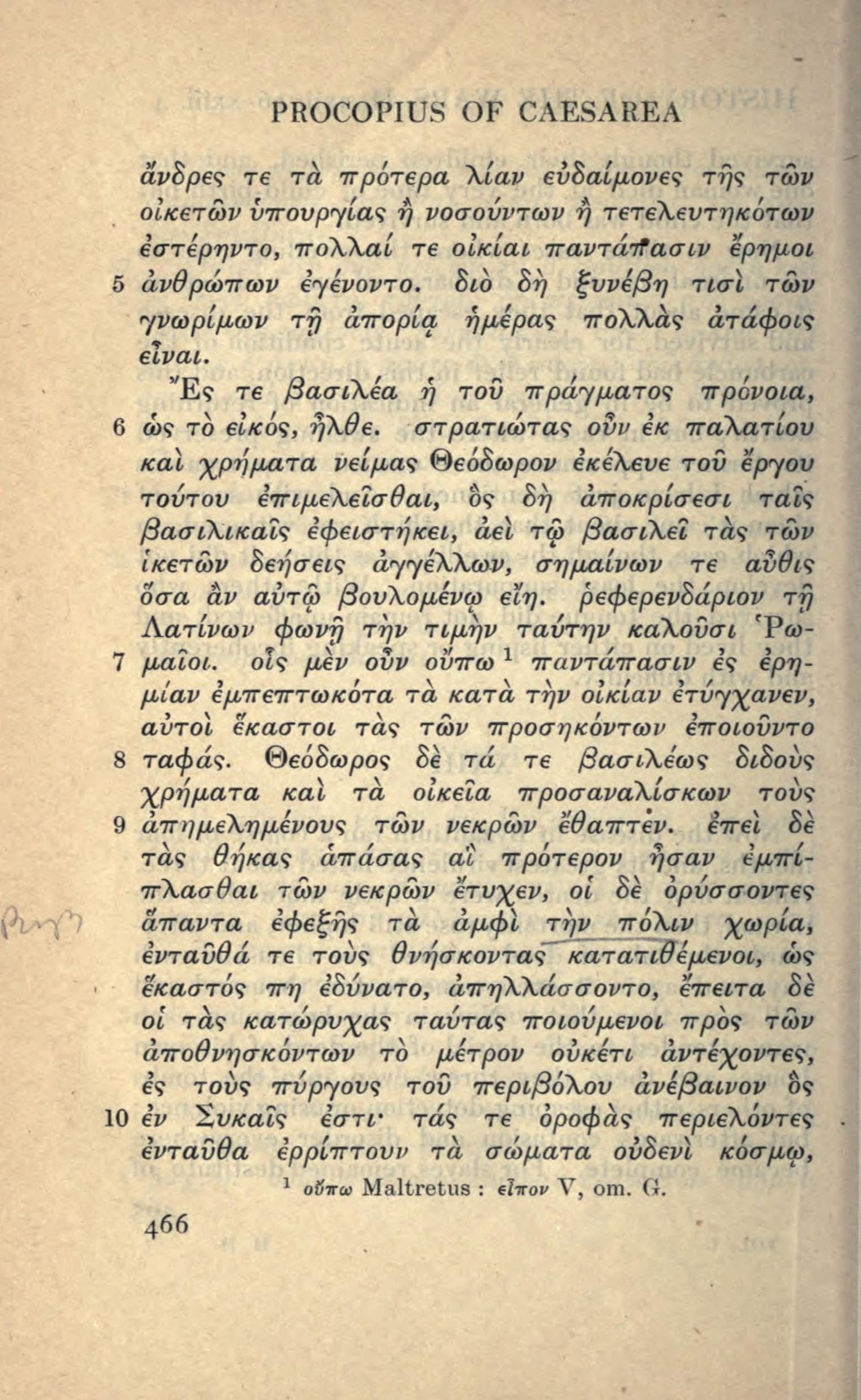
p. 466, Theodorus and the towers at Sycae 
p. 472, where the passage ends Procopii Caesariensis opera omnia, ed. J. Haury, vol. 1 (De bellis 1–4), Leipzig 1905
Internet Archive (University of Michigan copy, digitized by Google). No statement on the record (published 1905).
Haury's Teubner edition, which the Loeb reprints; Book 2, chapters 22–23.
Other translations of this passage. Links go to copies that are free to read online.
History of the Wars, Books I and II (Loeb Classical Library)
H. B. Dewing, 1914. English. Public domain.
The whole passage. An excerpt is in the Internet Medieval Sourcebook: https://sourcebooks.web.fordham.edu/source/542procopius-plague.asp
Difficulty: Moderate, plain words in long, careful descriptions; the court, the factions, and Procopius's debt to Thucydides need context.
Fits these units
- After the Plague. Did epidemics change societies, or did people go back to normal?
- The Healer's Burden. What does an epidemic ask of those who care for the sick?
- Explaining Disease Before Germs. How did people make sense of what they couldn't see?
- Faith and Catastrophe. How did religious believers respond, and did responses differ?
- Reading Sources Critically. How do we decide whom to believe?
Key vocabulary
- bubo
- a painful swelling of a gland in the groin, armpit, or neck; the mark of bubonic plague
- carbuncle
- a hard, dark, inflamed lump in the flesh
- contagion
- the spread of disease from person to person
- delirium
- a state of wild, confused thinking, often with frightening visions, brought on by illness
- demon
- an evil spirit; many Christians of Procopius's time believed demons could cause illness
- faction
- a rival group within a community; in Constantinople, the Blues and the Greens, clubs of chariot-racing fans
- providence
- God's care for the world and plan for what happens in it
- sophist
- a learned speaker or teacher; Procopius uses the word for clever people with empty explanations
Questions
- Comprehension
How did the disease begin in a person, according to Procopius, and what different courses could it then take? What sign gave a sick person the best hope of recovery?
- Analysis (reliability)
Procopius was in Byzantium when the plague arrived, but he wrote years later and modeled his account on Thucydides. Which details seem most likely to come from what he saw for himself, and which might be borrowed or exaggerated? Look closely at the daily death tolls in 23.2 and at the comment on the survivors in 23.16.
- Analysis
Procopius says the plague's cause can be traced only to God, yet he also says it seemed to spare the wickedest people. What, if anything, does he think the plague teaches? How does his own answer differ from those of the theorists he mocks in 22.1?
- Connection
Thucydides (P01) was Procopius's model. Thucydides saw the disease pass to those who nursed the sick (2.51); what does Procopius say about whether it passed from person to person (22.23), and what evidence does he give? Where else does his account follow Thucydides, and where does it part from it?
Activity
You are Theodore, the official Justinian put in charge of burying the dead. Using only details from the excerpt, write a one-page report to the emperor on what you found, what you did, and what you still need. Then compare reports with a classmate and discuss what an official report would leave out that Procopius puts in.
New translation from the Greek text of Procopius, History of the Wars (De bellis), edited by Jakob Haury (Leipzig, 1905), as printed in H. B. Dewing's Loeb edition (1914), Book 2, chapters 22–23.
The complete passage, 100 percent of the original.
- Original
- Source text extracted by code from the named edition and collated against it. Edition: Jakob Haury, ed., Procopii Caesariensis opera omnia, vol. 1, De bellis libri I–IV (Leipzig: Teubner, 1905), as printed in H. B. Dewing, ed. and trans., Procopius, vol. 1, Loeb Classical Library (London: Heinemann; New York: Macmillan, 1914), whose introduction states that it follows Haury's text; this passage pp. 452–472. Digital text: Perseus Digital Library, urn:cts:greekLit:tlg4029.tlg001.perseus-grc2 (canonical-greekLit, commit bcc5df0), extracted by code. Text only.
- Transliterated
- Machine transliteration (grc-romanized), generated by script, not reviewed
- Close English
- Working literal draft, machine-drafted, not edited for publication
- Simplified English
- Drafted by Claude (Anthropic) from the original and checked unit by unit against the original in a separate review, then compared with earlier translations and tested for borrowed wording.
- Editor’s review
- Not yet.
- Specialist review
- Not yet. Readings a specialist should confirm are listed for later review.
- Rights
- Original: public domain. Edition: public domain.
Sources for the notes
- Procopius. De bellis, Book 2, chapters 22–23. In Procopii Caesariensis opera omnia, vol. 1, edited by Jakob Haury. Leipzig: Teubner, 1905. Greek text as printed in Procopius, History of the Wars, vol. 1, Loeb Classical Library. London: Heinemann; New York: Macmillan, 1914.
- Procopius. History of the Wars, Books 1–2. Translated by H. B. Dewing. Loeb Classical Library. London: Heinemann; New York: Macmillan, 1914. Consulted for comparison; introduction on his debt to Herodotus and Thucydides and on his religion.
- Evans, J. A. S. "The Dates of Procopius' Works: A Recapitulation of the Evidence." Greek, Roman, and Byzantine Studies 37 (1996): 301–313. (Books 1–7 of the Wars made public in 551 at the earliest.)
- Fahey, William. Review of Procopius of Caesarea: Tyranny, History, and Philosophy at the End of Antiquity, by Anthony Kaldellis. Bryn Mawr Classical Review 2005.10.11. https://bmcr.brynmawr.edu/2005/2005.10.11/. (Summarizes Averil Cameron's reading of Procopius as a conventional Christian and Kaldellis's argument against it.)
- Harbeck, Michaela, Lisa Seifert, Stephanie Hänsch, et al. "Yersinia pestis DNA from Skeletal Remains from the 6th Century AD Reveals Insights into Justinianic Plague." PLOS Pathogens 9, no. 5 (2013): e1003349. Abstract and author summary.
- Mordechai, Lee, Merle Eisenberg, Timothy P. Newfield, Adam Izdebski, Janet E. Kay, and Hendrik Poinar. "The Justinianic Plague: An Inconsequential Pandemic?" Proceedings of the National Academy of Sciences 116, no. 51 (2019): 25546–25554.
- Wagner, David M., Jennifer Klunk, Michaela Harbeck, et al. "Yersinia pestis and the Plague of Justinian 541–543 AD: A Genomic Analysis." Lancet Infectious Diseases 14, no. 4 (2014): 319–326.
- World Health Organization (WHO). "Plague." Fact sheet. Geneva: WHO, September 29, 2026. https://www.who.int/news-room/fact-sheets/detail/plague.