Once in a Lifetime, part 1
The Plague at Athens, and Pericles Answers the Athenians
- Written
- after 430 BCE (events of 430–429 BCE)
- Place
- Athens
- Language
- Ancient Greek (Attic)
- Kind of source
- history
- Reading time
- 18 minutes
- Difficulty
- Moderate
- Intensity
- High: detailed symptoms, unburied bodies, funeral pyres
Plague of Athens (430–426 BCE)Doctors and medical ideasSpeeches and edictsWar and conflictDeath and burial
Once in a Lifetime themes: Unknowns, Fear, Exhaustion, Tensions, Aftermath
Thucydides caught the disease he describes, and lived. That fact gives this account its authority. He writes as a survivor who watched his neighbors die and who set down the signs so that anyone could recognize the sickness if it ever came back.
Thucydides was an Athenian citizen, born around 460 BCE. When war broke out in 431 BCE between Athens and Sparta, each with its allies, he began at once to write its history. He expected it to be the greatest war the Greeks had ever fought. In the second summer of the war, 430 BCE, the Spartans and their allies invaded Attica, the farmland around Athens. Pericles, the city's leading general, had brought the country people inside the city walls, where they crowded into huts and temples. A few days after the invasion, a disease broke out in the port of Piraeus and swept through the packed city. It came back in later years. Pericles himself died in 429 BCE. Thucydides later served as a general, failed to save the town of Amphipolis in 424 BCE, and spent twenty years in exile, where he kept writing.
Greek doctors of his time, the followers of Hippocrates, explained illness through the body's fluids and its surroundings rather than through the gods. Thucydides shares their habit of close observation. He refuses to guess at causes and describes the symptoms in order. He notices that the disease passed between people and that no one who survived it died of it a second time. Many of his neighbors saw the plague as the work of the gods.
For the plague, Thucydides is an eyewitness, though he wrote it up later. The speech is different. He says that he wrote his speeches to give the general sense of what was said, in the words he thought the moment called for. So Pericles's defense is Thucydides's version of a real speech. Thucydides admired Pericles, and the closing tribute to him is Thucydides's own judgment, written after Athens lost the war in 404 BCE.
Watch how the account moves from the sick body to the sick city: first the symptoms, then despair, then the collapse of burial customs and of respect for law. And notice what Pericles says about the plague. It is the one thing, he admits, that he did not foresee.
What we know now
No one knows what disease struck Athens. Thucydides's careful description fits no single modern illness, and scholars have proposed typhus, smallpox, and even Ebola, among many others. In 2006, a team led by researchers at the University of Athens reported finding DNA of the typhoid germ in teeth from a mass grave of about 430–426 BCE in the city's Kerameikos cemetery (Papagrigorakis et al. 2006). Other scientists replied that the DNA was too different from typhoid to prove the case (Shapiro et al. 2006), and the question remains open. The toll was heavy. Thucydides himself later counted at least 4,400 heavy infantry and 300 cavalry among the dead (History 3.87); at the start of the war, Athens had about 13,000 heavy infantry in its field army (2.13).
Read alongside
- The Plague at Constantinople
Nearly a thousand years later, Procopius modeled his description of the plague in Constantinople on this one.
- The Plague at My Country House, and a Life for a Life
Aelius Aristides survived an epidemic some six hundred years later and read every turn of his illness as a message from the gods, above all the healing god Asclepius.
The edited translation, in simplified modern English. Bracketed words were added for clarity; [...] marks a cut. Tap a note number to read the note. Point at or tap a phrase to see the original behind it. Phrase links checked in a separate review.
47[The Peloponnesians]1 had been in Attica2 only a few days when the sickness first broke out among the Athenians. It was said to have struck many places before, around Lemnos and elsewhere. But no one could remember a plague so great, or so many people dying, anywhere. At first the doctors were helpless. They were treating a disease they did not know, and they themselves died in the greatest numbers, because they came closest to the sick. No other human skill did any good either. People prayed at the temples, consulted oracles,3 and tried everything else of the kind, but nothing worked. In the end, overwhelmed by the disaster, they gave it all up.
48It began, people say, in Ethiopia, beyond Egypt. From there it spread down into Egypt and Libya and across most of the Persian Empire. Then it fell on Athens without warning. It struck first at Piraeus,4 so that people there even claimed the Peloponnesians had poisoned the wells, for Piraeus had no fountains yet. Later it reached the upper city too, and from then on far more people died.
Let each person, doctor or layman, give his own opinion about where it probably came from, and what causes could have been powerful enough to bring about so great a change. I will describe what it was like, and set down the signs that would let anyone who studies them recognize it if it ever strikes again. I can do this because I had the sickness myself and watched others suffer from it.
49Everyone agreed that this year had been freer of other illnesses than any other, and anyone who was already sick with something found it turning into this. Others were healthy when it seized them suddenly, with no apparent cause. First came a burning heat in the head and red, inflamed eyes. Inside the mouth, the throat and tongue turned bloody at once, and the breath became strange and foul. Next came sneezing and hoarseness, and soon the pain moved down into the chest with a hard cough. When it settled in the stomach,5 it turned the stomach over. Then came vomiting of every kind of bile the doctors have names for,6 all of it in great agony. Most people then suffered fits of dry retching that brought on violent spasms. In some, these soon stopped; in others, they went on much longer.
To the touch, the body was not especially hot, nor was it pale. It was reddish and bruise-colored, broken out in small blisters and sores. But inside, people burned so fiercely that they could not bear even the lightest clothes or linen sheets on them, or anything but to be naked. Nothing would have pleased them more than to throw themselves into cold water. Many with no one to look after them actually did, plunging into wells in their endless thirst. Yet it made no difference whether they drank a little or a lot.
They could find no rest and could not sleep, and this went on the whole time. As long as the disease was at its height, the body did not waste away but held out against the suffering better than anyone expected. So most people died on the ninth or the seventh day from the burning inside, while they still had some strength left. Or, if they survived that, the disease moved down into the bowels, causing severe ulcers and uncontrollable diarrhea. Most of them died later from the weakness this brought on.
The disease settled first in the head and worked its way down through the whole body. Even if someone survived the worst of it, it still left its mark on the extremities. It attacked the genitals, fingers, and toes, and many survived but lost them. Some lost their eyes as well. Others, as soon as they rose from their sickbeds, lost their memory of everything. They did not know themselves or their friends.
50The nature of the disease was beyond words. In every way it struck each victim more cruelly than human nature can bear. And in one way above all it showed that it was unlike any familiar illness. Though many bodies lay unburied, the birds and animals that feed on human flesh either stayed away or died after tasting them. Here is the proof. Birds of that kind clearly vanished: they were seen neither near the bodies nor anywhere else. The effect was even easier to see in dogs, because they live among people.
51Such, in general, was the disease, though I pass over many other strange features, since it took a somewhat different course in each person. Meanwhile, none of the usual illnesses troubled anyone, and any that did appear turned into this. Some died from neglect, others despite the best of care. There was, you might say, not a single remedy that could be counted on. What helped one person harmed another. Strong or weak, no one's body could hold out against it. It carried off everyone alike, even those who were nursed with every kind of diet.
The most terrible part of the whole disaster was the despair. As soon as people felt themselves falling sick, they lost all hope, gave themselves up far more easily, and stopped fighting. Just as terrible, they caught the disease from one another as they nursed each other,7 and they died like sheep. This caused more deaths than anything else. If people were afraid to visit one another, they died alone, and many households were wiped out because no one was left to care for them. If they did visit, they died, especially those who took pride in doing the right thing. Ashamed to hold back, they went in to their friends without sparing themselves. They did so because in the end even the families of the dying, overwhelmed by the sheer size of the disaster, were too worn out even to mourn them.
Still, it was those who had come through it who showed the most pity for the dying and the sick. They knew what it was like, and they now felt safe, because the disease never struck the same person twice, at least not fatally.8 Others called them lucky, and in the joy of the moment they even had an empty hope that no other disease could ever kill them.
52The crowding of people from the countryside into the city9 made the suffering even worse, and the newcomers suffered most of all. There were no houses for them, so they lived in stifling huts in the hottest season of the year, and they died in total disorder. The dying lay heaped on top of one another. Half-dead people rolled about in the streets and around every fountain, desperate for water. The temples where they had camped were full of corpses, because people died right there. The disaster was so overwhelming that people, not knowing what would become of them, stopped respecting anything, sacred or secular.
All the customs they had once followed for burials were thrown into confusion, and each family buried its dead however it could. So many in their households had already died that many families ran short of what they needed and turned to shameless kinds of burial.10 Some would arrive first at a pyre that others had built, lay their own dead on it, and set it alight. Others would throw the body they were carrying onto a pyre that was already burning, and walk away.
53In other ways, too, the sickness was the beginning of greater lawlessness in the city. People now dared more readily to do openly the things they had once done for pleasure only in secret. They saw how quickly fortune could change: the rich died suddenly, and people who had owned nothing at once had all that was theirs. So they decided to seize their pleasures quickly, thinking that their lives and their money alike would last only a day. No one was eager to work hard for what was considered honorable, since no one knew whether he would live long enough to reach it. Whatever was pleasant now, and whatever led to pleasure in any way, came to count as both honorable and useful.
Neither fear of the gods nor the law of men held them back. As for the gods, people decided it made no difference whether they worshiped them or not, since they saw everyone dying alike. As for crimes, no one expected to live long enough to stand trial and pay the penalty. Each felt that a far heavier sentence had already been passed on him and was hanging over his head. Before it fell, he might as well get some enjoyment out of life.
54Such was the disaster that had fallen on the Athenians and weighed them down, with people dying inside the walls and their land being ravaged outside. In their misery they naturally remembered an old verse that the older men said had been chanted long ago: "A Dorian war will come, and plague along with it."11 People argued over whether the old verse had really said "famine" rather than "plague."12 For the time being, "plague" naturally won, since people shaped their memories to fit what they were suffering. But I suppose that if another Dorian war comes someday, and a famine happens to come with it, they will most likely chant the verse that way.
Those who knew of it also remembered the oracle given to the Spartans.13 When they asked the god whether to go to war, he answered that if they fought with all their might, they would win, and that he himself would take their side.14 People supposed that events were matching the oracle. The sickness broke out just after the Peloponnesians invaded, and it never entered the Peloponnese to any extent worth mentioning. It spread most of all through Athens, and after that through the most crowded of the other places. Such were the events of the sickness.
[...]
57The whole time the Peloponnesians were in Athenian territory, and the Athenians were away with their fleet, the sickness kept killing Athenians, both in the army and in the city. It was even said that the Peloponnesians left the country sooner because they feared the disease: deserters told them it was in the city, and they could see the Athenians burying their dead.
[...]
59After the second Peloponnesian invasion, the Athenians had a change of heart. Their land had now been ravaged twice, and they were suffering from the sickness and the war at once. They blamed Pericles for persuading them to go to war, as though he had caused their misfortunes, and they were eager to come to terms with the Spartans. They even sent envoys, but the envoys achieved nothing. Feeling trapped on every side, the Athenians turned their anger on Pericles. Pericles saw that they were angry about their situation and were doing exactly what he had expected. Since he was still general,15 he called a meeting of the Assembly.16 He wanted to restore their courage, to calm their anger, and to bring them to a gentler and less fearful frame of mind. He came forward and spoke as follows.
60"I expected your anger against me, because I understand the reasons for it. That is why I have called this Assembly: to remind you of a few things, and to rebuke you if you are wrong to be angry with me or to give in to your misfortunes.
"I believe that a city does more good for its citizens when it prospers as a whole than when individuals do well while the city as a whole fails. A man may do well for himself, but if his country is ruined, he is ruined with it. A man who does badly in a city that does well has a far better chance of coming through. A city can bear the misfortunes of its citizens, but no citizen can bear the misfortunes of his city. So surely you must all defend it, instead of doing what you are doing now. Stunned by your troubles at home, you are abandoning the safety we all share, and blaming both me, who advised you to go to war, and yourselves, who voted for it with me.
"Yet the man you are angry with is, I believe, second to none at seeing what must be done and explaining it, a man who loves his city and cannot be bought. A man who sees what is needed but cannot explain it clearly might as well never have thought of it. A man who can do both but does not wish his city well will not speak up for it as he would for himself. And a man who loves his city but can be bribed would sell it all for money. So if you went to war because you believed I had these qualities even a little more than others, it is unfair to blame me now for doing wrong.
61"For people who are free to choose and are doing well otherwise, going to war is great folly. But suppose the choice was forced on us: give in at once and obey our neighbors, or take the risk and prevail. Then the man who runs from danger deserves more blame than the man who faces it. I am the same man, and I have not changed my position. It is you who have changed. You were persuaded while you were still unharmed, and now that you are suffering, you regret it. In your weakened state of mind, my reasoning seems wrong to you, because each of you already feels the pain, while the benefit is not yet clear to anyone. A great reversal has struck you, and struck suddenly, and your spirit is too low to hold to what you decided.
"Whatever is sudden, unexpected, and beyond all calculation enslaves the spirit, and that is what has happened to you, in many ways and not least with the sickness. Still, you live in a great city and were raised in a way of life worthy of it. So you must be ready to face even the greatest disasters without letting your good name be wiped out. People think it just as right to blame a man who, through weakness, falls short of the glory he already has as to hate a man who boldly grabs for glory he has not earned. Put aside your private grief and hold fast to the safety we all share.
[...]
63"You should also defend the honor our city gains from its empire, an honor you all take pride in. You cannot avoid the burdens of empire unless you also give up its honors. And do not think you are fighting over just one thing, slavery or freedom. You are also fighting against the loss of your empire, and against the danger from the hatred you have earned by ruling it. You can no longer give that empire up, even if someone, frightened by the present danger, wants to pose as a good citizen by keeping out of public affairs. For you already hold it like a tyranny.17 It may seem wrong to have taken it, but it is dangerous to let it go. [...]
64"But do not be misled by citizens like these, and do not stay angry with me. You voted for war together with me. The enemy invaded and did just what was to be expected once you refused to obey them. And on top of everything we expected, this sickness came, the one thing of all that has turned out worse than anyone could foresee. I know it is part of the reason you hate me even more. That is unfair, unless you will also give me the credit whenever some unexpected good luck comes your way. We must bear what the gods send18 because we must, and what the enemy does with courage. That has always been the way of this city, and it must not end with you.
"Remember that our city has the greatest name in the world because it does not give in to disaster. It has spent more lives and labor in war than any other, and it has held the greatest power known up to our time. Even if we should someday give way a little, since everything that grows also declines, the memory of that power will live forever. Future generations will remember that we were Greeks who ruled more Greeks than anyone else. They will remember that we held out in the greatest wars, against all our enemies together and against each one alone, and that we lived in the richest and greatest city of all.
"Those who prefer to stay out of affairs may find fault with all this. But those who want to act will try to match it, and those who have not achieved it will envy it. Every people that has tried to rule others has been hated and resented for a time. But whoever accepts envy for the greatest goals has chosen wisely. Hatred does not last long, while the glory of the moment and the fame that follows are remembered forever.
"So look ahead. See what will be honorable in the future and what will not be shameful now, and win both with the courage you show today. Do not send heralds to the Spartans to ask for peace, and do not let them see that your present hardships weigh on you. In the face of disaster, those who are least troubled in mind and who hold out hardest in action are the strongest, whether they are cities or individuals."
65With words like these, Pericles tried to ease the Athenians' anger against him and to turn their minds away from their present terrors. As a people, they were persuaded. They sent no more envoys to the Spartans and threw themselves into the war with more energy. But privately they still grieved over what they had suffered. The common people had started with little, and now they had lost even that. The powerful had lost fine country estates, with their buildings and costly furnishings. Worst of all, they had war instead of peace. All the same, they did not stop being angry with him until they had fined him. But not long afterward, as crowds tend to do, they elected him general again and put him in charge of everything. By then each man felt his private losses less sharply, and they judged him the most valuable man for what the city as a whole needed.
As long as he led the city in peacetime, he guided it with moderation and kept it safe, and under him it reached the height of its greatness. When the war came, he clearly judged the city's strength correctly in that, too. He lived on for two years and six months [after the war began],19 and after his death his foresight about the war was recognized even more. He had told the Athenians that they would prevail if they kept quiet, looked after their navy, did not try to enlarge their empire during the war, and did not put the city at risk. They did the exact opposite. In other matters, too, that seemed to have nothing to do with the war, they made bad policy for themselves and their allies, driven by private ambition and private gain. When these schemes succeeded, the honor and profit went mostly to individuals. When they failed, they hurt the city's war effort.
The reason was this. Pericles was powerful because of his standing and his judgment, and everyone could see that he was above taking bribes. He held the people in check while respecting their freedom,20 and he led them rather than being led by them. Because he had not gained his power by improper means, he never had to flatter them. His standing was so high that he could even contradict them and make them angry. Whenever he saw them growing arrogant and overconfident at the wrong moment, his words struck fear into them. When they were afraid without good reason, he restored their confidence. So Athens was a democracy in name, but in fact it was ruled by its first man. The leaders who came after him were more equal to one another, and each was grabbing for first place. So they began to hand over even the running of the state to the people, to please them.
[...]
Notes
- The Peloponnesians were Sparta and its allies. Their army had invaded Attica in early summer, in the second year of the war (430 BCE). back
- The countryside around Athens, which belonged to the city. back
- In a crisis, Greeks prayed and made offerings at temples, and asked oracles what to do. An oracle was a shrine where a god was believed to answer questions through a priest or priestess. back
- The port of Athens, a few miles from the city and joined to it by long walls. back
- The Greek word kardia can mean either the heart or the upper stomach. Most readers take it as the stomach here, since vomiting follows. back
- Greek doctors named several kinds of bile. Many believed health depended on a balance of body fluids, later called the four humors: blood, phlegm, yellow bile, and black bile. back
- An observation of contagion: the idea that disease passed from person to person by touch or breath, long before anyone knew about germs. back
- An early record of what we now call immunity: people who survive some diseases cannot catch them again, or catch them only mildly. back
- At the start of the war, Pericles had the people of Attica move inside the city walls, leaving their farms to the invading army. back
- Greeks believed each family owed its dead proper funeral rites. Burning a body on another family's pyre broke both custom and religious duty. back
- The Spartans were Dorians, one of the main branches of the Greek people, so the verse was taken to foretell a war with Sparta. back
- In Greek the two words differ by one letter: loimos (plague) and limos (famine). back
- The Greek says Lacedaemonians. Lacedaemon was the official name of the Spartan state. back
- The oracle at Delphi, where the god Apollo was believed to answer questions through his priestess. back
- Athens elected ten generals every year. The post carried political as well as military power, and Pericles had held it year after year. back
- The meeting of all adult male citizens, which made the city's decisions. back
- A tyranny was rule by one man who had taken power without a legal right to it. Pericles means that Athens holds its empire by force. back
- Literally, "the things from the divine powers." Greeks often saw sudden disasters such as plagues as sent by the gods. back
- Pericles died in the autumn of 429 BCE. The biographer Plutarch, writing over five hundred years later, says that he died of the plague. back
- The Greek word can also mean that Pericles acted with a free hand, answering to no one. Translators divide between the two readings. back
καὶ ὄντων αὐτῶν οὐ πολλάς πω ἡμέρας ἐν τῇ Ἀττικῇ ἡ νόσος πρῶτον ἤρξατο γενέσθαι τοῖς Ἀθηναίοις, λεγόμενον μὲν καὶ πρότερον πολλαχόσε ἐγκατασκῆψαι καὶ περὶ Λῆμνον καὶ ἐν ἄλλοις χωρίοις, οὐ μέντοι τοσοῦτός γε λοιμὸς οὐδὲ φθορὰ οὕτως ἀνθρώπων οὐδαμοῦ ἐμνημονεύετο γενέσθαι.
And when they had been not yet many days in Attica, the sickness first began to arise among the Athenians, though it was said that it had also earlier struck down in many places, both around Lemnos and in other places; yet nowhere was so great a plague, nor such a destruction of men, remembered to have occurred.
[The Peloponnesians] had been in Attica only a few days when the sickness first broke out among the Athenians. It was said to have struck many places before, around Lemnos and elsewhere. But no one could remember a plague so great, or so many people dying, anywhere.
Not many days after their arrival in Attica the plague first began to show itself among the Athenians. It was said that it had broken out in many places previously in the neighbourhood of Lemnos and elsewhere; but a pestilence of such extent and mortality was nowhere remembered.
- The Peloponnesians were Sparta and its allies. Their army had invaded Attica in early summer, in the second year of the war (430 BCE).
- The countryside around Athens, which belonged to the city.
οὔτε γὰρ ἰατροὶ ἤρκουν τὸ πρῶτον θεραπεύοντες ἀγνοίᾳ, ἀλλ’ αὐτοὶ μάλιστα ἔθνῃσκον ὅσῳ καὶ μάλιστα προσῇσαν, οὔτε ἄλλη ἀνθρωπεία τέχνη οὐδεμία· ὅσα τε πρὸς ἱεροῖς ἱκέτευσαν ἢ μαντείοις καὶ τοῖς τοιούτοις ἐχρήσαντο, πάντα ἀνωφελῆ ἦν, τελευτῶντές τε αὐτῶν ἀπέστησαν ὑπὸ τοῦ κακοῦ νικώμενοι.
For neither were the doctors sufficient at first, treating [it] in ignorance, but they themselves died most, inasmuch as they also most approached [the sick], nor [was] any other human art at all; and as many things as they supplicated at sanctuaries [temples], or [as often as] they made use of oracles and such things, all were useless, and in the end they gave them up, being conquered by the evil.
At first the doctors were helpless. They were treating a disease they did not know, and they themselves died in the greatest numbers, because they came closest to the sick. No other human skill did any good either. People prayed at the temples, consulted oracles, and tried everything else of the kind, but nothing worked. In the end, overwhelmed by the disaster, they gave it all up.
Neither were the physicians at first of any service, ignorant as they were of the proper way to treat it, but they died themselves the most thickly, as they visited the sick most often; nor did any human art succeed any better. Supplications in the temples, divinations, and so forth were found equally futile, till the overwhelming nature of the disaster at last put a stop to them altogether.
- In a crisis, Greeks prayed and made offerings at temples, and asked oracles what to do. An oracle was a shrine where a god was believed to answer questions through a priest or priestess.
ἤρξατο δὲ τὸ μὲν πρῶτον, ὡς λέγεται, ἐξ Αἰθιοπίας τῆς ὑπὲρ Αἰγύπτου, ἔπειτα δὲ καὶ ἐς Αἴγυπτον καὶ Λιβύην κατέβη καὶ ἐς τὴν βασιλέως γῆν τὴν πολλήν.
And it began first, as it is said, from Ethiopia, the [part] above [beyond] Egypt, and then it came down also into Egypt and Libya and into the greater part of the Persian Empire.
It began, people say, in Ethiopia, beyond Egypt. From there it spread down into Egypt and Libya and across most of the Persian Empire.
It first began, it is said, in the parts of Ethiopia above Egypt, and thence descended into Egypt and Libya and into most of the King's country.
ἐς δὲ τὴν Ἀθηναίων πόλιν ἐξαπιναίως ἐσέπεσε, καὶ τὸ πρῶτον ἐν τῷ Πειραιεῖ ἥψατο τῶν ἀνθρώπων, ὥστε καὶ ἐλέχθη ὑπ’ αὐτῶν ὡς οἱ Πελοποννήσιοι φάρμακα ἐσβεβλήκοιεν ἐς τὰ φρέατα· κρῆναι γὰρ οὔπω ἦσαν αὐτόθι. ὕστερον δὲ καὶ ἐς τὴν ἄνω πόλιν ἀφίκετο, καὶ ἔθνῃσκον πολλῷ μᾶλλον ἤδη.
And into the city of the Athenians it fell suddenly, and first in Piraeus it laid hold of the people, so that it was even said by them that the Peloponnesians had thrown poisons [drugs] into the wells; for there were not yet fountains [springs] there. And later it arrived also in the upper city, and they were dying much more by now.
Then it fell on Athens without warning. It struck first at Piraeus, so that people there even claimed the Peloponnesians had poisoned the wells, for Piraeus had no fountains yet. Later it reached the upper city too, and from then on far more people died.
Suddenly falling upon Athens, it first attacked the population in Piraeus—which was the occasion of their saying that the Peloponnesians had poisoned the reservoirs, there being as yet no wells there—and afterwards appeared in the upper city, when the deaths became much more frequent.
- The port of Athens, a few miles from the city and joined to it by long walls.
λεγέτω μὲν οὖν περὶ αὐτοῦ ὡς ἕκαστος γιγνώσκει καὶ ἰατρὸς καὶ ἰδιώτης, ἀφ’ ὅτου εἰκὸς ἦν γενέσθαι αὐτό, καὶ τὰς αἰτίας ἅστινας νομίζει τοσαύτης μεταβολῆς ἱκανὰς εἶναι δύναμιν ἐς τὸ μεταστῆσαι σχεῖν· ἐγὼ δὲ οἷόν τε ἐγίγνετο λέξω, καὶ ἀφ’ ὧν ἄν τις σκοπῶν, εἴ ποτε καὶ αὖθις ἐπιπέσοι, μάλιστ’ ἂν ἔχοι τι προειδὼς μὴ ἀγνοεῖν, ταῦτα δηλώσω αὐτός τε νοσήσας καὶ αὐτὸς ἰδὼν ἄλλους πάσχοντας.
Let each one, then, both doctor and layman, speak about it as he judges [knows], from what it was likely to have arisen, and the causes which he thinks sufficient to have had the power to bring about so great a change; but I will tell what sort of thing it was as it occurred, and [the signs] from which someone, observing, if ever it should fall upon [them] again, would best be able, knowing something beforehand, not to be ignorant [of it], these I will make clear, having both myself been sick and myself seen others suffering.
Let each person, doctor or layman, give his own opinion about where it probably came from, and what causes could have been powerful enough to bring about so great a change. I will describe what it was like, and set down the signs that would let anyone who studies them recognize it if it ever strikes again. I can do this because I had the sickness myself and watched others suffer from it.
All speculation as to its origin and its causes, if causes can be found adequate to produce so great a disturbance, I leave to other writers, whether lay or professional; for myself, I shall simply set down its nature, and explain the symptoms by which perhaps it may be recognized by the student, if it should ever break out again. This I can the better do, as I had the disease myself, and watched its operation in the case of others.
τὸ μὲν γὰρ ἔτος, ὡς ὡμολογεῖτο, ἐκ πάντων μάλιστα δὴ ἐκεῖνο ἄνοσον ἐς τὰς ἄλλας ἀσθενείας ἐτύγχανεν ὄν· εἰ δέ τις καὶ προύκαμνέ τι, ἐς τοῦτο πάντα ἀπεκρίθη.
For the year, as was agreed, happened to be that one, of all [years], especially free from sickness as regards the other illnesses; and if anyone was also already suffering somewhat beforehand, all [cases] ended [were resolved] in this.
Everyone agreed that this year had been freer of other illnesses than any other, and anyone who was already sick with something found it turning into this.
That year then is admitted to have been otherwise unprecedentedly free from sickness; and such few cases as occurred all determined in this.
τοὺς δὲ ἄλλους ἀπ’ οὐδεμιᾶς προφάσεως, ἀλλ’ ἐξαίφνης ὑγιεῖς ὄντας πρῶτον μὲν τῆς κεφαλῆς θέρμαι ἰσχυραὶ καὶ τῶν ὀφθαλμῶν ἐρυθήματα καὶ φλόγωσις ἐλάμβανε, καὶ τὰ ἐντός, ἥ τε φάρυγξ καὶ ἡ γλῶσσα, εὐθὺς αἱματώδη ἦν καὶ πνεῦμα ἄτοπον καὶ δυσῶδες ἠφίει·
But the others, from no apparent cause [pretext], but suddenly, while being healthy, first strong heats [fevers] of the head and rednesses and inflammation of the eyes seized, and the inner parts, both the throat and the tongue, were immediately bloody and gave out a strange [unnatural] and foul-smelling breath;
Others were healthy when it seized them suddenly, with no apparent cause. First came a burning heat in the head and red, inflamed eyes. Inside the mouth, the throat and tongue turned bloody at once, and the breath became strange and foul.
As a rule, however, there was no ostensible cause; but people in good health were all of a sudden attacked by violent heats in the head, and redness and inflammation in the eyes, the inward parts, such as the throat or tongue, becoming bloody and emitting an unnatural and fetid breath.
ἔπειτα ἐξ αὐτῶν πταρμὸς καὶ βράγχος ἐπεγίγνετο, καὶ ἐν οὐ πολλῷ χρόνῳ κατέβαινεν ἐς τὰ στήθη ὁ πόνος μετὰ βηχὸς ἰσχυροῦ· καὶ ὁπότε ἐς τὴν καρδίαν στηρίξειεν, ἀνέστρεφέ τε αὐτὴν καὶ ἀποκαθάρσεις χολῆς πᾶσαι ὅσαι ὑπὸ ἰατρῶν ὠνομασμέναι εἰσὶν ἐπῇσαν, καὶ αὗται μετὰ ταλαιπωρίας μεγάλης.
then after these, sneezing and hoarseness came on, and in no long time the distress [pain] went down into the chest with a strong cough; and whenever it settled in the heart [stomach?], it both turned it over [upset it] and there came on all the discharges of bile, as many as have been named by doctors, and these with great misery [distress].
Next came sneezing and hoarseness, and soon the pain moved down into the chest with a hard cough. When it settled in the stomach, it turned the stomach over. Then came vomiting of every kind of bile the doctors have names for, all of it in great agony.
These symptoms were followed by sneezing and hoarseness, after which the pain soon reached the chest, and produced a hard cough. When it fixed in the stomach, it upset it; and discharges of bile of every kind named by physicians ensued, accompanied by very great distress.
- The Greek word kardia can mean either the heart or the upper stomach. Most readers take it as the stomach here, since vomiting follows.
- Greek doctors named several kinds of bile. Many believed health depended on a balance of body fluids, later called the four humors: blood, phlegm, yellow bile, and black bile.
λύγξ τε τοῖς πλέοσιν ἐνέπιπτε κενή, σπασμὸν ἐνδιδοῦσα ἰσχυρόν, τοῖς μὲν μετὰ ταῦτα λωφήσαντα, τοῖς δὲ καὶ πολλῷ ὕστερον.
And an empty hiccuping [retching] fell upon most, bringing on a strong convulsion [spasm], which abated for some after these things, but for others even much later.
Most people then suffered fits of dry retching that brought on violent spasms. In some, these soon stopped; in others, they went on much longer.
In most cases also an ineffectual retching followed, producing violent spasms, which in some cases ceased soon after, in others much later.
καὶ τὸ μὲν ἔξωθεν ἁπτομένῳ σῶμα οὔτ’ ἄγαν θερμὸν ἦν οὔτε χλωρόν, ἀλλ’ ὑπέρυθρον, πελιτνόν, φλυκταίναις μικραῖς καὶ ἕλκεσιν ἐξηνθηκός· τὰ δὲ ἐντὸς οὕτως ἐκάετο ὥστε μήτε τῶν πάνυ λεπτῶν ἱματίων καὶ σινδόνων τὰς ἐπιβολὰς μηδ’ ἄλλο τι ἢ γυμνοὶ ἀνέχεσθαι, ἥδιστά τε ἂν ἐς ὕδωρ ψυχρὸν σφᾶς αὐτοὺς ῥίπτειν. καὶ πολλοὶ τοῦτο τῶν ἠμελημένων ἀνθρώπων καὶ ἔδρασαν ἐς φρέατα, τῇ δίψῃ ἀπαύστῳ ξυνεχόμενοι· καὶ ἐν τῷ ὁμοίῳ καθειστήκει τό τε πλέον καὶ ἔλασσον ποτόν.
And the body, to one touching it from outside, was neither too hot nor pale [greenish-yellow], but reddish, livid, having broken out [blossomed] with small blisters and sores; but the inner parts burned so that they could bear neither the coverings of very thin garments and linen sheets nor anything other than [being] naked, and most gladly would they throw themselves into cold water. And many of the neglected people actually did this, into wells, gripped by unceasing thirst; and the more and the less drinking had come to be in the same state.
To the touch, the body was not especially hot, nor was it pale. It was reddish and bruise-colored, broken out in small blisters and sores. But inside, people burned so fiercely that they could not bear even the lightest clothes or linen sheets on them, or anything but to be naked. Nothing would have pleased them more than to throw themselves into cold water. Many with no one to look after them actually did, plunging into wells in their endless thirst. Yet it made no difference whether they drank a little or a lot.
Externally the body was not very hot to the touch, nor pale in its appearance, but reddish, livid, and breaking out into small pustules and ulcers. But internally it burned so that the patient could not bear to have on him clothing or linen even of the very lightest description; or indeed to be otherwise than stark naked. What they would have liked best would have been to throw themselves into cold water; as indeed was done by some of the neglected sick, who plunged into the rain-tanks in their agonies of unquenchable thirst; though it made no difference whether they drank little or much.
καὶ ἡ ἀπορία τοῦ μὴ ἡσυχάζειν καὶ ἡ ἀγρυπνία ἐπέκειτο διὰ παντός. καὶ τὸ σῶμα, ὅσονπερ χρόνον καὶ ἡ νόσος ἀκμάζοι, οὐκ ἐμαραίνετο, ἀλλ’ ἀντεῖχε παρὰ δόξαν τῇ ταλαιπωρίᾳ, ὥστε ἢ διεφθείροντο οἱ πλεῖστοι ἐναταῖοι καὶ ἑβδομαῖοι ὑπὸ τοῦ ἐντὸς καύματος, ἔτι ἔχοντές τι δυνάμεως, ἢ εἰ διαφύγοιεν, ἐπικατιόντος τοῦ νοσήματος ἐς τὴν κοιλίαν καὶ ἑλκώσεώς τε αὐτῇ ἰσχυρᾶς ἐγγιγνομένης καὶ διαρροίας ἅμα ἀκράτου ἐπιπιπτούσης οἱ πολλοὶ ὕστερον δι’ αὐτὴν ἀσθενείᾳ διεφθείροντο.
And the helplessness [restlessness] of not keeping still and the sleeplessness pressed upon [them] throughout. And the body, for as long a time as the sickness was at its height, did not waste away, but held out, contrary to expectation, against the misery, so that either most perished on the ninth and seventh [day] from the inner burning, still having some strength, or, if they escaped, the disease going down further into the belly, and a strong ulceration arising in it, and at the same time an unmixed [violent] diarrhoea falling upon [them], the many later perished through it, by weakness.
They could find no rest and could not sleep, and this went on the whole time. As long as the disease was at its height, the body did not waste away but held out against the suffering better than anyone expected. So most people died on the ninth or the seventh day from the burning inside, while they still had some strength left. Or, if they survived that, the disease moved down into the bowels, causing severe ulcers and uncontrollable diarrhea. Most of them died later from the weakness this brought on.
Besides this, the miserable feeling of not being able to rest or sleep never ceased to torment them. The body meanwhile did not waste away so long as the distemper was at its height, but held out to a marvel against its ravages; so that when they succumbed, as in most cases, on the seventh or eighth day to the internal inflammation, they had still some strength in them. But if they passed this stage, and the disease descended further into the bowels, inducing a violent ulceration there accompanied by severe diarrhoea, this brought on a weakness which was generally fatal.
διεξῄει γὰρ διὰ παντὸς τοῦ σώματος ἄνωθεν ἀρξάμενον τὸ ἐν τῇ κεφαλῇ πρῶτον ἱδρυθὲν κακόν, καὶ εἴ τις ἐκ τῶν μεγίστων περιγένοιτο, τῶν γε ἀκρωτηρίων ἀντίληψις αὐτοῦ ἐπεσήμαινεν.
For there passed through the whole body, beginning from above, the evil that had first settled in the head, and if anyone survived the worst [of it], at least its seizure of the extremities left its mark [gave signs of it].
The disease settled first in the head and worked its way down through the whole body. Even if someone survived the worst of it, it still left its mark on the extremities.
For the disorder first settled in the head, ran its course from thence through the whole of the body, and, even where it did not prove mortal, it still left its mark on the extremities;
κατέσκηπτε γὰρ ἐς αἰδοῖα καὶ ἐς ἄκρας χεῖρας καὶ πόδας, καὶ πολλοὶ στερισκόμενοι τούτων διέφευγον, εἰσὶ δ’ οἳ καὶ τῶν ὀφθαλμῶν. τοὺς δὲ καὶ λήθη ἐλάμβανε παραυτίκα ἀναστάντας τῶν πάντων ὁμοίως, καὶ ἠγνόησαν σφᾶς τε αὐτοὺς καὶ τοὺς ἐπιτηδείους.
For it struck down into the genitals and into the ends of the hands and feet, and many, being deprived of these, escaped, and there are some who [were deprived] also of the eyes. And others forgetfulness seized immediately upon rising up [recovering], of all things alike, and they did not know either themselves or their friends [those close to them].
It attacked the genitals, fingers, and toes, and many survived but lost them. Some lost their eyes as well. Others, as soon as they rose from their sickbeds, lost their memory of everything. They did not know themselves or their friends.
for it settled in the privy parts, the fingers and the toes, and many escaped with the loss of these, some too with that of their eyes. Others again were seized with an entire loss of memory on their first recovery, and did not know either themselves or their friends.
γενόμενον γὰρ κρεῖσσον λόγου τὸ εἶδος τῆς νόσου τά τε ἄλλα χαλεπωτέρως ἢ κατὰ τὴν ἀνθρωπείαν φύσιν προσέπιπτεν ἑκάστῳ καὶ ἐν τῷδε ἐδήλωσε μάλιστα ἄλλο τι ὂν ἢ τῶν ξυντρόφων τι· τὰ γὰρ ὄρνεα καὶ τετράποδα ὅσα ἀνθρώπων ἅπτεται, πολλῶν ἀτάφων γιγνομένων ἢ οὐ προσῄει ἢ γευσάμενα διεφθείρετο.
For the form [nature] of the sickness, having become beyond description [stronger than words], both in other respects fell upon each one more harshly than according to human nature, and in this it showed most of all that it was something other than any of the familiar [native] [diseases]: for the birds and four-footed animals, as many as touch [feed on] humans, though many were lying unburied, either did not approach or, having tasted, perished.
The nature of the disease was beyond words. In every way it struck each victim more cruelly than human nature can bear. And in one way above all it showed that it was unlike any familiar illness. Though many bodies lay unburied, the birds and animals that feed on human flesh either stayed away or died after tasting them.
But while the nature of the distemper was such as to baffle all description, and its attacks almost too grievous for human nature to endure, it was still in the following circumstance that its difference from all ordinary disorders was most clearly shown. All the birds and beasts that prey upon human bodies, either abstained from touching them (though there were many lying unburied), or died after tasting them.
τεκμήριον δέ· τῶν μὲν τοιούτων ὀρνίθων ἐπίλειψις σαφὴς ἐγένετο, καὶ οὐχ ἑωρῶντο οὔτε ἄλλως οὔτε περὶ τοιοῦτον οὐδέν· οἱ δὲ κύνες μᾶλλον αἴσθησιν παρεῖχον τοῦ ἀποβαίνοντος διὰ τὸ ξυνδιαιτᾶσθαι.
And [here is] evidence: of such birds a clear disappearance [failing] occurred, and they were not seen either otherwise or around any such thing; and the dogs gave more [clearly] perception of the outcome [what was happening] because of living together [with humans].
Here is the proof. Birds of that kind clearly vanished: they were seen neither near the bodies nor anywhere else. The effect was even easier to see in dogs, because they live among people.
In proof of this, it was noticed that birds of this kind actually disappeared; they were not about the bodies, or indeed to be seen at all. But of course the effects which I have mentioned could best be studied in a domestic animal like the dog.
τὸ μὲν οὖν νόσημα, πολλὰ καὶ ἄλλα παραλιπόντι ἀτοπίας, ὡς ἑκάστῳ ἐτύγχανέ τι διαφερόντως ἑτέρῳ πρὸς ἕτερον γιγνόμενον, τοιοῦτον ἦν ἐπὶ πᾶν τὴν ἰδέαν. καὶ ἄλλο παρελύπει κατ’ ἐκεῖνον τὸν χρόνον οὐδὲν τῶν εἰωθότων· ὃ δὲ καὶ γένοιτο, ἐς τοῦτο ἐτελεύτα.
The disease, then, to one passing over also many other [features] of its strangeness, as it happened to [be] something differently for each one, one compared to another, was of such a kind on the whole in its form [character]. And no other of the customary [illnesses] gave additional trouble during that time; and whatever did occur, ended in this.
Such, in general, was the disease, though I pass over many other strange features, since it took a somewhat different course in each person. Meanwhile, none of the usual illnesses troubled anyone, and any that did appear turned into this.
Such then, if we pass over the varieties of particular cases which were many and peculiar, were the general features of the distemper. Meanwhile the town enjoyed an immunity from all the ordinary disorders; or if any case occurred, it ended in this.
ἔθνῃσκον δὲ οἱ μὲν ἀμελείᾳ, οἱ δὲ καὶ πάνυ θεραπευόμενοι. ἕν τε οὐδὲ ἓν κατέστη ἴαμα ὡς εἰπεῖν ὅτι χρῆν προσφέροντας ὠφελεῖν· τὸ γάρ τῳ ξυνενεγκὸν ἄλλον τοῦτο ἔβλαπτεν.
And some died through neglect, others even while being very much [carefully] cared for. And not even one single remedy was established, so to speak, which those applying [it] ought to benefit [with]; for that which helped one, this harmed another.
Some died from neglect, others despite the best of care. There was, you might say, not a single remedy that could be counted on. What helped one person harmed another.
Some died in neglect, others in the midst of every attention. No remedy was found that could be used as a specific; for what did good in one case, did harm in another.
σῶμά τε αὔταρκες ὂν οὐδὲν διεφάνη πρὸς αὐτὸ ἰσχύος πέρι ἢ ἀσθενείας, ἀλλὰ πάντα ξυνῄρει καὶ τὰ πάσῃ διαίτῃ θεραπευόμενα.
And no body, being self-sufficient, showed itself [able to resist] against it, as regards strength or weakness, but it carried off all, even those cared for with every regimen [diet].
Strong or weak, no one's body could hold out against it. It carried off everyone alike, even those who were nursed with every kind of diet.
Strong and weak constitutions proved equally incapable of resistance, all alike being swept away, although dieted with the utmost precaution.
δεινότατον δὲ παντὸς ἦν τοῦ κακοῦ ἥ τε ἀθυμία ὁπότε τις αἴσθοιτο κάμνων (πρὸς γὰρ τὸ ἀνέλπιστον εὐθὺς τραπόμενοι τῇ γνώμῃ πολλῷ μᾶλλον προΐεντο σφᾶς αὐτοὺς καὶ οὐκ ἀντεῖχον), καὶ ὅτι ἕτερος ἀφ’ ἑτέρου θεραπείας ἀναπιμπλάμενοι ὥσπερ τὰ πρόβατα ἔθνῃσκον· καὶ τὸν πλεῖστον φθόρον τοῦτο ἐνεποίει.
And most terrible of the whole evil was both the despondency whenever anyone perceived [that he was] sick (for, turning immediately in their judgment [mind] to hopelessness, they gave themselves up much more and did not hold out), and that, being infected one from another through caring [for each other], they died like sheep; and this caused the greatest destruction.
The most terrible part of the whole disaster was the despair. As soon as people felt themselves falling sick, they lost all hope, gave themselves up far more easily, and stopped fighting. Just as terrible, they caught the disease from one another as they nursed each other, and they died like sheep. This caused more deaths than anything else.
By far the most terrible feature in the malady was the dejection which ensued when any one felt himself sickening, for the despair into which they instantly fell took away their power of resistance, and left them a much easier prey to the disorder; besides which, there was the awful spectacle of men dying like sheep, through having caught the infection in nursing each other. This caused the greatest mortality.
- An observation of contagion: the idea that disease passed from person to person by touch or breath, long before anyone knew about germs.
εἴτε γὰρ μὴ ᾽θέλοιεν δεδιότες ἀλλήλοις προσιέναι, ἀπώλλυντο ἐρῆμοι, καὶ οἰκίαι πολλαὶ ἐκενώθησαν ἀπορίᾳ τοῦ θεραπεύσοντος· εἴτε προσίοιεν, διεφθείροντο, καὶ μάλιστα οἱ ἀρετῆς τι μεταποιούμενοι· αἰσχύνῃ γὰρ ἠφείδουν σφῶν αὐτῶν ἐσιόντες παρὰ τοὺς φίλους, ἐπεὶ καὶ τὰς ὀλοφύρσεις τῶν ἀπογιγνομένων τελευτῶντες καὶ οἱ οἰκεῖοι ἐξέκαμνον ὑπὸ τοῦ πολλοῦ κακοῦ νικώμενοι.
For if, being afraid, they were not willing to approach one another, they perished deserted [alone], and many houses were emptied through lack of one who would care [for them]; or if they approached, they were destroyed, and especially those laying claim to some virtue [goodness]; for out of shame they did not spare themselves, going in to their friends, since even the household members [relatives] in the end grew weary of the lamentations for those departing [dying], being overcome by the great evil.
If people were afraid to visit one another, they died alone, and many households were wiped out because no one was left to care for them. If they did visit, they died, especially those who took pride in doing the right thing. Ashamed to hold back, they went in to their friends without sparing themselves. They did so because in the end even the families of the dying, overwhelmed by the sheer size of the disaster, were too worn out even to mourn them.
On the one hand, if they were afraid to visit each other, they perished from neglect; indeed many houses were emptied of their inmates for want of a nurse: on the other, if they ventured to do so, death was the consequence. This was especially the case with such as made any pretensions to goodness: honour made them unsparing of themselves in their attendance in their friends' houses, where even the members of the family were at last worn out by the moans of the dying, and succumbed to the force of the disaster.
ἐπὶ πλέον δ’ ὅμως οἱ διαπεφευγότες τόν τε θνῄσκοντα καὶ τὸν πονούμενον ᾠκτίζοντο διὰ τὸ προειδέναι τε καὶ αὐτοὶ ἤδη ἐν τῷ θαρσαλέῳ εἶναι· δὶς γὰρ τὸν αὐτόν, ὥστε καὶ κτείνειν, οὐκ ἐπελάμβανεν. καὶ ἐμακαρίζοντό τε ὑπὸ τῶν ἄλλων, καὶ αὐτοὶ τῷ παραχρῆμα περιχαρεῖ καὶ ἐς τὸν ἔπειτα χρόνον ἐλπίδος τι εἶχον κούφης μηδ’ ἂν ὑπ’ ἄλλου νοσήματός ποτε ἔτι διαφθαρῆναι.
But still more those who had escaped [recovered] pitied both the dying and the suffering, because of both knowing [it] beforehand and themselves already being in a state of confidence; for it did not seize the same [person] twice, so as also to kill. And they were both called blessed [congratulated] by the others, and they themselves, in their immediate great joy, also had some light [vain] hope for the time afterward that they would never again be destroyed even by another disease.
Still, it was those who had come through it who showed the most pity for the dying and the sick. They knew what it was like, and they now felt safe, because the disease never struck the same person twice, at least not fatally. Others called them lucky, and in the joy of the moment they even had an empty hope that no other disease could ever kill them.
Yet it was with those who had recovered from the disease that the sick and the dying found most compassion. These knew what it was from experience, and had now no fear for themselves; for the same man was never attacked twice—never at least fatally. And such persons not only received the congratulations of others, but themselves also, in the elation of the moment, half entertained the vain hope that they were for the future safe from any disease whatsoever.
- An early record of what we now call immunity: people who survive some diseases cannot catch them again, or catch them only mildly.
ἐπίεσε δ’ αὐτοὺς μᾶλλον πρὸς τῷ ὑπάρχοντι πόνῳ καὶ ἡ ξυγκομιδὴ ἐκ τῶν ἀγρῶν ἐς τὸ ἄστυ, καὶ οὐχ ἧσσον τοὺς ἐπελθόντας.
And in addition to the existing distress [suffering], the gathering together from the fields [countryside] into the city also oppressed them more, and not less those who had come in.
The crowding of people from the countryside into the city made the suffering even worse, and the newcomers suffered most of all.
An aggravation of the existing calamity was the influx from the country into the city, and this was especially felt by the new arrivals.
- At the start of the war, Pericles had the people of Attica move inside the city walls, leaving their farms to the invading army.
οἰκιῶν γὰρ οὐχ ὑπαρχουσῶν, ἀλλ’ ἐν καλύβαις πνιγηραῖς ὥρᾳ ἔτους διαιτωμένων ὁ φθόρος ἐγίγνετο οὐδενὶ κόσμῳ, ἀλλὰ καὶ νεκροὶ ἐπ’ ἀλλήλοις ἀποθνῄσκοντες ἔκειντο καὶ ἐν ταῖς ὁδοῖς ἐκαλινδοῦντο καὶ περὶ τὰς κρήνας ἁπάσας ἡμιθνῆτες τοῦ ὕδατος ἐπιθυμίᾳ.
For, there being no houses [for them], but living in stifling huts at the season of the year, the destruction took place in no order, but even dead men [bodies], dying upon one another, lay [there] and [people] rolled about in the streets and around all the fountains [springs], half-dead, from desire for water.
There were no houses for them, so they lived in stifling huts in the hottest season of the year, and they died in total disorder. The dying lay heaped on top of one another. Half-dead people rolled about in the streets and around every fountain, desperate for water.
As there were no houses to receive them, they had to be lodged at the hot season of the year in stifling cabins, where the mortality raged without restraint. The bodies of dying men lay one upon another, and half-dead creatures reeled about the streets and gathered round all the fountains in their longing for water.
τά τε ἱερὰ ἐν οἷς ἐσκήνηντο νεκρῶν πλέα ἦν, αὐτοῦ ἐναποθνῃσκόντων· ὑπερβιαζομένου γὰρ τοῦ κακοῦ οἱ ἄνθρωποι, οὐκ ἔχοντες ὅτι γένωνται, ἐς ὀλιγωρίαν ἐτράποντο καὶ ἱερῶν καὶ ὁσίων ὁμοίως.
And the sanctuaries [temples] in which they had camped were full of corpses, [people] dying there in them; for, the evil overpowering [them], the people, not knowing what would become of them, turned to disregard of both sacred and profane [religious and secular?] things alike.
The temples where they had camped were full of corpses, because people died right there. The disaster was so overwhelming that people, not knowing what would become of them, stopped respecting anything, sacred or secular.
The sacred places also in which they had quartered themselves were full of corpses of persons that had died there, just as they were; for as the disaster passed all bounds, men, not knowing what was to become of them, became utterly careless of everything, whether sacred or profane.
νόμοι τε πάντες ξυνεταράχθησαν οἷς ἐχρῶντο πρότερον περὶ τὰς ταφάς, ἔθαπτον δὲ ὡς ἕκαστος ἐδύνατο. καὶ πολλοὶ ἐς ἀναισχύντους θήκας ἐτράποντο σπάνει τῶν ἐπιτηδείων διὰ τὸ συχνοὺς ἤδη προτεθνάναι σφίσιν· ἐπὶ πυρὰς γὰρ ἀλλοτρίας φθάσαντες τοὺς νήσαντας οἱ μὲν ἐπιθέντες τὸν ἑαυτῶν νεκρὸν ὑφῆπτον, οἱ δὲ καιομένου ἄλλου ἐπιβαλόντες ἄνωθεν ὃν φέροιεν ἀπῇσαν.
And all the customs [laws] which they used before concerning burials were thrown into confusion, and they buried as each one was able. And many turned to shameless modes of burial [disposal] through lack of necessary things [supplies], because many had already died before them [in their households]; for, getting ahead of those who had piled [them] up, at others' pyres some, placing their own dead on them, set [them] alight, and others, while another was burning, throwing on top the one whom they were carrying, went away.
All the customs they had once followed for burials were thrown into confusion, and each family buried its dead however it could. So many in their households had already died that many families ran short of what they needed and turned to shameless kinds of burial. Some would arrive first at a pyre that others had built, lay their own dead on it, and set it alight. Others would throw the body they were carrying onto a pyre that was already burning, and walk away.
All the burial rites before in use were entirely upset, and they buried the bodies as best they could. Many from want of the proper appliances, through so many of their friends having died already, had recourse to the most shameless sepultures: sometimes getting the start of those who had raised a pile, they threw their own dead body upon the stranger's pyre and ignited it; sometimes they tossed the corpse which they were carrying on the top of another that was burning, and so went off.
- Greeks believed each family owed its dead proper funeral rites. Burning a body on another family's pyre broke both custom and religious duty.
πρῶτόν τε ἦρξε καὶ ἐς τἆλλα τῇ πόλει ἐπὶ πλέον ἀνομίας τὸ νόσημα. ῥᾷον γὰρ ἐτόλμα τις ἃ πρότερον ἀπεκρύπτετο μὴ καθ’ ἡδονὴν ποιεῖν, ἀγχίστροφον τὴν μεταβολὴν ὁρῶντες τῶν τε εὐδαιμόνων καὶ αἰφνιδίως θνῃσκόντων καὶ τῶν οὐδὲν πρότερον κεκτημένων, εὐθὺς δὲ τἀκείνων ἐχόντων.
And the disease also first began greater lawlessness in the city in other respects too. For more readily did a person dare [to do] what previously he used to hide [conceal] that he did not do according to pleasure, seeing the swift-turning change both of the prosperous and suddenly dying and of those who previously possessed nothing, but immediately had the things of those [men].
In other ways, too, the sickness was the beginning of greater lawlessness in the city. People now dared more readily to do openly the things they had once done for pleasure only in secret. They saw how quickly fortune could change: the rich died suddenly, and people who had owned nothing at once had all that was theirs.
Nor was this the only form of lawless extravagance which owed its origin to the plague. Men now coolly ventured on what they had formerly done in a corner, and not just as they pleased, seeing the rapid transitions produced by persons in prosperity suddenly dying and those who before had nothing succeeding to their property.
ὥστε ταχείας τὰς ἐπαυρέσεις καὶ πρὸς τὸ τερπνὸν ἠξίουν ποιεῖσθαι, ἐφήμερα τά τε σώματα καὶ τὰ χρήματα ὁμοίως ἡγούμενοι.
So that they thought it right to make their enjoyments [gains] quick and directed toward pleasure, considering both their bodies and their possessions [money] alike as [lasting] for a day.
So they decided to seize their pleasures quickly, thinking that their lives and their money alike would last only a day.
So they resolved to spend quickly and enjoy themselves, regarding their lives and riches as alike things of a day.
καὶ τὸ μὲν προσταλαιπωρεῖν τῷ δόξαντι καλῷ οὐδεὶς πρόθυμος ἦν, ἄδηλον νομίζων εἰ πρὶν ἐπ’ αὐτὸ ἐλθεῖν διαφθαρήσεται· ὅτι δὲ ἤδη τε ἡδὺ πανταχόθεν τε ἐς αὐτὸ κερδαλέον, τοῦτο καὶ καλὸν καὶ χρήσιμον κατέστη.
And no one was eager to toil further for what seemed noble [honorable], thinking it unclear whether he would be destroyed before coming to it; but whatever was both pleasant now and from every side profitable toward it [pleasure], this became established as both noble and useful.
No one was eager to work hard for what was considered honorable, since no one knew whether he would live long enough to reach it. Whatever was pleasant now, and whatever led to pleasure in any way, came to count as both honorable and useful.
Perseverance in what men called honour was popular with none, it was so uncertain whether they would be spared to attain the object; but it was settled that present enjoyment, and all that contributed to it, was both honourable and useful.
θεῶν δὲ φόβος ἢ ἀνθρώπων νόμος οὐδεὶς ἀπεῖργε, τὸ μὲν κρίνοντες ἐν ὁμοίῳ καὶ σέβειν καὶ μὴ ἐκ τοῦ πάντας ὁρᾶν ἐν ἴσῳ ἀπολλυμένους, τῶν δὲ ἁμαρτημάτων οὐδεὶς ἐλπίζων μέχρι τοῦ δίκην γενέσθαι βιοὺς ἂν τὴν τιμωρίαν ἀντιδοῦναι, πολὺ δὲ μείζω τὴν ἤδη κατεψηφισμένην σφῶν ἐπικρεμασθῆναι, ἣν πρὶν ἐμπεσεῖν εἰκὸς εἶναι τοῦ βίου τι ἀπολαῦσαι.
And no fear of gods or law of men restrained [them], on the one hand judging it to be alike both to revere [the gods] and not, from seeing all perishing equally, and on the other, of [their] offences, no one expecting, living until a trial [justice] should take place, to pay the penalty, but [thinking] a much greater [penalty], the one already voted against them, to hang over [them], and that before it fell upon [them] it was reasonable to enjoy something of life.
Neither fear of the gods nor the law of men held them back. As for the gods, people decided it made no difference whether they worshiped them or not, since they saw everyone dying alike. As for crimes, no one expected to live long enough to stand trial and pay the penalty. Each felt that a far heavier sentence had already been passed on him and was hanging over his head. Before it fell, he might as well get some enjoyment out of life.
Fear of gods or law of man there was none to restrain them. As for the first, they judged it to be just the same whether they worshipped them or not, as they saw all alike perishing; and for the last, no one expected to live to be brought to trial for his offences, but each felt that a far severer sentence had been already passed upon them all and hung ever over their heads, and before this fell it was only reasonable to enjoy life a little.
τοιούτῳ μὲν πάθει οἱ Ἀθηναῖοι περιπεσόντες ἐπιέζοντο, ἀνθρώπων τ’ ἔνδον θνῃσκόντων καὶ γῆς ἔξω δῃουμένης.
The Athenians, then, having fallen into such a misfortune [suffering], were oppressed, with people dying within [the walls] and the land outside being ravaged.
Such was the disaster that had fallen on the Athenians and weighed them down, with people dying inside the walls and their land being ravaged outside.
Such was the nature of the calamity, and heavily did it weigh on the Athenians; death raging within the city and devastation without.
ἐν δὲ τῷ κακῷ οἷα εἰκὸς ἀνεμνήσθησαν καὶ τοῦδε τοῦ ἔπους, φάσκοντες οἱ πρεσβύτεροι πάλαι ᾄδεσθαι ‘ἥξει Δωριακὸς πόλεμος καὶ λοιμὸς ἅμ’ αὐτῷ.’
And in the evil, as was likely, they also remembered this verse, the older men saying that long ago it was sung: 'A Dorian war will come, and plague along with it.'
In their misery they naturally remembered an old verse that the older men said had been chanted long ago: "A Dorian war will come, and plague along with it."
Among other things which they remembered in their distress was, very naturally, the following verse which the old men said had long ago been uttered: A Dorian war shall come and with it death.
- The Spartans were Dorians, one of the main branches of the Greek people, so the verse was taken to foretell a war with Sparta.
ἐγένετο μὲν οὖν ἔρις τοῖς ἀνθρώποις μὴ λοιμὸν ὠνομάσθαι ἐν τῷ ἔπει ὑπὸ τῶν παλαιῶν, ἀλλὰ λιμόν, ἐνίκησε δὲ ἐπὶ τοῦ παρόντος εἰκότως λοιμὸν εἰρῆσθαι· οἱ γὰρ ἄνθρωποι πρὸς ἃ ἔπασχον τὴν μνήμην ἐποιοῦντο. ἢν δέ γε οἶμαί ποτε ἄλλος πόλεμος καταλάβῃ Δωρικὸς τοῦδε ὕστερος καὶ ξυμβῇ γενέσθαι λιμόν, κατὰ τὸ εἰκὸς οὕτως ᾄσονται.
There arose, then, a dispute among the people that not plague [loimos] had been named in the verse by the ancients, but famine [limos], but it prevailed, as was natural for the present circumstances, that plague had been said; for people made their memory [fit] to the things which they were suffering. But if, I think, another Dorian war later than this should ever overtake [them], and it should happen that a famine occurs, in all likelihood they will sing it thus.
People argued over whether the old verse had really said "famine" rather than "plague." For the time being, "plague" naturally won, since people shaped their memories to fit what they were suffering. But I suppose that if another Dorian war comes someday, and a famine happens to come with it, they will most likely chant the verse that way.
So a dispute arose as to whether dearth and not death had not been the word in the verse; but at the present juncture, it was of course decided in favour of the latter; for the people made their recollection fit in with their sufferings. I fancy, however, that if another Dorian war should ever afterwards come upon us, and a dearth should happen to accompany it, the verse will probably be read accordingly.
- In Greek the two words differ by one letter: loimos (plague) and limos (famine).
μνήμη δὲ ἐγένετο καὶ τοῦ Λακεδαιμονίων χρηστηρίου τοῖς εἰδόσιν, ὅτε ἐπερωτῶσιν αὐτοῖς τὸν θεὸν εἰ χρὴ πολεμεῖν ἀνεῖλε κατὰ κράτος πολεμοῦσι νίκην ἔσεσθαι, καὶ αὐτὸς ἔφη ξυλλήψεσθαι.
And there was also a remembrance among those who knew [it] of the oracle [given] to the Spartans, when, to them asking the god whether they should go to war, he answered that to those making war with [all their] might there would be victory, and he himself said he would help [take part].
Those who knew of it also remembered the oracle given to the Spartans. When they asked the god whether to go to war, he answered that if they fought with all their might, they would win, and that he himself would take their side.
The oracle also which had been given to the Lacedaemonians was now remembered by those who knew of it. When the god was asked whether they should go to war, he answered that if they put their might into it, victory would be theirs, and that he would himself be with them.
- The Greek says Lacedaemonians. Lacedaemon was the official name of the Spartan state.
- The oracle at Delphi, where the god Apollo was believed to answer questions through his priestess.
περὶ μὲν οὖν τοῦ χρηστηρίου τὰ γιγνόμενα ᾔκαζον ὁμοῖα εἶναι· ἐσβεβληκότων δὲ τῶν Πελοποννησίων ἡ νόσος ἤρξατο εὐθύς, καὶ ἐς μὲν Πελοπόννησον οὐκ ἐσῆλθεν, ὅτι καὶ ἄξιον εἰπεῖν, ἐπενείματο δὲ Ἀθήνας μὲν μάλιστα, ἔπειτα δὲ καὶ τῶν ἄλλων χωρίων τὰ πολυανθρωπότατα. ταῦτα μὲν τὰ κατὰ τὴν νόσον γενόμενα.
About the oracle, then, they guessed that the things happening were alike [corresponding]; for, the Peloponnesians having invaded, the sickness began immediately, and into the Peloponnese it did not enter, at least to any extent worth mentioning, but it grazed over [spread through] Athens most of all, and then also the most populous of the other places. These are the things that happened concerning the sickness.
People supposed that events were matching the oracle. The sickness broke out just after the Peloponnesians invaded, and it never entered the Peloponnese to any extent worth mentioning. It spread most of all through Athens, and after that through the most crowded of the other places. Such were the events of the sickness.
With this oracle events were supposed to tally. For the plague broke out as soon as the Peloponnesians invaded Attica, and never entering Peloponnese (not at least to an extent worth noticing), committed its worst ravages at Athens, and next to Athens, at the most populous of the other towns. Such was the history of the plague.
Left out of this excerpt.
ὅσον δὲ χρόνον οἵ τε Πελοποννήσιοι ἦσαν ἐν τῇ γῇ τῇ Ἀθηναίων καὶ οἱ Ἀθηναῖοι ἐστράτευον ἐπὶ τῶν νεῶν, ἡ νόσος ἔν τε τῇ στρατιᾷ τοὺς Ἀθηναίους ἔφθειρε καὶ ἐν τῇ πόλει, ὥστε καὶ ἐλέχθη τοὺς Πελοποννησίους δείσαντας τὸ νόσημα, ὡς ἐπυνθάνοντο τῶν αὐτομόλων ὅτι ἐν τῇ πόλει εἴη καὶ θάπτοντας ἅμα ᾐσθάνοντο, θᾶσσον ἐκ τῆς γῆς ἐξελθεῖν.
And for as much time as both the Peloponnesians were in the land of the Athenians and the Athenians were campaigning with the ships, the sickness was destroying the Athenians both in the army and in the city, so that it was even said that the Peloponnesians, fearing the disease, when they learned from the deserters that it was in the city and at the same time perceived [them] burying, left the land more quickly.
The whole time the Peloponnesians were in Athenian territory, and the Athenians were away with their fleet, the sickness kept killing Athenians, both in the army and in the city. It was even said that the Peloponnesians left the country sooner because they feared the disease: deserters told them it was in the city, and they could see the Athenians burying their dead.
During the whole time that the Peloponnesians were in Attica and the Athenians on the expedition in their ships, men kept dying of the plague both in the armament and in Athens. Indeed it was actually asserted that the departure of the Peloponnesians was hastened by fear of the disorder; as they heard from deserters that it was in the city, and also could see the burials going on.
Left out of this excerpt.
μετὰ δὲ τὴν δευτέραν ἐσβολὴν τῶν Πελοποννησίων οἱ Ἀθηναῖοι, ὡς ἥ τε γῆ αὐτῶν ἐτέτμητο τὸ δεύτερον καὶ ἡ νόσος ἐπέκειτο ἅμα καὶ ὁ πόλεμος, ἠλλοίωντο τὰς γνώμας,
And after the second invasion of the Peloponnesians, the Athenians, since both their land had been ravaged [cut] for the second time and the sickness and the war were pressing upon [them] at the same time, were changed in their minds [opinions],
After the second Peloponnesian invasion, the Athenians had a change of heart. Their land had now been ravaged twice, and they were suffering from the sickness and the war at once.
After the second invasion of the Peloponnesians a change came over the spirit of the Athenians. Their land had now been twice laid waste; and war and pestilence at once pressed heavy upon them.
καὶ τὸν μὲν Περικλέα ἐν αἰτίᾳ εἶχον ὡς πείσαντα σφᾶς πολεμεῖν καὶ δι’ ἐκεῖνον ταῖς ξυμφοραῖς περιπεπτωκότες, πρὸς δὲ τοὺς Λακεδαιμονίους ὥρμηντο ξυγχωρεῖν· καὶ πρέσβεις τινὰς πέμψαντες ὡς αὐτοὺς ἄπρακτοι ἐγένοντο. πανταχόθεν τε τῇ γνώμῃ ἄποροι καθεστηκότες ἐνέκειντο τῷ Περικλεῖ.
and they held Pericles to blame, as having persuaded them to make war and [as if] because of him they had fallen into their misfortunes, and they were eager to come to terms with the Spartans; and having sent some envoys to them, they were unsuccessful [accomplished nothing]. And, having become helpless [at a loss] in their judgment on every side, they pressed upon [attacked] Pericles.
They blamed Pericles for persuading them to go to war, as though he had caused their misfortunes, and they were eager to come to terms with the Spartans. They even sent envoys, but the envoys achieved nothing. Feeling trapped on every side, the Athenians turned their anger on Pericles.
They began to find fault with Pericles, as the author of the war and the cause of all their misfortunes, and became eager to come to terms with Lacedaemon, and actually sent ambassadors thither, who did not however succeed in their mission. Their despair was now complete and all vented itself upon Pericles.
ὁ δὲ ὁρῶν αὐτοὺς πρὸς τὰ παρόντα χαλεπαίνοντας καὶ πάντα ποιοῦντας ἅπερ αὐτὸς ἤλπιζε, ξύλλογον ποιήσας (ἔτι δ’ ἐστρατήγει) ἐβούλετο θαρσῦναί τε καὶ ἀπαγαγὼν τὸ ὀργιζόμενον τῆς γνώμης πρὸς τὸ ἠπιώτερον καὶ ἀδεέστερον καταστῆσαι· παρελθὼν δὲ ἔλεξε τοιάδε.
And he, seeing them being angry at the present circumstances and doing everything just as he himself had expected, having called a meeting [assembly] (for he was still general), wished both to encourage [them] and, having led away the angry part of their mind, to bring [it] to a gentler and less fearful state; and having come forward he spoke as follows.
Pericles saw that they were angry about their situation and were doing exactly what he had expected. Since he was still general, he called a meeting of the Assembly. He wanted to restore their courage, to calm their anger, and to bring them to a gentler and less fearful frame of mind. He came forward and spoke as follows.
When he saw them exasperated at the present turn of affairs and acting exactly as he had anticipated, he called an assembly, being (it must be remembered) still general, with the double object of restoring confidence and of leading them from these angry feelings to a calmer and more hopeful state of mind. He accordingly came forward and spoke as follows:
- Athens elected ten generals every year. The post carried political as well as military power, and Pericles had held it year after year.
- The meeting of all adult male citizens, which made the city's decisions.
‘καὶ προσδεχομένῳ μοι τὰ τῆς ὀργῆς ὑμῶν ἔς με γεγένηται (αἰσθάνομαι γὰρ τὰς αἰτίας) καὶ ἐκκλησίαν τούτου ἕνεκα ξυνήγαγον, ὅπως ὑπομνήσω καὶ μέμψωμαι εἴ τι μὴ ὀρθῶς ἢ ἐμοὶ χαλεπαίνετε ἢ ταῖς ξυμφοραῖς εἴκετε.
'The [outbursts] of your anger toward me have happened to me [while I was] expecting [them] (for I perceive the causes), and I called an assembly for this reason, so that I may remind [you] and reproach [you] if in anything you are either wrongly angry with me or [wrongly] yield to your misfortunes.
"I expected your anger against me, because I understand the reasons for it. That is why I have called this Assembly: to remind you of a few things, and to rebuke you if you are wrong to be angry with me or to give in to your misfortunes.
"I was not unprepared for the indignation of which I have been the object, as I know its causes; and I have called an assembly for the purpose of reminding you upon certain points, and of protesting against your being unreasonably irritated with me, or cowed by your sufferings.
ἐγὼ γὰρ ἡγοῦμαι πόλιν πλείω ξύμπασαν ὀρθουμένην ὠφελεῖν τοὺς ἰδιώτας ἢ καθ’ ἕκαστον τῶν πολιτῶν εὐπραγοῦσαν, ἁθρόαν δὲ σφαλλομένην.
For I believe that a city, being successful [set upright] as a whole, benefits its private citizens more than [one] faring well in respect of each of its citizens, but failing [stumbling] as a whole.
"I believe that a city does more good for its citizens when it prospers as a whole than when individuals do well while the city as a whole fails.
I am of opinion that national greatness is more for the advantage of private citizens, than any individual well-being coupled with public humiliation.
καλῶς μὲν γὰρ φερόμενος ἀνὴρ τὸ καθ’ ἑαυτὸν διαφθειρομένης τῆς πατρίδος οὐδὲν ἧσσον ξυναπόλλυται, κακοτυχῶν δὲ ἐν εὐτυχούσῃ πολλῷ μᾶλλον διασῴζεται.
For a man faring well as regards himself, when his fatherland is being destroyed, none the less perishes along with [it], but faring badly in a fortunate [city] he is much more preserved.
A man may do well for himself, but if his country is ruined, he is ruined with it. A man who does badly in a city that does well has a far better chance of coming through.
A man may be personally ever so well off, and yet if his country be ruined he must be ruined with it; whereas a flourishing commonwealth always affords chances of salvation to unfortunate individuals.
ὁπότε οὖν πόλις μὲν τὰς ἰδίας ξυμφορὰς οἵα τε φέρειν, εἷς δ’ ἕκαστος τὰς ἐκείνης ἀδύνατος, πῶς οὐ χρὴ πάντας ἀμύνειν αὐτῇ, καὶ μὴ ὃ νῦν ὑμεῖς δρᾶτε· ταῖς κατ’ οἶκον κακοπραγίαις ἐκπεπληγμένοι τοῦ κοινοῦ τῆς σωτηρίας ἀφίεσθε, καὶ ἐμέ τε τὸν παραινέσαντα πολεμεῖν καὶ ὑμᾶς αὐτοὺς οἳ ξυνέγνωτε δι’ αἰτίας ἔχετε.
Since, then, a city is able to bear private misfortunes, but each single one is unable [to bear] hers, how is it not necessary for all to defend her, and not [to do] what you are now doing: struck with dismay by the misfortunes at home, you let go of the common safety, and you hold both me, the one who advised [you] to go to war, and yourselves, who agreed [voted with me], to blame.
A city can bear the misfortunes of its citizens, but no citizen can bear the misfortunes of his city. So surely you must all defend it, instead of doing what you are doing now. Stunned by your troubles at home, you are abandoning the safety we all share, and blaming both me, who advised you to go to war, and yourselves, who voted for it with me.
Since then a state can support the misfortunes of private citizens, while they cannot support hers, it is surely the duty of every one to be forward in her defence, and not like you to be so confounded with your domestic afflictions as to give up all thoughts of the common safety, and to blame me for having counselled war and yourselves for having voted it.
καίτοι ἐμοὶ τοιούτῳ ἀνδρὶ ὀργίζεσθε ὃς οὐδενὸς ἥσσων οἴομαι εἶναι γνῶναί τε τὰ δέοντα καὶ ἑρμηνεῦσαι ταῦτα, φιλόπολίς τε καὶ χρημάτων κρείσσων.
And yet you are angry with me, such a man as I think I am inferior to no one both at recognizing what is needed and at expounding [explaining] it, both a lover of the city and superior to money [incorruptible].
"Yet the man you are angry with is, I believe, second to none at seeing what must be done and explaining it, a man who loves his city and cannot be bought.
And yet if you are angry with me, it is with one who, as I believe, is second to no man either in knowledge of the proper policy, or in the ability to expound it, and who is moreover not only a patriot but an honest one.
ὅ τε γὰρ γνοὺς καὶ μὴ σαφῶς διδάξας ἐν ἴσῳ καὶ εἰ μὴ ἐνεθυμήθη· ὅ τε ἔχων ἀμφότερα, τῇ δὲ πόλει δύσνους, οὐκ ἂν ὁμοίως τι οἰκείως φράζοι· προσόντος δὲ καὶ τοῦδε, χρήμασι δὲ νικωμένου, τὰ ξύμπαντα τούτου ἑνὸς ἂν πωλοῖτο.
For both the one who has recognized [it] and not taught [it] clearly is in the same position as if he had not thought [of it]; and the one having both, but ill-disposed to the city, would not in the same way speak anything as his own [concern]; and, this also being present, but [he] being conquered by money, all things would be sold for this one thing.
A man who sees what is needed but cannot explain it clearly might as well never have thought of it. A man who can do both but does not wish his city well will not speak up for it as he would for himself. And a man who loves his city but can be bribed would sell it all for money.
A man possessing that knowledge without that faculty of exposition might as well have no idea at all on the matter: if he had both these gifts, but no love for his country, he would be but a cold advocate for her interests; while were his patriotism not proof against bribery, everything would go for a price.
ὥστ’ εἴ μοι καὶ μέσως ἡγούμενοι μᾶλλον ἑτέρων προσεῖναι αὐτὰ πολεμεῖν ἐπείσθητε, οὐκ ἂν εἰκότως νῦν τοῦ γε ἀδικεῖν αἰτίαν φεροίμην.
So that, if you were persuaded to make war, believing that these [qualities] were present in me even moderately more than in others, I would not now reasonably bear the charge at least of doing wrong.
So if you went to war because you believed I had these qualities even a little more than others, it is unfair to blame me now for doing wrong.
So that if you thought that I was even moderately distinguished for these qualities when you took my advice and went to war, there is certainly no reason now why I should be charged with having done wrong.
‘καὶ γὰρ οἷς μὲν αἵρεσις γεγένηται τἆλλα εὐτυχοῦσι, πολλὴ ἄνοια πολεμῆσαι· εἰ δ’ ἀναγκαῖον ἦν ἢ εἴξαντας εὐθὺς τοῖς πέλας ὑπακοῦσαι ἢ κινδυνεύσαντας περιγενέσθαι, ὁ φυγὼν τὸν κίνδυνον τοῦ ὑποστάντος μεμπτότερος.
'For to those for whom choice has been [available], being fortunate in other respects, [it is] great folly to make war; but if it was necessary either, yielding immediately, to obey their neighbours, or, running the risk, to prevail [survive], the one who fled the danger [is] more blameworthy than the one who stood up to [it].
"For people who are free to choose and are doing well otherwise, going to war is great folly. But suppose the choice was forced on us: give in at once and obey our neighbors, or take the risk and prevail. Then the man who runs from danger deserves more blame than the man who faces it.
"For those of course who have a free choice in the matter and whose fortunes are not at stake, war is the greatest of follies. But if the only choice was between submission with loss of independence, and danger with the hope of preserving that independence, in such a case it is he who will not accept the risk that deserves blame, not he who will.
καὶ ἐγὼ μὲν ὁ αὐτός εἰμι καὶ οὐκ ἐξίσταμαι· ὑμεῖς δὲ μεταβάλλετε, ἐπειδὴ ξυνέβη ὑμῖν πεισθῆναι μὲν ἀκεραίοις, μεταμέλειν δὲ κακουμένοις, καὶ τὸν ἐμὸν λόγον ἐν τῷ ὑμετέρῳ ἀσθενεῖ τῆς γνώμης μὴ ὀρθὸν φαίνεσθαι, διότι τὸ μὲν λυποῦν ἔχει ἤδη τὴν αἴσθησιν ἑκάστῳ, τῆς δὲ ὠφελίας ἄπεστιν ἔτι ἡ δήλωσις ἅπασι, καὶ μεταβολῆς μεγάλης, καὶ ταύτης ἐξ ὀλίγου, ἐμπεσούσης ταπεινὴ ὑμῶν ἡ διάνοια ἐγκαρτερεῖν ἃ ἔγνωτε.
And I am the same and do not depart [from my position]; but you change, since it happened that you were persuaded while unharmed, but repent when suffering harm, and [that] my argument appears not correct in the weakness of your judgment, because what is painful already has its perception for each one, but the clear showing of the benefit is still absent for all, and, a great change, and this from a short [time], having fallen upon [you], your mind is too low [humbled] to persist in what you resolved.
I am the same man, and I have not changed my position. It is you who have changed. You were persuaded while you were still unharmed, and now that you are suffering, you regret it. In your weakened state of mind, my reasoning seems wrong to you, because each of you already feels the pain, while the benefit is not yet clear to anyone. A great reversal has struck you, and struck suddenly, and your spirit is too low to hold to what you decided.
I am the same man and do not alter, it is you who change, since in fact you took my advice while unhurt, and waited for misfortune to repent of it; and the apparent error of my policy lies in the infirmity of your resolution, since the suffering that it entails is being felt by every one among you, while its advantage is still remote and obscure to all, and a great and sudden reverse having befallen you, your mind is too much depressed to persevere in your resolves.
δουλοῖ γὰρ φρόνημα τὸ αἰφνίδιον καὶ ἀπροσδόκητον καὶ τὸ πλείστῳ παραλόγῳ ξυμβαῖνον· ὃ ὑμῖν πρὸς τοῖς ἄλλοις οὐχ ἥκιστα καὶ κατὰ τὴν νόσον γεγένηται.
For the sudden and unexpected and that which happens with the most miscalculation enslaves the spirit [pride]; which has happened to you, in addition to the other things, not least also in respect of the sickness.
"Whatever is sudden, unexpected, and beyond all calculation enslaves the spirit, and that is what has happened to you, in many ways and not least with the sickness.
For before what is sudden, unexpected, and least within calculation, the spirit quails; and putting all else aside, the plague has certainly been an emergency of this kind.
ὅμως δὲ πόλιν μεγάλην οἰκοῦντας καὶ ἐν ἤθεσιν ἀντιπάλοις αὐτῇ τεθραμμένους χρεὼν καὶ ξυμφοραῖς ταῖς μεγίσταις ἐθέλειν ὑφίστασθαι καὶ τὴν ἀξίωσιν μὴ ἀφανίζειν (ἐν ἴσῳ γὰρ οἱ ἄνθρωποι δικαιοῦσι τῆς τε ὑπαρχούσης δόξης αἰτιᾶσθαι ὅστις μαλακίᾳ ἐλλείπει καὶ τῆς μὴ προσηκούσης μισεῖν τὸν θρασύτητι ὀρεγόμενον), ἀπαλγήσαντας δὲ τὰ ἴδια τοῦ κοινοῦ τῆς σωτηρίας ἀντιλαμβάνεσθαι.
But nevertheless, [you,] inhabiting a great city and having been brought up in characters [habits] equal [matching] to it, ought to be willing to stand up to even the greatest misfortunes and not to obliterate your reputation [standing] (for people think it equally just both to blame whoever falls short of the existing glory through softness and to hate the one who reaches out with boldness for [glory] not belonging [to him]), and, having ceased to grieve over your private [sufferings], to lay hold of the common safety.
Still, you live in a great city and were raised in a way of life worthy of it. So you must be ready to face even the greatest disasters without letting your good name be wiped out. People think it just as right to blame a man who, through weakness, falls short of the glory he already has as to hate a man who boldly grabs for glory he has not earned. Put aside your private grief and hold fast to the safety we all share.
Born, however, as you are, citizens of a great state, and brought up, as you have been, with habits equal to your birth, you should be ready to face the greatest disasters and still to keep unimpaired the lustre of your name. For the judgment of mankind is as relentless to the weakness that falls short of a recognized renown, as it is jealous of the arrogance that aspires higher than its due. Cease then to grieve for your private afflictions, and address yourselves instead to the safety of the commonwealth.
Left out of this excerpt.
τῆς τε πόλεως ὑμᾶς εἰκὸς τῷ τιμωμένῳ ἀπὸ τοῦ ἄρχειν, ᾧπερ ἅπαντες ἀγάλλεσθε, βοηθεῖν, καὶ μὴ φεύγειν τοὺς πόνους ἢ μηδὲ τὰς τιμὰς διώκειν· μηδὲ νομίσαι περὶ ἑνὸς μόνου, δουλείας ἀντ’ ἐλευθερίας, ἀγωνίζεσθαι, ἀλλὰ καὶ ἀρχῆς στερήσεως καὶ κινδύνου ὧν ἐν τῇ ἀρχῇ ἀπήχθεσθε.
And it is reasonable that you support the honour of the city that comes from ruling, in which you all take pride, and either not flee the toils or not pursue the honours either; and not to think that you are contending about one thing only, slavery instead of freedom, but also about loss of empire and the danger of [the hatreds] which you incurred in the empire.
"You should also defend the honor our city gains from its empire, an honor you all take pride in. You cannot avoid the burdens of empire unless you also give up its honors. And do not think you are fighting over just one thing, slavery or freedom. You are also fighting against the loss of your empire, and against the danger from the hatred you have earned by ruling it.
"Again, your country has a right to your services in sustaining the glories of her position. These are a common source of pride to you all, and you cannot decline the burdens of empire and still expect to share its honours. You should remember also that what you are fighting against is not merely slavery as an exchange for independence, but also loss of empire and danger from the animosities incurred in its exercise.
ἧς οὐδ’ ἐκστῆναι ἔτι ὑμῖν ἔστιν, εἴ τις καὶ τόδε ἐν τῷ παρόντι δεδιὼς ἀπραγμοσύνῃ ἀνδραγαθίζεται· ὡς τυραννίδα γὰρ ἤδη ἔχετε αὐτήν, ἣν λαβεῖν μὲν ἄδικον δοκεῖ εἶναι, ἀφεῖναι δὲ ἐπικίνδυνον.
From which it is no longer possible for you even to stand aside, if anyone, fearing this also in the present, plays the honest man [acts the brave man?] through inactivity [quietism]; for you already hold it as a tyranny, which to take seems to be unjust, but to let go dangerous.
You can no longer give that empire up, even if someone, frightened by the present danger, wants to pose as a good citizen by keeping out of public affairs. For you already hold it like a tyranny. It may seem wrong to have taken it, but it is dangerous to let it go.
Besides, to recede is no longer possible, if indeed any of you in the alarm of the moment has become enamoured of the honesty of such an unambitious part. For what you hold is, to speak somewhat plainly, a tyranny; to take it perhaps was wrong, but to let it go is unsafe.
- A tyranny was rule by one man who had taken power without a legal right to it. Pericles means that Athens holds its empire by force.
Left out of this excerpt.
‘ὑμεῖς δὲ μήτε ὑπὸ τῶν τοιῶνδε πολιτῶν παράγεσθε μήτε ἐμὲ δι’ ὀργῆς ἔχετε, ᾧ καὶ αὐτοὶ ξυνδιέγνωτε πολεμεῖν, εἰ καὶ ἐπελθόντες οἱ ἐναντίοι ἔδρασαν ἅπερ εἰκὸς ἦν μὴ ἐθελησάντων ὑμῶν ὑπακούειν, ἐπιγεγένηταί τε πέρα ὧν προσεδεχόμεθα ἡ νόσος ἥδε, πρᾶγμα μόνον δὴ τῶν πάντων ἐλπίδος κρεῖσσον γεγενημένον. καὶ δι’ αὐτὴν οἶδ’ ὅτι μέρος τι μᾶλλον ἔτι μισοῦμαι, οὐ δικαίως, εἰ μὴ καὶ ὅταν παρὰ λόγον τι εὖ πράξητε ἐμοὶ ἀναθήσετε.
'But do you neither be led astray by such citizens nor hold me in anger, [me] with whom you yourselves also jointly decided to make war, even if the enemy, having come against [you], did what was likely, you not having been willing to obey, and [even if] there has come upon [us], beyond what we expected, this sickness, the only thing indeed of all things that has turned out beyond [stronger than] expectation. And because of it, I know that I am hated somewhat still more, not justly, unless also, whenever you fare well in something contrary to reckoning, you will attribute [it] to me.
"But do not be misled by citizens like these, and do not stay angry with me. You voted for war together with me. The enemy invaded and did just what was to be expected once you refused to obey them. And on top of everything we expected, this sickness came, the one thing of all that has turned out worse than anyone could foresee. I know it is part of the reason you hate me even more. That is unfair, unless you will also give me the credit whenever some unexpected good luck comes your way.
"But you must not be seduced by citizens like these or angry with me—who, if I voted for war, only did as you did yourselves—in spite of the enemy having invaded your country and done what you could be certain that he would do, if you refused to comply with his demands; and although besides what we counted for, the plague has come upon us—the only point indeed at which our calculation has been at fault. It is this, I know, that has had a large share in making me more unpopular than I should otherwise have been—quite undeservedly, unless you are also prepared to give me the credit of any success with which chance may present you.
φέρειν δὲ χρὴ τά τε δαιμόνια ἀναγκαίως τά τε ἀπὸ τῶν πολεμίων ἀνδρείως· ταῦτα γὰρ ἐν ἔθει τῇδε τῇ πόλει πρότερόν τε ἦν νῦν τε μὴ ἐν ὑμῖν κωλυθῇ.
And one must bear both the things from the gods [heaven-sent things] as necessary [of necessity] and the things from the enemies bravely; for these things were both formerly in the custom of this city and now let them not be hindered in you.
We must bear what the gods send because we must, and what the enemy does with courage. That has always been the way of this city, and it must not end with you.
Besides, the hand of heaven must be borne with resignation, that of the enemy with fortitude; this was the old way at Athens, and do not you prevent it being so still.
- Literally, "the things from the divine powers." Greeks often saw sudden disasters such as plagues as sent by the gods.
γνῶτε δὲ ὄνομα μέγιστον αὐτὴν ἔχουσαν ἐν ἅπασιν ἀνθρώποις διὰ τὸ ταῖς ξυμφοραῖς μὴ εἴκειν, πλεῖστα δὲ σώματα καὶ πόνους ἀνηλωκέναι πολέμῳ, καὶ δύναμιν μεγίστην δὴ μέχρι τοῦδε κεκτημένην, ἧς ἐς ἀΐδιον τοῖς ἐπιγιγνομένοις, ἢν καὶ νῦν ὑπενδῶμέν ποτε (πάντα γὰρ πέφυκε καὶ ἐλασσοῦσθαι), μνήμη καταλελείψεται, Ἑλλήνων τε ὅτι Ἕλληνες πλείστων δὴ ἤρξαμεν, καὶ πολέμοις μεγίστοις ἀντέσχομεν πρός τε ξύμπαντας καὶ καθ’ ἑκάστους, πόλιν τε τοῖς πᾶσιν εὐπορωτάτην καὶ μεγίστην ᾠκήσαμεν.
And know that it has the greatest name among all people because of not yielding to misfortunes, and having spent the most bodies [lives] and toils in war, and having possessed the greatest power indeed up to this [time], of which, for all time to those coming after, even if we now should ever give way somewhat (for all things are by nature also [liable] to be diminished), a memory will be left behind, both that, being Greeks, we ruled the most Greeks indeed, and that we held out in the greatest wars both against all together and against each separately, and that we inhabited a city richest [best provided] in all things and greatest.
"Remember that our city has the greatest name in the world because it does not give in to disaster. It has spent more lives and labor in war than any other, and it has held the greatest power known up to our time. Even if we should someday give way a little, since everything that grows also declines, the memory of that power will live forever. Future generations will remember that we were Greeks who ruled more Greeks than anyone else. They will remember that we held out in the greatest wars, against all our enemies together and against each one alone, and that we lived in the richest and greatest city of all.
Remember, too, that if your country has the greatest name in all the world, it is because she never bent before disaster; because she has expended more life and effort in war than any other city, and has won for herself a power greater than any hitherto known, the memory of which will descend to the latest posterity; even if now, in obedience to the general law of decay, we should ever be forced to yield, still it will be remembered that we held rule over more Hellenes than any other Hellenic state, that we sustained the greatest wars against their united or separate powers, and inhabited a city unrivalled by any other in resources or magnitude.
καίτοι ταῦτα ὁ μὲν ἀπράγμων μέμψαιτ’ ἄν, ὁ δὲ δρᾶν τι καὶ αὐτὸς βουλόμενος ζηλώσει· εἰ δέ τις μὴ κέκτηται, φθονήσει.
And yet these things the inactive [quiet] man might blame, but the one who himself also wishes to do something will emulate [them]; and if anyone has not obtained [them], he will envy [them].
"Those who prefer to stay out of affairs may find fault with all this. But those who want to act will try to match it, and those who have not achieved it will envy it.
These glories may incur the censure of the slow and unambitious; but in the breast of energy they will awake emulation, and in those who must remain without them an envious regret.
τὸ δὲ μισεῖσθαι καὶ λυπηροὺς εἶναι ἐν τῷ παρόντι πᾶσι μὲν ὑπῆρξε δὴ ὅσοι ἕτεροι ἑτέρων ἠξίωσαν ἄρχειν· ὅστις δὲ ἐπὶ μεγίστοις τὸ ἐπίφθονον λαμβάνει, ὀρθῶς βουλεύεται. μῖσος μὲν γὰρ οὐκ ἐπὶ πολὺ ἀντέχει, ἡ δὲ παραυτίκα τε λαμπρότης καὶ ἐς τὸ ἔπειτα δόξα αἰείμνηστος καταλείπεται.
And to be hated and to be offensive [painful] in the present has befallen indeed all who, some of them, thought it right to rule over others; but whoever incurs envy for the greatest things, deliberates rightly. For hatred does not hold out for long, but both the immediate brilliance and, for the time afterward, ever-remembered glory is left behind.
Every people that has tried to rule others has been hated and resented for a time. But whoever accepts envy for the greatest goals has chosen wisely. Hatred does not last long, while the glory of the moment and the fame that follows are remembered forever.
Hatred and unpopularity at the moment have fallen to the lot of all who have aspired to rule others; but where odium must be incurred, true wisdom incurs it for the highest objects. Hatred also is short-lived; but that which makes the splendour of the present and the glory of the future remains for ever unforgotten.
ὑμεῖς δὲ ἔς τε τὸ μέλλον καλὸν προγνόντες ἔς τε τὸ αὐτίκα μὴ αἰσχρὸν τῷ ἤδη προθύμῳ ἀμφότερα κτήσασθε, καὶ Λακεδαιμονίοις μήτε ἐπικηρυκεύεσθε μήτε ἔνδηλοι ἔστε τοῖς παροῦσι πόνοις βαρυνόμενοι, ὡς οἵτινες πρὸς τὰς ξυμφορὰς γνώμῃ μὲν ἥκιστα λυποῦνται, ἔργῳ δὲ μάλιστα ἀντέχουσιν, οὗτοι καὶ πόλεων καὶ ἰδιωτῶν κράτιστοί εἰσιν.’
And you, foreseeing both what is noble for the future and what is not shameful for the immediate [present], acquire both by your eagerness now, and neither send heralds to the Spartans nor be evident [as] weighed down by the present toils, since those who in the face of misfortunes are least grieved in judgment [mind], but most hold out in deed, these are the strongest both of cities and of private individuals.'
"So look ahead. See what will be honorable in the future and what will not be shameful now, and win both with the courage you show today. Do not send heralds to the Spartans to ask for peace, and do not let them see that your present hardships weigh on you. In the face of disaster, those who are least troubled in mind and who hold out hardest in action are the strongest, whether they are cities or individuals."
Make your decision, therefore, for glory then and honour now, and attain both objects by instant and zealous effort: do not send heralds to Lacedaemon, and do not betray any sign of being oppressed by your present sufferings, since they whose minds are least sensitive to calamity, and whose hands are most quick to meet it, are the greatest men and the greatest communities."
τοιαῦτα ὁ Περικλῆς λέγων ἐπειρᾶτο τοὺς Ἀθηναίους τῆς τε ἐς αὑτὸν ὀργῆς παραλύειν καὶ ἀπὸ τῶν παρόντων δεινῶν ἀπάγειν τὴν γνώμην.
Saying such things, Pericles tried to release the Athenians from their anger toward him and to lead their mind [judgment] away from the present terrors.
With words like these, Pericles tried to ease the Athenians' anger against him and to turn their minds away from their present terrors.
Such were the arguments by which Pericles tried to cure the Athenians of their anger against him and to divert their thoughts from their immediate afflictions.
οἱ δὲ δημοσίᾳ μὲν τοῖς λόγοις ἀνεπείθοντο καὶ οὔτε πρὸς τοὺς Λακεδαιμονίους ἔτι ἔπεμπον ἔς τε τὸν πόλεμον μᾶλλον ὥρμηντο, ἰδίᾳ δὲ τοῖς παθήμασιν ἐλυποῦντο, ὁ μὲν δῆμος ὅτι ἀπ’ ἐλασσόνων ὁρμώμενος ἐστέρητο καὶ τούτων, οἱ δὲ δυνατοὶ καλὰ κτήματα κατὰ τὴν χώραν οἰκοδομίαις τε καὶ πολυτελέσι κατασκευαῖς ἀπολωλεκότες, τὸ δὲ μέγιστον, πόλεμον ἀντ’ εἰρήνης ἔχοντες.
And they, publicly, were persuaded by his words, and neither sent any longer to the Spartans and were more eager for the war, but privately they were grieved by their sufferings, the people [common people] because, starting from fewer [resources], they had been deprived even of these, and the powerful [men] having lost fine possessions throughout the countryside with buildings and costly furnishings, and, the greatest thing, having war instead of peace.
As a people, they were persuaded. They sent no more envoys to the Spartans and threw themselves into the war with more energy. But privately they still grieved over what they had suffered. The common people had started with little, and now they had lost even that. The powerful had lost fine country estates, with their buildings and costly furnishings. Worst of all, they had war instead of peace.
As a community he succeeded in convincing them; they not only gave up all idea of sending to Lacedaemon, but applied themselves with increased energy to the war; still as private individuals they could not help smarting under their sufferings, the common people having been deprived of the little that they were possessed, while the higher orders had lost fine properties with costly establishments and buildings in the country, and, worst of all, had war instead of peace.
οὐ μέντοι πρότερόν γε οἱ ξύμπαντες ἐπαύσαντο ἐν ὀργῇ ἔχοντες αὐτὸν πρὶν ἐζημίωσαν χρήμασιν.
Yet they did not, all together, cease holding him in anger before they punished [fined] him with money.
All the same, they did not stop being angry with him until they had fined him.
In fact, the public feeling against him did not subside until he had been fined.
ὕστερον δ’ αὖθις οὐ πολλῷ, ὅπερ φιλεῖ ὅμιλος ποιεῖν, στρατηγὸν εἵλοντο καὶ πάντα τὰ πράγματα ἐπέτρεψαν, ὧν μὲν περὶ τὰ οἰκεῖα ἕκαστος ἤλγει ἀμβλύτεροι ἤδη ὄντες, ὧν δὲ ἡ ξύμπασα πόλις προσεδεῖτο πλείστου ἄξιον νομίζοντες εἶναι.
But not much later again, just as a crowd is accustomed to do, they elected him general and entrusted [to him] all affairs, being by now duller [less sensitive] regarding the things over which each one was pained concerning his private [affairs], but thinking him to be worth the most for what the whole city needed.
But not long afterward, as crowds tend to do, they elected him general again and put him in charge of everything. By then each man felt his private losses less sharply, and they judged him the most valuable man for what the city as a whole needed.
Not long afterwards, however, according to the way of the multitude, they again elected him general and committed all their affairs to his hands, having now become less sensitive to their private and domestic afflictions, and understanding that he was the best man of all for the public necessities.
ὅσον τε γὰρ χρόνον προύστη τῆς πόλεως ἐν τῇ εἰρήνῃ, μετρίως ἐξηγεῖτο καὶ ἀσφαλῶς διεφύλαξεν αὐτήν, καὶ ἐγένετο ἐπ’ ἐκείνου μεγίστη, ἐπειδή τε ὁ πόλεμος κατέστη, ὁ δὲ φαίνεται καὶ ἐν τούτῳ προγνοὺς τὴν δύναμιν.
For as long a time as he led the city in peace, he guided [it] moderately and kept it safely, and under him it became greatest, and when the war came about, he appears also in this to have foreseen its power.
As long as he led the city in peacetime, he guided it with moderation and kept it safe, and under him it reached the height of its greatness. When the war came, he clearly judged the city's strength correctly in that, too.
For as long as he was at the head of the state during the peace, he pursued a moderate and conservative policy; and in his time its greatness was at its height. When the war broke out, here also he seems to have rightly gauged the power of his country.
ἐπεβίω δὲ δύο ἔτη καὶ ἓξ μῆνας· καὶ ἐπειδὴ ἀπέθανεν, ἐπὶ πλέον ἔτι ἐγνώσθη ἡ πρόνοια αὐτοῦ ἡ ἐς τὸν πόλεμον.
And he survived two years and six months; and when he died, his foresight regarding the war was recognized still more.
He lived on for two years and six months [after the war began], and after his death his foresight about the war was recognized even more.
He outlived its commencement two years and six months, and the correctness of his previsions respecting it became better known by his death.
- Pericles died in the autumn of 429 BCE. The biographer Plutarch, writing over five hundred years later, says that he died of the plague.
ὁ μὲν γὰρ ἡσυχάζοντάς τε καὶ τὸ ναυτικὸν θεραπεύοντας καὶ ἀρχὴν μὴ ἐπικτωμένους ἐν τῷ πολέμῳ μηδὲ τῇ πόλει κινδυνεύοντας ἔφη περιέσεσθαι· οἱ δὲ ταῦτά τε πάντα ἐς τοὐναντίον ἔπραξαν καὶ ἄλλα ἔξω τοῦ πολέμου δοκοῦντα εἶναι κατὰ τὰς ἰδίας φιλοτιμίας καὶ ἴδια κέρδη κακῶς ἔς τε σφᾶς αὐτοὺς καὶ τοὺς ξυμμάχους ἐπολίτευσαν, ἃ κατορθούμενα μὲν τοῖς ἰδιώταις τιμὴ καὶ ὠφελία μᾶλλον ἦν, σφαλέντα δὲ τῇ πόλει ἐς τὸν πόλεμον βλάβη καθίστατο.
For he said that, keeping quiet and taking care of the navy and not acquiring additional empire during the war and not endangering the city, they would prevail [survive]; but they did all these things to the contrary, and in other things seeming to be outside the war, in accordance with private ambitions and private gains, they governed badly both with regard to themselves and the allies, things which, being successful, were rather honour and benefit to private individuals, but having failed, became harm to the city for the war.
He had told the Athenians that they would prevail if they kept quiet, looked after their navy, did not try to enlarge their empire during the war, and did not put the city at risk. They did the exact opposite. In other matters, too, that seemed to have nothing to do with the war, they made bad policy for themselves and their allies, driven by private ambition and private gain. When these schemes succeeded, the honor and profit went mostly to individuals. When they failed, they hurt the city's war effort.
He told them to wait quietly, to pay attention to their marine, to attempt no new conquests, and to expose the city to no hazards during the war, and doing this, promised them a favourable result. What they did was the very contrary, allowing private ambitions and private interests, in matters apparently quite foreign to the war, to lead them into projects unjust both to themselves and to their allies—projects whose success would only conduce to the honour and advantage of private persons, and whose failure entailed certain disaster on the country in the war.
αἴτιον δ’ ἦν ὅτι ἐκεῖνος μὲν δυνατὸς ὢν τῷ τε ἀξιώματι καὶ τῇ γνώμῃ χρημάτων τε διαφανῶς ἀδωρότατος γενόμενος κατεῖχε τὸ πλῆθος ἐλευθέρως, καὶ οὐκ ἤγετο μᾶλλον ὑπ᾽ αὐτοῦ ἢ αὐτὸς ἦγε, διὰ τὸ μὴ κτώμενος ἐξ οὐ προσηκόντων τὴν δύναμιν πρὸς ἡδονήν τι λέγειν, ἀλλ’ ἔχων ἐπ’ ἀξιώσει καὶ πρὸς ὀργήν τι ἀντειπεῖν.
And the cause was that he, being powerful both by his reputation [standing] and his judgment, and having become clearly most incorruptible by money [bribes], restrained the multitude freely, and was not led by it more than he himself led [it], because, not acquiring his power from improper [means], [he did not] say anything to please [them], but, having [it] on the basis of his standing, [he could] even contradict [them] to the point of anger.
The reason was this. Pericles was powerful because of his standing and his judgment, and everyone could see that he was above taking bribes. He held the people in check while respecting their freedom, and he led them rather than being led by them. Because he had not gained his power by improper means, he never had to flatter them. His standing was so high that he could even contradict them and make them angry.
The causes of this are not far to seek. Pericles indeed, by his rank, ability, and known integrity, was enabled to exercise an independent control over the multitude—in short, to lead them instead of being led by them; for as he never sought power by improper means, he was never compelled to flatter them, but, on the contrary, enjoyed so high an estimation that he could afford to anger them by contradiction.
- The Greek word can also mean that Pericles acted with a free hand, answering to no one. Translators divide between the two readings.
ὁπότε γοῦν αἴσθοιτό τι αὐτοὺς παρὰ καιρὸν ὕβρει θαρσοῦντας, λέγων κατέπλησσεν ἐπὶ τὸ φοβεῖσθαι, καὶ δεδιότας αὖ ἀλόγως ἀντικαθίστη πάλιν ἐπὶ τὸ θαρσεῖν. ἐγίγνετό τε λόγῳ μὲν δημοκρατία, ἔργῳ δὲ ὑπὸ τοῦ πρώτου ἀνδρὸς ἀρχή.
Whenever, at any rate, he perceived them being confident with insolence out of season [inopportunely], by speaking he struck [them] down into being afraid, and, when they were fearing irrationally, he set [them] up again to being confident. And it became in word a democracy, but in deed rule by the first man.
Whenever he saw them growing arrogant and overconfident at the wrong moment, his words struck fear into them. When they were afraid without good reason, he restored their confidence. So Athens was a democracy in name, but in fact it was ruled by its first man.
Whenever he saw them unseasonably and insolently elated, he would with a word reduce them to alarm; on the other hand, if they fell victims to a panic, he could at once restore them to confidence. In short, what was nominally a democracy became in his hands government by the first citizen.
οἱ δὲ ὕστερον ἴσοι μᾶλλον αὐτοὶ πρὸς ἀλλήλους ὄντες καὶ ὀρεγόμενοι τοῦ πρῶτος ἕκαστος γίγνεσθαι ἐτράποντο καθ’ ἡδονὰς τῷ δήμῳ καὶ τὰ πράγματα ἐνδιδόναι.
But those later, being more equal themselves to one another and each reaching out to become first, turned to handing over even the affairs [of state] to the people according to [their] pleasures.
The leaders who came after him were more equal to one another, and each was grabbing for first place. So they began to hand over even the running of the state to the people, to please them.
With his successors it was different. More on a level with one another, and each grasping at supremacy, they ended by committing even the conduct of state affairs to the whims of the multitude.
Left out of this excerpt.
Questions a reader might ask, with short answers and the sections they rest on. Not yet checked.
What happens
When and where did the plague break out?
In 430 BCE, a few days after the Spartans and their allies invaded Attica. It struck first at Piraeus, the port of Athens, and then the upper city, where far more people died.
Who did people blame at first?
People in Piraeus claimed the Peloponnesians had poisoned the wells, since the port had no fountains yet. Later the Athenians turned their anger on Pericles, who had persuaded them to go to war.
Why did Thucydides write down the symptoms so carefully?
So that anyone who studied them could recognize the disease if it ever came back. He had caught it himself and watched others suffer, so he wrote as an eyewitness.
Read section 2.48.3
What were the main signs of the disease?
It began with heat in the head, red eyes and a bloody throat, then moved down to the chest and stomach with coughing and vomiting. The skin broke out in blisters, the sick burned inside with thirst, and many died around the seventh or ninth day.
Thinking further
Why did crowding make things worse?
Pericles had brought the country people inside the city walls. With no houses, they lived in stifling huts in the hot season, and the dying lay heaped in the streets and temples.
What does Thucydides notice that we would now call immunity?
Survivors were the kindest to the sick, because the disease never struck the same person twice, at least not fatally. No one in his time knew about germs, so this was a careful observation, not a theory.
Read section 2.51.6
How did the plague change the way people behaved?
Burial customs broke down, and families used other families' pyres. Expecting to die soon, people seized their pleasures, and neither fear of the gods nor the law held them back.
How does Thucydides's view of the plague differ from his neighbors'?
Many Athenians looked to the gods, recalling an old verse and the oracle that promised Sparta the god's help. Thucydides, like the Hippocratic doctors of his time, describes symptoms and refuses to guess at causes, and he notes how people shaped their memories to fit what they suffered.
How does Pericles defend himself, and how much can we trust his words?
He argues that citizens survive only if the city survives, and admits the plague was the one thing he could not foresee. Thucydides wrote his speeches to give the general sense of what was said, so this is his version of a real speech.
Who and what this source names, in the original. Each name links to every source in the library that mentions it. Not yet checked.
Ideas
- burial and the dead How the dead were buried, or could not be, during an epidemic. Sections 2.50.1, 2.52.4, 2.57.1.
- contagion The idea that disease passed from person to person by touch, breath, or objects, long before anyone knew about germs. Sections 2.51.4.
- doctors and their limits What the writers say doctors could and could not do against the epidemic. Sections 2.47.4, 2.48.3, 2.49.3.
- epidemic, plague, pestilence The words the writers themselves used for an epidemic: Greek loimos and nosos, Latin pestis, pestilentia and mortalitas, Chinese 疫 yi, Japanese 疫瘡 "epidemic sores". Sections 2.47.3, 2.49.6, 2.50.1, 2.54.2, 2.54.3, 2.54.5, 2.57.1, 2.59.1, 2.61.3, 2.64.1.
- fear and flight How people reacted with fear, despair, or by fleeing. Sections 2.51.4, 2.51.5, 2.57.1.
- oracles A shrine where a god was believed to answer questions through a priest or priestess, or the answer given there. Sections 2.47.4, 2.54.4, 2.54.5.
- rich and poor Whether the epidemic struck rich and poor alike. Sections 2.53.1.
- the humors The four body fluids (blood, phlegm, yellow bile, black bile) that doctors from Hippocrates to the 1800s believed had to stay in balance for health. Sections 2.49.3.
People
Places
- Athens The leading city of Attica and the largest city-state of classical Greece. Sections 2.48.2, 2.54.5.
- Attica The peninsula around Athens; its countryside and towns made up the Athenian state. Sections 2.47.3.
- Egypt The land of the lower Nile. Sections 2.48.1.
- Ethiopia (Aethiopia) The Greek name for the lands south of Egypt, along the upper Nile. Sections 2.48.1.
- Lemnos An island in the northern Aegean Sea. Sections 2.47.3.
- Libya The Greek name for North Africa west of Egypt. Sections 2.48.1.
- Persia The Persian Empire, ruled by the Achaemenid kings in Thucydides' day and by the Sasanian kings in Procopius'. Sections 2.48.1.
- Piraeus The port of Athens, joined to the city by the Long Walls. Sections 2.48.2.
- the Peloponnese The large peninsula of southern Greece, home of Sparta and its allies. Sections 2.54.5.
Dates
Page images of the original object or of the printed edition, from the libraries and archives that hold them. The pages shown are copied here where the holder marks them public domain; titles link to the holder's own viewer. Click a page to see it full size.
Thucydides, Historiae, manuscript F (Augustanus), 10th century
Bayerische Staatsbibliothek, Munich (Cod.graec. 430). CC BY-NC-SA 4.0.
One of the main medieval manuscripts behind the Oxford text; whole history, 268 leaves.
Thucydidis Historiae, ed. H. Stuart Jones, vol. 1 (Books 1–4), Oxford 1902
Internet Archive (University of Toronto copy). Not in copyright (Internet Archive).
An earlier printing of the Oxford text we follow (ours is the printing of about 1910).
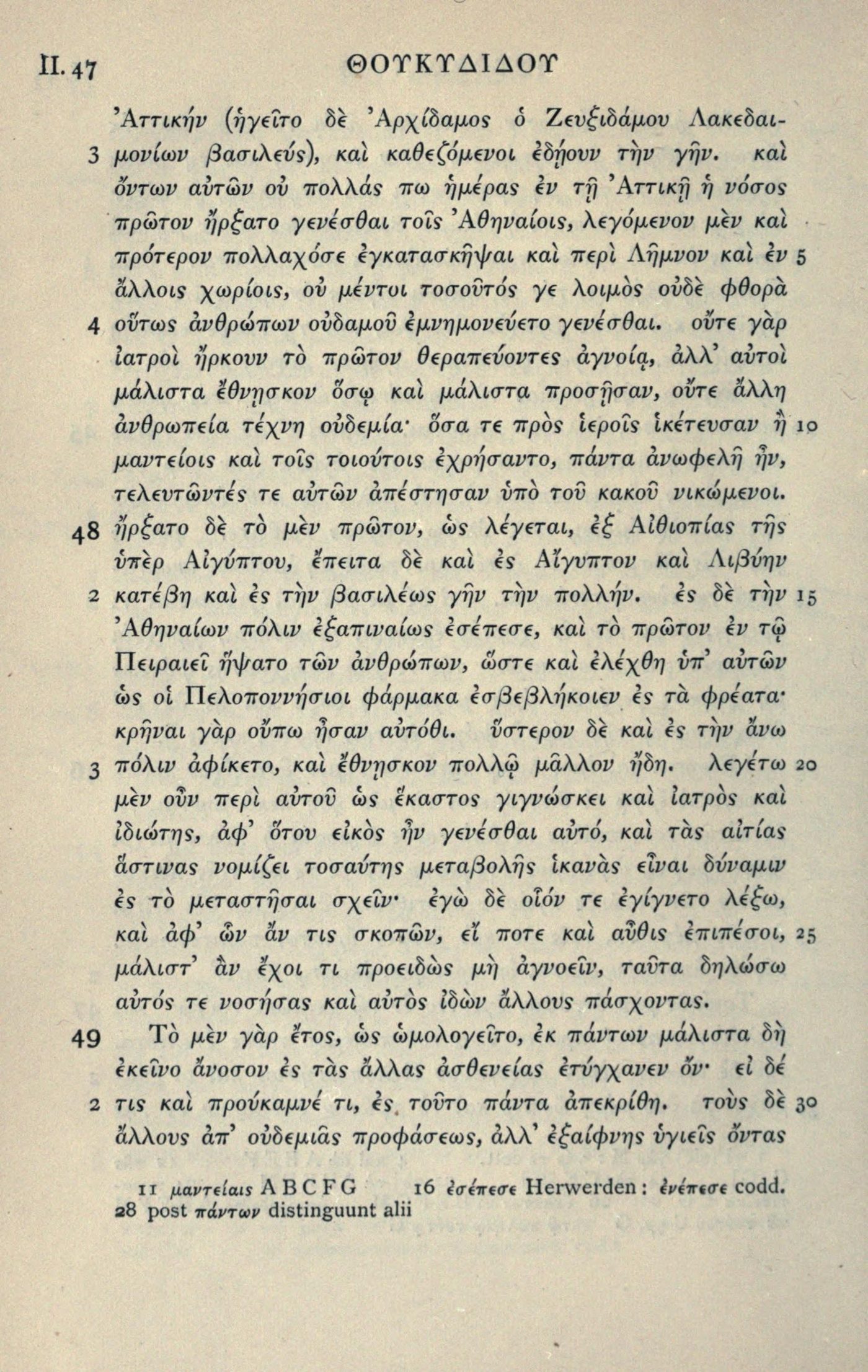
2.47–49, where the passage begins 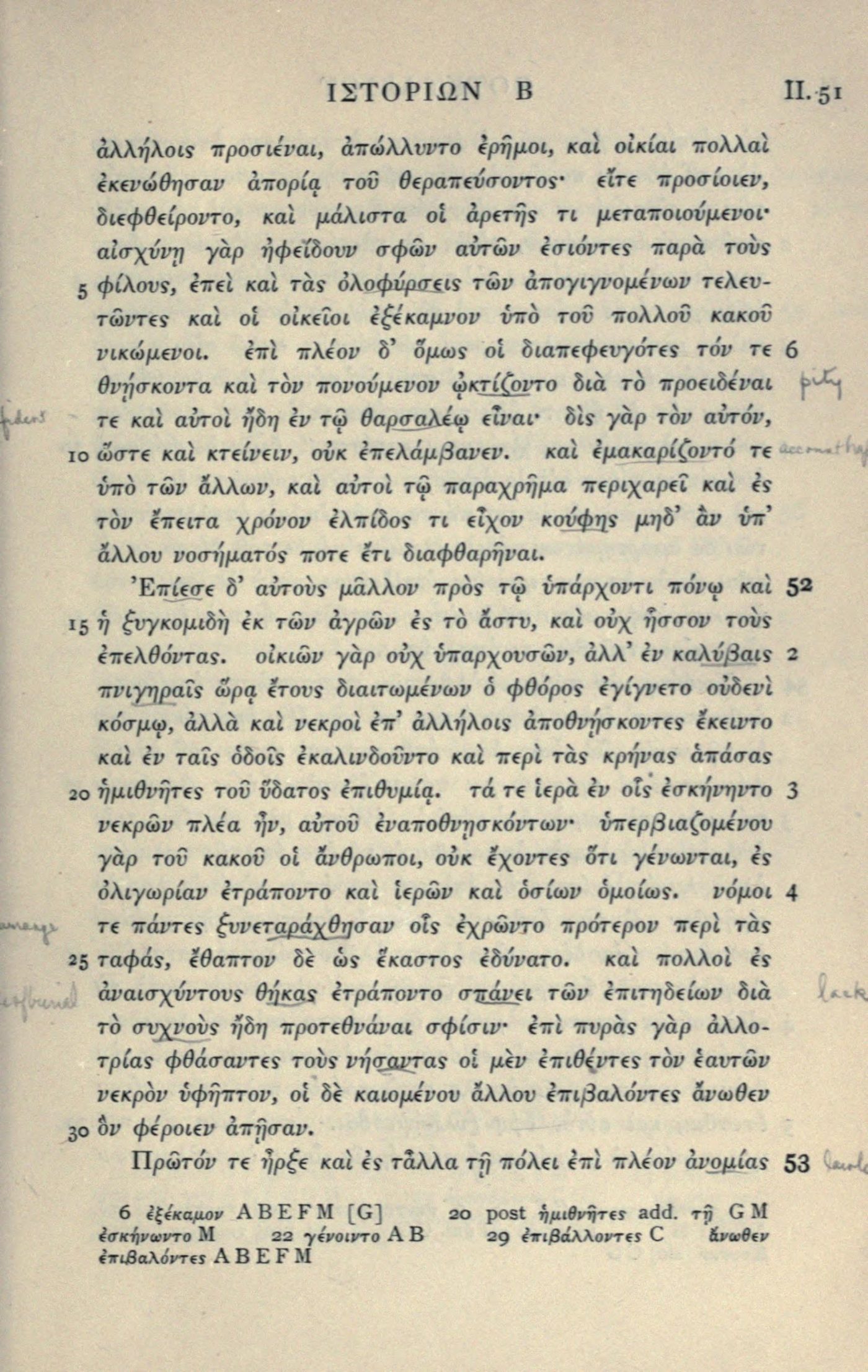
2.51–53, crowding, burials, lawlessness 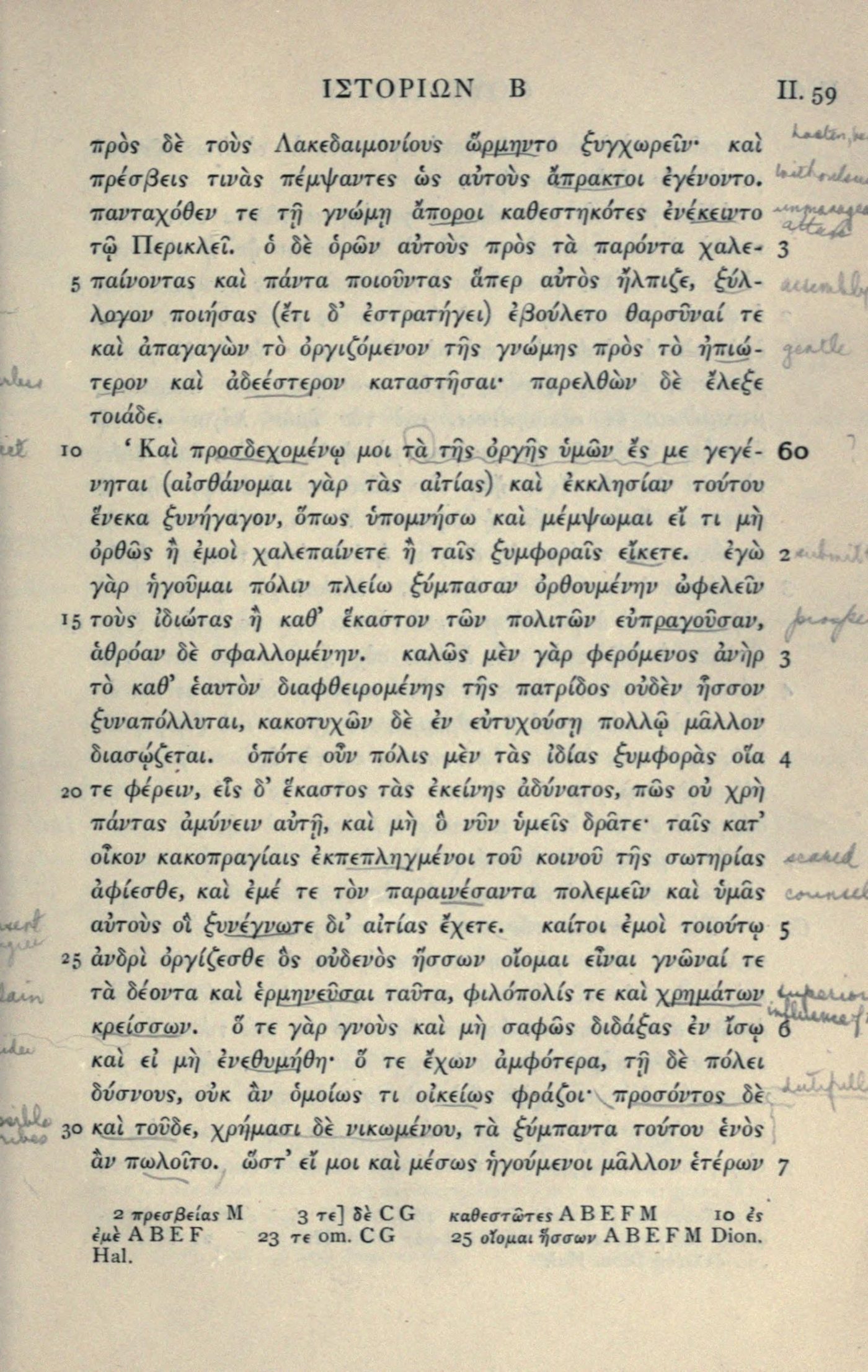
2.59–60, Pericles begins to speak 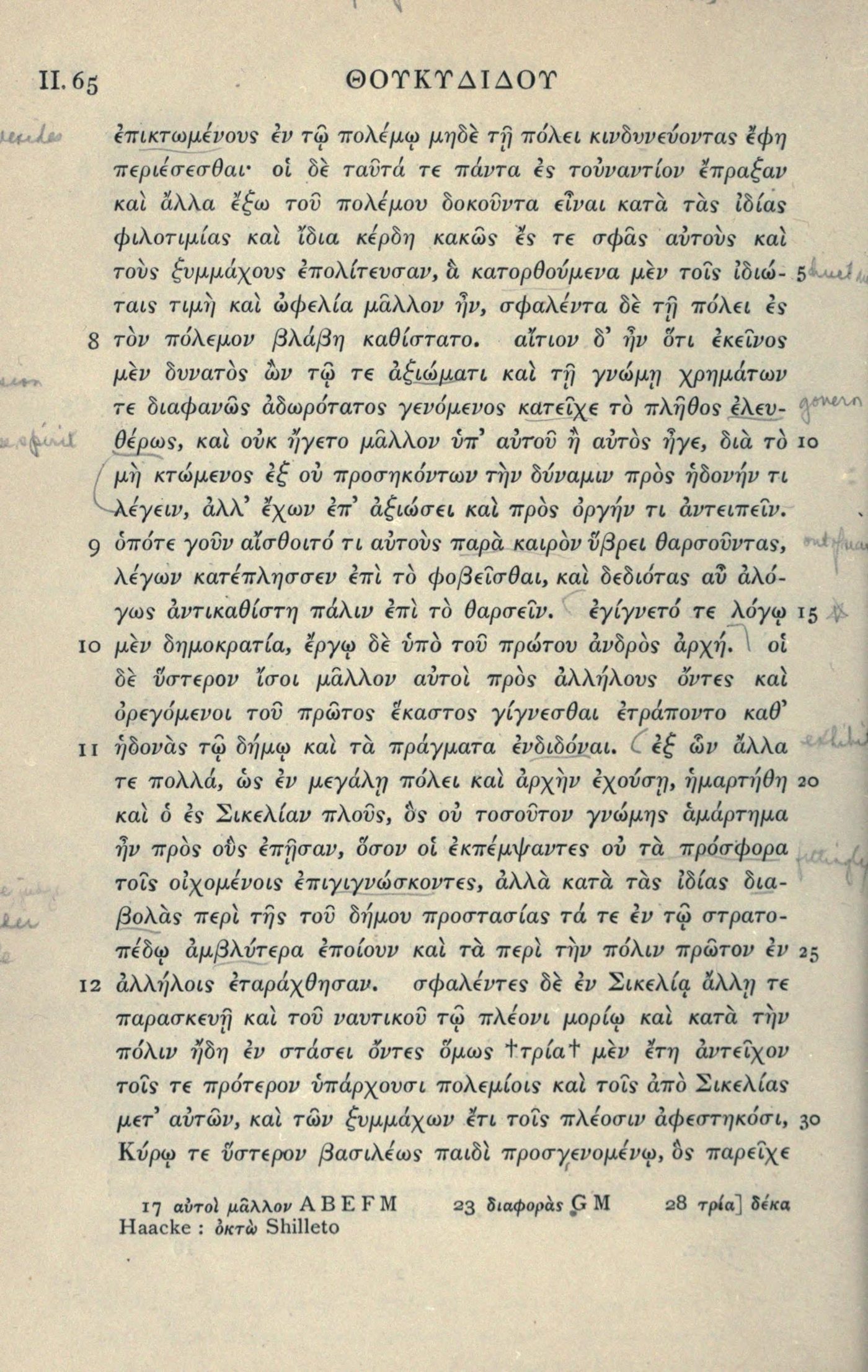
2.65, the judgement on Pericles
Other translations of this passage. Links go to copies that are free to read online.
History of the Peloponnesian War
Richard Crawley, 1874. English. Public domain.
The whole passage. The whole book is also at Project Gutenberg (ebook 7142).
The History of the Grecian War
Thomas Hobbes, 1629. English. Public domain.
The whole passage.
Thucydides Translated into English
Benjamin Jowett, 1881. English. Public domain.
The whole passage.
Thucydides, vol. 1 (Loeb Classical Library)
Charles Forster Smith, 1919. English. Public domain.
The whole passage, with the Greek on facing pages.
Difficulty: Moderate, plain language; Pericles's argument needs context.
Fits these units
- The Healer's Burden. What does an epidemic ask of those who care for the sick?
- Governments, Quarantine, and Consent. When may authorities restrict people to stop a disease?
- After the Plague. Did epidemics change societies, or did people go back to normal?
- Reading Sources Critically. How do we decide whom to believe?
Key vocabulary
- oracle
- a shrine where a god was believed to answer questions, or the answer given there
- contagion
- the spread of disease from person to person
- pyre
- a pile of wood for burning a dead body
- Assembly
- the meeting of Athenian citizens that made the city's decisions
- general
- one of ten elected officials who led the Athenian armies and much of the city's politics
- envoy
- a messenger sent to bargain with another state
- tyranny
- rule by one person who took power without a legal right
- humors
- the body fluids (later fixed as four, blood, phlegm, yellow bile, and black bile) that doctors believed had to stay in balance
Questions
- Comprehension
Trace the course of the disease in one sufferer, from the first signs to death or recovery. What happened to many who survived?
- Analysis (reliability)
Thucydides says he had the disease himself. How does that make his account stronger, and what might a survivor leave out? He also says he wrote the speeches in his own words, keeping as close as he could to the general sense of what was said. How should that change the way we read Pericles's defense?
- Analysis
Thucydides says people stopped fearing the gods and the law. What reasons does he give, and do they follow from what he has described?
- Connection
Procopius (P06) modeled his account on this one. Compare how the two writers describe what happened to burial customs, and what each says about the gods.
Activity
Hold the Athenian Assembly of 430 BCE. Half the class argues for sending envoys to make peace with Sparta; half defends Pericles's policy. Each side may use only evidence from the excerpt. Vote, then read 2.65 to compare with what the Athenians actually did.
New translation from the Greek text of Thucydides, Historiae, edited by H. Stuart Jones (Oxford Classical Texts), Book 2, sections 47–65.
About 76 percent of the original passage.
- Original
- Source text extracted by code from the named edition and collated against it. Edition: Henry Stuart Jones, ed., Thucydidis Historiae, Oxford Classical Texts (Oxford University Press); undated printing of about 1910 (Internet Archive catalog: [1910?-11?]; Perseus header: published 1910), reissued 1942 with the critical notes revised by J. E. Powell. Digital text: Perseus Digital Library, urn:cts:greekLit:tlg0003.tlg001.perseus-grc2. Text only.
- Transliterated
- Machine transliteration (grc-romanized), generated by script, not reviewed
- Close English
- Working literal draft, machine-drafted, not edited for publication
- Simplified English
- Drafted by Claude (Anthropic) from the original and checked unit by unit against the original in a separate review, then compared with earlier translations and tested for borrowed wording.
- Editor’s review
- Not yet.
- Specialist review
- Not yet. Readings a specialist should confirm are listed for later review.
- Rights
- Original: public domain. Edition: public domain.
Sources for the notes
- Thucydides. Thucydidis Historiae. Edited by Henry Stuart Jones. 2 vols. Oxford Classical Texts. Oxford: Clarendon Press, about 1910 (undated printing). Text from the Perseus Digital Library. Reissued in 1942 with the critical notes revised by J. Enoch Powell.
- Thucydides. History of the Peloponnesian War. Translated by Richard Crawley (1874). Everyman's Library. London: J. M. Dent, 1910. A later reprint consulted for comparison.
- Papagrigorakis, M. J., C. Yapijakis, P. N. Synodinos, and E. Baziotopoulou-Valavani. "DNA Examination of Ancient Dental Pulp Incriminates Typhoid Fever as a Probable Cause of the Plague of Athens." International Journal of Infectious Diseases 10, no. 3 (2006): 206–214.
- Plutarch. Lives. Vol. 3. Translated by Bernadotte Perrin. Loeb Classical Library. London: Heinemann, 1916. (Life of Pericles 38: Pericles's death, which Thucydides reports at 2.65.)
- Scott, Susan, and Christopher J. Duncan. Biology of Plagues: Evidence from Historical Populations. Cambridge: Cambridge University Press, 2001. (Survey of the diseases proposed for the plague of Athens.)
- Shapiro, Beth, Andrew Rambaut, and M. Thomas P. Gilbert. "No Proof That Typhoid Caused the Plague of Athens (a Reply to Papagrigorakis et al.)." International Journal of Infectious Diseases 10, no. 4 (2006): 334–335.