Once in a Lifetime, part 2
The Plague in the Bishop of Rochester’s Household
- Written
- soon after the events of 1348–1349
- Place
- Rochester, Kent, England
- Language
- Latin
- Kind of source
- chronicle
- Reading time
- 4 minutes
- Difficulty
- Moderate
- Intensity
- Low: deaths listed, nothing graphic
Black Death (1347–1351)ChristianityWork and wagesDeath and burial
Once in a Lifetime themes: Aftermath, Exhaustion
When the plague reached the household of the bishop of Rochester, it took four of his priests, five squires, ten servants, seven young clerks, and six pages. By the chronicle’s account, no one was left in any post to serve him.
The bishop was Hamo de Hethe, elected bishop of Rochester, in Kent, in 1317 and consecrated in 1319. He was an old man; one historian, citing a papal statement of 1353, puts him at over eighty. The chronicle that records his years in office survives in a single manuscript and covers 1314 to 1350. The scholar Henry Wharton printed selections from it in 1691 and named its author as William Dene, a notary in the bishop’s service. One historian has suggested that the text stands so close to Hamo that it may be the bishop’s own account of his life.
The writer knew the bishop’s household and the business of the diocese from the inside. He gives the date of the bishop’s order to the chaplains, June 27, 1349. Nine days earlier the king had told the bishops to make chaplains who demanded excessive pay serve for the usual wage, under the same penalties. The writer says nothing about what caused the disease, how it spread, or what the sick suffered. His concern is the church’s offices, incomes, and buildings.
He was not a neutral witness. He took the bishop’s side against the prior and monks of Rochester, and he resented the pope’s control of appointments in the English church. His record of the archbishops of Canterbury can be checked: Stratford died in August 1348, Offord in May 1349, and Bradwardine in August 1349. The chronicle does not say what killed them.
Watch how the plague shows up in this chronicle: in empty posts, wage demands, deserted parishes, and falling income. Notice, too, who in the writer’s telling still had plenty.
What we know now
Historians estimate that the Black Death killed 30 to 50 percent of Europe’s people between 1347 and 1351 (DeWitte 2014). The king’s Ordinance of Labourers of June 1349 complained that, with so many dead, servants would not work unless paid excessive wages, and it ordered that wages stay at the old rates (White and Notestein 1915). The chaplains of Rochester who demanded higher pay were part of the same pressure.
Read alongside
- The Plague Comes to Messina and Catania
An anonymous chronicler of Catania described the plague’s arrival at Messina in 1347. Compare how two chroniclers chose what to record: the sick and the dying there, offices and incomes here.
- The Plague as a Test: A Bishop's Sermon at Carthage
Cyprian, bishop of Carthage, preached to his congregation during a Roman epidemic eleven centuries earlier. Compare what each bishop’s writer thought the church should do, and what it could not do, when its people died.
The edited translation, in simplified modern English. Bracketed words were added for clarity; [...] marks a cut. Tap a note number to read the note. Point at or tap a phrase to see the original behind it. Phrase links checked in a separate review.
The bishop's household and the plague
In the twenty-third year of the reign of King Edward III,1 John de Stratford, Archbishop of Canterbury, died at Maghfeld. In his lifetime he had been the king's guide and his chief counselor. And so, after his death, this was his reward: all his goods were seized, and his property and estates were laid waste. All this time the Bishop of Rochester stayed at Hallynges and Trottisclive,2 anxious about the strange things happening in the world. In both places he held ordinations [of clergy] at the appointed seasons. That same year a plague never heard of before raged through England.
From his small household the Bishop of Rochester lost four priests, five squires, ten servants, seven young clerks, and six pages. So there was no one left in any post to serve him.
At Mallinges3 he installed two abbesses, and both soon died. Only four professed nuns and four who had not yet taken their vows were left there. The bishop put one of them in charge of spiritual matters and another in charge of property, because no one fit to be abbess could be found.
During this pestilence many chaplains and hired parish priests refused to serve unless they were paid far too much. On June 27, 1349, the Bishop of Rochester sent an order to the Archdeacon of Rochester. It commanded these priests to serve for the same pay as before, on pain of suspension and interdict.4
Many clergy who held parishes also abandoned them. The plague had cut the number of parishioners so far that the priests could not live on the offerings of those who were left. The bishop ordered them back to their parishes. Some parishes were so poor that their yearly income was truly worth less than ten marks. To their rectors and vicars he gave permission to take on one annual5 each year, or some other set of Masses paid at the same rate. They could accept these from their own parishioners or from anyone else, for as long as their income stayed so small.
Three archbishops in a year
After the archbishop's death, the pope, at the king's request, gave the archbishopric to Master John de Offord, the king's chancellor, a weak and paralyzed man. He borrowed large sums of money from everyone and spent it uselessly on gifts and payments to the pope, and lost it all. For he did not live long afterward. He died on Ascension Day and was buried secretly in Canterbury Cathedral, elected but never consecrated.6 And so he ruined many creditors and left them poor. [...]
Around the same time the monks of Canterbury Cathedral elected Master Thomas Bradewardyn of Condenna, a native of the diocese of Rochester, for the second time. They had first elected him soon after the archbishop's death. Before the election even reached the pope, the pope gave Master Thomas the archbishopric himself, as usual. He preferred to have the thanks rather than let the electors have it. After the pope's grant, the king, who had blocked him before, wrote in support of the man elected. [...]
So Master Thomas came back from the papal court, already consecrated, and hurried toward London. At La Place, the Bishop of Rochester's house,7 he lay ill for four days and died. [...]
The following year
In the twenty-fourth year of King Edward III's reign, the Bishop of Rochester, old and frail, stayed at Trottisclyve all year. He was weak and grieving over how suddenly the world had changed. On every manor of the bishopric the buildings and fences were falling down, and that year the manors barely brought in a hundred pounds. Besides this, food was so short in the monastery at Rochester that the monks were forced to thresh the grain for their own bread. The prior,8 however, had plenty of everything. [...]
The Bishop of Rochester visited the abbeys of Liesnes and Mallyng.9 He found them so ruined by years of bad management that people believed they could not be restored in this world, not before Judgment Day.10 [...]
Notes
- The chronicle dates events by the years of Edward III’s reign. Its editor, Henry Wharton, equated this year with 1348 and the next with 1349. In fact this entry runs from Stratford’s death on August 23, 1348, to the end of 1349, and the next reaches 1350. back
- Modern Halling and Trottiscliffe, manors of the bishops of Rochester in Kent. back
- Malling Abbey, a house of Benedictine nuns in the bishop’s diocese. back
- Church penalties: suspension barred a priest from his duties, and interdict from church services. Nine days earlier, the king’s Ordinance of Labourers had told bishops to use them against chaplains demanding excessive pay. back
- A mark was a sum of money, two-thirds of a pound. An annual was a paid memorial service, or set of Masses, for someone who had died. back
- Other records date Offord’s death to May 20, 1349. The monks had in fact elected Thomas Bradwardine; the pope set their choice aside and appointed Offord. back
- The Rochester bishops’ house at Lambeth, near London. Bradwardine died there on August 25 or 26, 1349, days after the king handed him the archbishopric’s lands. A modern biographer says he died of plague. back
- John de Sheppey, head of the monks who served Rochester Cathedral. In a passage left out here, the chronicle says the bishop had offered to resign in his favor. Sheppey became bishop in 1353. back
- Liesnes is Lesnes Abbey, a house of Augustinian canons founded in 1178, now a ruin in southeast London. Mallyng is Malling Abbey, where the two abbesses had died. back
- The day at the end of time when, Christians believed, Christ would return to judge the living and the dead. back
Anno xxiii. regni Regis Edwardi III. obiit Johannes de Stratford Archiepiscopus Cant. apud Maghfeld, dux Regis & ejus Consiliarius principalis in vitâ suâ; & ideo post mortem ipsius pro mercede suâ omnia ejus bona confiscantur, possessiones & praedia destruuntur.
In the 23rd year of the reign of King Edward III died John de Stratford, Archbishop of Canterbury, at Maghfeld [Mayfield], the guide [leader?] of the King and his principal Counselor in his life; and therefore after his death, for his reward, all his goods are confiscated, [his] possessions and estates are destroyed [laid waste?].
In the twenty-third year of the reign of King Edward III, John de Stratford, Archbishop of Canterbury, died at Maghfeld. In his lifetime he had been the king's guide and his chief counselor. And so, after his death, this was his reward: all his goods were seized, and his property and estates were laid waste.
Not in this translation.
- The chronicle dates events by the years of Edward III’s reign. Its editor, Henry Wharton, equated this year with 1348 and the next with 1349. In fact this entry runs from Stratford’s death on August 23, 1348, to the end of 1349, and the next reaches 1350.
Toto hoc tempore Episcopus Roffensis moram fecit apud Hallynges & Trottisclive, sollicitus de mirabilibus mundi; & Ordines celebravit in utroque loco certis interstitiis temporum.
All this time the Bishop of Rochester stayed at Hallynges [Halling] and Trottisclive [Trottiscliffe], anxious about the marvels [strange happenings?] of the world; and he celebrated Orders [held ordinations] in both places at fixed intervals of times.
All this time the Bishop of Rochester stayed at Hallynges and Trottisclive, anxious about the strange things happening in the world. In both places he held ordinations [of clergy] at the appointed seasons.
The whole of this time … the Bishop of Rochester remained at Halling and Trotterscliff, and he conferred orders in both places at certain intervals.
- Modern Halling and Trottiscliffe, manors of the bishops of Rochester in Kent.
Eodem anno pestis antea inaudita in Angliâ desaeviebat.
In the same year a plague unheard of before raged in England.
That same year a plague never heard of before raged through England.
A plague such as never before had been heard of … ravaged England in this year.
Episcopus Roffensis de modicâ familiâ suâ iv. Sacerdotes, v. Scutiferos, x. homines de ministerio, vii. Clericos juvenes, & vi. pagetos perdidit; & sic non remansit in aliquo officio qui sibi serviret.
The Bishop of Rochester lost from his small household 4 Priests, 5 Squires, 10 men of service [household servants], 7 young Clerks, and 6 pages; and thus there did not remain in any office [anyone] who might serve him.
From his small household the Bishop of Rochester lost four priests, five squires, ten servants, seven young clerks, and six pages. So there was no one left in any post to serve him.
The Bishop of Rochester out of his small household lost four priests, five gentlemen, ten serving men, seven young clerks, and six pages, so that not a soul remained who might serve him in any office.
Apud Mallinges fecit duas Abbatissas; & mox obierunt. Nec remanserunt ibidem nisi iv. Professae & quatuor non professae Moniales; de quibus Episcopus uni spiritualia alteri temporalia custodienda commisit, quia non inveniebatur sufficiens persona ad officium Abbatissae.
At Mallinges [Malling] he made two Abbesses; and soon they died. Nor did there remain there [any] except 4 professed and four not professed Nuns; of whom the Bishop committed to one the spiritual [matters], to another the temporal [matters] to be kept, because no sufficient person was found for the office of Abbess.
At Mallinges he installed two abbesses, and both soon died. Only four professed nuns and four who had not yet taken their vows were left there. The bishop put one of them in charge of spiritual matters and another in charge of property, because no one fit to be abbess could be found.
At Malling (a Benedictine nunnery) he blessed two abbesses, and both quickly died, and there were left there only four professed nuns and four novices. To one of these the Bishop committed the charge of the temporals, to another that of the spirituals, because no proper person for abbess could be found.
- Malling Abbey, a house of Benedictine nuns in the bishop’s diocese.
In hac pestilentiâ plures Capellani & stipendiarii Curati noluerunt sine excessivo salario deservire. Hos Episcopus Roffensis dato ad Archidiaconum Roff. mandato anno MCCCXLIX. die xxvii. Junii, sub poenâ suspensionis & interdicti jussit eisdem stipendiis deservire.
In this pestilence many Chaplains and stipendiary Curates refused to serve without excessive salary. These the Bishop of Rochester, by a mandate given to the Archdeacon of Rochester in the year 1349, the 27th day of June, under penalty of suspension and interdict ordered to serve for the same stipends.
During this pestilence many chaplains and hired parish priests refused to serve unless they were paid far too much. On June 27, 1349, the Bishop of Rochester sent an order to the Archdeacon of Rochester. It commanded these priests to serve for the same pay as before, on pain of suspension and interdict.
In this pestilence many chaplains and paid clerics refused to serve, except at excessive salaries. The Bishop of Rochester, by a mandate addressed to the archdeacon of Rochester, on the 27th of June, 1349, orders all these, on pain of suspension, to serve such cures;
- Church penalties: suspension barred a priest from his duties, and interdict from church services. Nine days earlier, the king’s Ordinance of Labourers had told bishops to use them against chaplains demanding excessive pay.
Plures etiam Clerici beneficiati, numero Parochianorum per pestem adeò diminuto, ut de reliquis oblationibus vivere non possent, beneficia sua deserverunt. Hos Episcopus mandavit Parochias suas repetere; & Rectoribus seu Vicariis Beneficiorum exilium, quorum proventus annui ad verum valorem x. marcarum se non extendunt, licentiam dedit annuatim unum Annuale vel alium Missarum numerum, pro quibus aequalia debeantur stipendia, à suis Parochianis vel alienis undequaque recipere, hujusmodi exilitate proventuum durante.
Many beneficed Clerics also, the number of Parishioners having been so diminished through the plague that they could not live from the remaining offerings, deserted their benefices. These the Bishop ordered to return to their Parishes; and to the Rectors or Vicars of slender Benefices, whose annual revenues do not reach the true value of 10 marks, he gave license to receive yearly one Annual or another number of Masses, for which equal stipends would be owed, from their own Parishioners or from strangers from anywhere, while such slenderness of revenues lasted.
Many clergy who held parishes also abandoned them. The plague had cut the number of parishioners so far that the priests could not live on the offerings of those who were left. The bishop ordered them back to their parishes. Some parishes were so poor that their yearly income was truly worth less than ten marks. To their rectors and vicars he gave permission to take on one annual each year, or some other set of Masses paid at the same rate. They could accept these from their own parishioners or from anyone else, for as long as their income stayed so small.
Not in this translation.
- A mark was a sum of money, two-thirds of a pound. An annual was a paid memorial service, or set of Masses, for someone who had died.
Post mortem Archiepiscopi Papa ad preces Domini Regis M. Johanni de Offord ejus Cancellario Archiepiscopatum dedit, viro debili & paralitico; qui pecuniam magnam undique mutuans ad magnam summam, inutiliter Papam eam exeniavit & presentavit, & totam perdidit; quia non multùm pòst vixit, sed die Ascensionis Domini obiit, & in Ecclesiâ Cant. est occultè sepultus, electus non consecratus; & sic multos creditores depauperando destruxit.
After the death of the Archbishop the Pope, at the prayers of the Lord King, gave the Archbishopric to Master John de Offord, his Chancellor, a weak and paralytic man; who, borrowing great money from all sides to a great sum, uselessly gave it to the Pope as gifts and presented [it], and lost it all; because he did not live long after, but died on the day of the Lord's Ascension, and was secretly buried in the Church of Canterbury, elected not consecrated; and thus by impoverishing many creditors he ruined [them].
After the archbishop's death, the pope, at the king's request, gave the archbishopric to Master John de Offord, the king's chancellor, a weak and paralyzed man. He borrowed large sums of money from everyone and spent it uselessly on gifts and payments to the pope, and lost it all. For he did not live long afterward. He died on Ascension Day and was buried secretly in Canterbury Cathedral, elected but never consecrated. And so he ruined many creditors and left them poor.
Not in this translation.
- Other records date Offord’s death to May 20, 1349. The monks had in fact elected Thomas Bradwardine; the pope set their choice aside and appointed Offord.
Left out of this excerpt.
Per idem tempus Capitulum Cant. M. Thomam Bradewardyn de Condennâ Roffensis Dioceseos oriundum, quem mox post mortem Archiepiscopi elegerant, secundò nunc elegerunt; & priusquam electio ad Papam pervenit, Papa M. Thomae more solito dedit Archiepiscopatum Cant. malens grates habere ipsemet quàm eligentes. Sed post collationem suam Dominus Rex pro Electo scripsit, qui aliàs eum impedivit.
About the same time the Chapter of Canterbury elected now a second time Master Thomas Bradewardyn of Condenna, born in the Diocese of Rochester, whom they had elected soon after the death of the Archbishop; and before the election reached the Pope, the Pope in the usual way gave Master Thomas the Archbishopric of Canterbury, preferring to have the thanks himself rather than the electors. But after his conferral the Lord King wrote for the Elect, [he] who before had hindered him.
Around the same time the monks of Canterbury Cathedral elected Master Thomas Bradewardyn of Condenna, a native of the diocese of Rochester, for the second time. They had first elected him soon after the archbishop's death. Before the election even reached the pope, the pope gave Master Thomas the archbishopric himself, as usual. He preferred to have the thanks rather than let the electors have it. After the pope's grant, the king, who had blocked him before, wrote in support of the man elected.
Not in this translation.
Left out of this excerpt.
Igitur M. Thoma de Curiâ Romanâ revertente consecrato, versùs Londoniam festinavit, & in Hospitio Episcopi Roffensis apud La Place per quatuor dies infirmus pausans obiit.
Therefore, Master Thomas returning consecrated from the Roman Curia, he hurried toward London, and in the Lodging of the Bishop of Rochester at La Place, resting sick for four days, he died.
So Master Thomas came back from the papal court, already consecrated, and hurried toward London. At La Place, the Bishop of Rochester's house, he lay ill for four days and died.
Not in this translation.
- The Rochester bishops’ house at Lambeth, near London. Bradwardine died there on August 25 or 26, 1349, days after the king handed him the archbishopric’s lands. A modern biographer says he died of plague.
Left out of this excerpt.
Anno xxiv. regni Regis Edwardi III. per totum illum annum Episcopus Roffensis senex & decrepitus apud Trottisclyve morabatur, languens & dolens de subitâ mutatione saeculi; quia in omnibus Maneriis Episcopatûs aedificia & clausurae corruebant, & vix Maneria illo anno de centum libris respondebant.
In the 24th year of the reign of King Edward III, through all that year the Bishop of Rochester, old and decrepit, stayed at Trottisclyve, languishing and grieving over the sudden change of the world [age]; because in all the Manors of the Bishopric the buildings and enclosures were collapsing, and the Manors that year scarcely answered for [yielded?] a hundred pounds.
In the twenty-fourth year of King Edward III's reign, the Bishop of Rochester, old and frail, stayed at Trottisclyve all year. He was weak and grieving over how suddenly the world had changed. On every manor of the bishopric the buildings and fences were falling down, and that year the manors barely brought in a hundred pounds.
Throughout the whole of that winter and spring the Bishop of Rochester, an old and decrepid man, remained at Trotterscliff, saddened and grieving over the sudden change of the age. And in every manor of the Bishopric buildings and walls fell to ruins, and that year there was hardly a manor which returned a hundred pounds.
Praeterea in Monasterio Roffensi tanta fuit victualium inopia, quòd Monachi ad triturandum panem suum sunt coacti. Prior tamen omnibus bonis abundabat.
Moreover in the Monastery of Rochester there was so great a scarcity of provisions that the Monks were forced to thresh their bread [the grain for their bread]. The Prior, however, abounded in all good things.
Besides this, food was so short in the monastery at Rochester that the monks were forced to thresh the grain for their own bread. The prior, however, had plenty of everything.
In the monastery of Rochester, also, there was such a scarcity of provisions that the community were troubled with great want of food; so much so that the monks were obliged to grind their own bread.
- John de Sheppey, head of the monks who served Rochester Cathedral. In a passage left out here, the chronicle says the bishop had offered to resign in his favor. Sheppey became bishop in 1353.
Left out of this excerpt.
Episcopus Roffensis Abbatias & Monasteria de Liesnes & Mallyng visitans, invenit ea ita destructa per malam diutinam custodiam; quòd durante isto saeculo usque ad diem judicii creditur ea non posse reparari.
The Bishop of Rochester, visiting the Abbeys and Monasteries of Liesnes and Mallyng, found them so destroyed through bad long-lasting custody [management]; that during this age until the day of judgment it is believed they cannot be repaired.
The Bishop of Rochester visited the abbeys of Liesnes and Mallyng. He found them so ruined by years of bad management that people believed they could not be restored in this world, not before Judgment Day.
Not in this translation.
- Liesnes is Lesnes Abbey, a house of Augustinian canons founded in 1178, now a ruin in southeast London. Mallyng is Malling Abbey, where the two abbesses had died.
- The day at the end of time when, Christians believed, Christ would return to judge the living and the dead.
Left out of this excerpt.
Questions a reader might ask, with short answers and the sections they rest on. Not yet checked.
What happens
Whose household is this chronicle about?
Hamo de Hethe, the old bishop of Rochester in Kent, who spent these years at his manors of Halling and Trottiscliffe. The writer, probably William Dene, served in his household.
How did the plague strike the bishop's household?
He lost four priests, five squires, ten servants, seven young clerks and six pages, so that no one was left in any post to serve him.
What happened at Malling Abbey?
The bishop installed two abbesses, and both soon died. With only eight nuns left and no one fit to be abbess, he put one in charge of spiritual matters and another in charge of property.
Read section 5
Why did the bishop order chaplains to serve for the old pay?
With so many dead, many chaplains and hired priests refused to serve unless paid far more. On June 27, 1349, he ordered them to take the same pay as before, on pain of suspension and interdict.
Read section 6
Why did priests leave their parishes, and how did the bishop respond?
So many parishioners had died that priests could not live on the offerings of those left. The bishop ordered them back and let priests of very poor parishes earn extra by saying paid Masses for the dead.
Read section 7
Thinking further
What does the writer record, and what does he leave out?
He records empty posts, wage demands, deserted parishes, falling income and ruined buildings. He says nothing about what caused the disease, how it spread, or what the sick suffered.
How does the chaplains' pay dispute fit the wider history of England?
Nine days before the bishop's order, the king's Ordinance of Labourers told bishops to make chaplains serve for the usual wage. With so many dead, workers of all kinds could demand more, and the king tried to hold wages at the old rates.
Read section 6
Can we trust the line about the prior having plenty?
Perhaps not fully. The writer took the bishop's side against the prior and monks of Rochester, so a historian would want other records before accepting it.
Read section 15
Who and what this source names, in the original. Each name links to every source in the library that mentions it. Not yet checked.
Ideas
- burial and the dead How the dead were buried, or could not be, during an epidemic. Sections 8.
- epidemic, plague, pestilence The words the writers themselves used for an epidemic: Greek loimos and nosos, Latin pestis, pestilentia and mortalitas, Chinese 疫 yi, Japanese 疫瘡 "epidemic sores". Sections 3, 6, 7.
- rich and poor Whether the epidemic struck rich and poor alike. Sections 15.
People
- Edward III King of England from 1327 to 1377. Sections 1, 8, 14.
- Hamo de Hethe Bishop of Rochester from 1319 to 1352. Sections 2, 4, 6.
- John de Offord Chancellor of England, chosen Archbishop of Canterbury in 1348; he died in 1349 before he could be consecrated. Sections 8.
- John de Stratford Archbishop of Canterbury from 1333 and a chief adviser to Edward III. Sections 1.
- Pope Clement VI Pope from 1342 to 1352, living at Avignon. Sections 8, 10.
- Thomas Bradwardine Scholar and theologian who became Archbishop of Canterbury in 1349 and died weeks later, probably of the plague. Sections 10, 12.
Places
- Canterbury Seat of the archbishop who heads the English church. Sections 1, 8, 10.
- England The kingdom ruled by Edward III at the time of the Black Death. Sections 3.
- Halling Village on the Medway with a manor of the bishops of Rochester. Sections 2.
- Lesnes Abbey Augustinian abbey in Kent, now in southeast London. Sections 17.
- London England's largest city and the seat of the royal government. Sections 12.
- Malling Town in Kent with a Benedictine abbey of nuns. Sections 5, 17.
- Mayfield Village with a palace of the archbishops of Canterbury. Sections 1.
- Rochester Cathedral city on the River Medway, seat of a bishop. Sections 6, 10, 15.
- Trottiscliffe Village in Kent with a manor of the bishops of Rochester. Sections 2, 14.
Dates
- 1349 The year the Black Death swept across England. Sections 6.
- 23rd year of Edward III Edward III's regnal year from January 25, 1349, to January 24, 1350. Sections 1.
- 24th year of Edward III Edward III's regnal year from January 25, 1350, to January 24, 1351. Sections 14.
Page images of the original object or of the printed edition, from the libraries and archives that hold them. The pages shown are copied here where the holder marks them public domain; titles link to the holder's own viewer. Click a page to see it full size.
Wharton, Anglia Sacra, pars prima, London 1691
Internet Archive. pp. 375–377 (leaves 440–442). Public Domain Mark 1.0.
The printed edition our text follows.
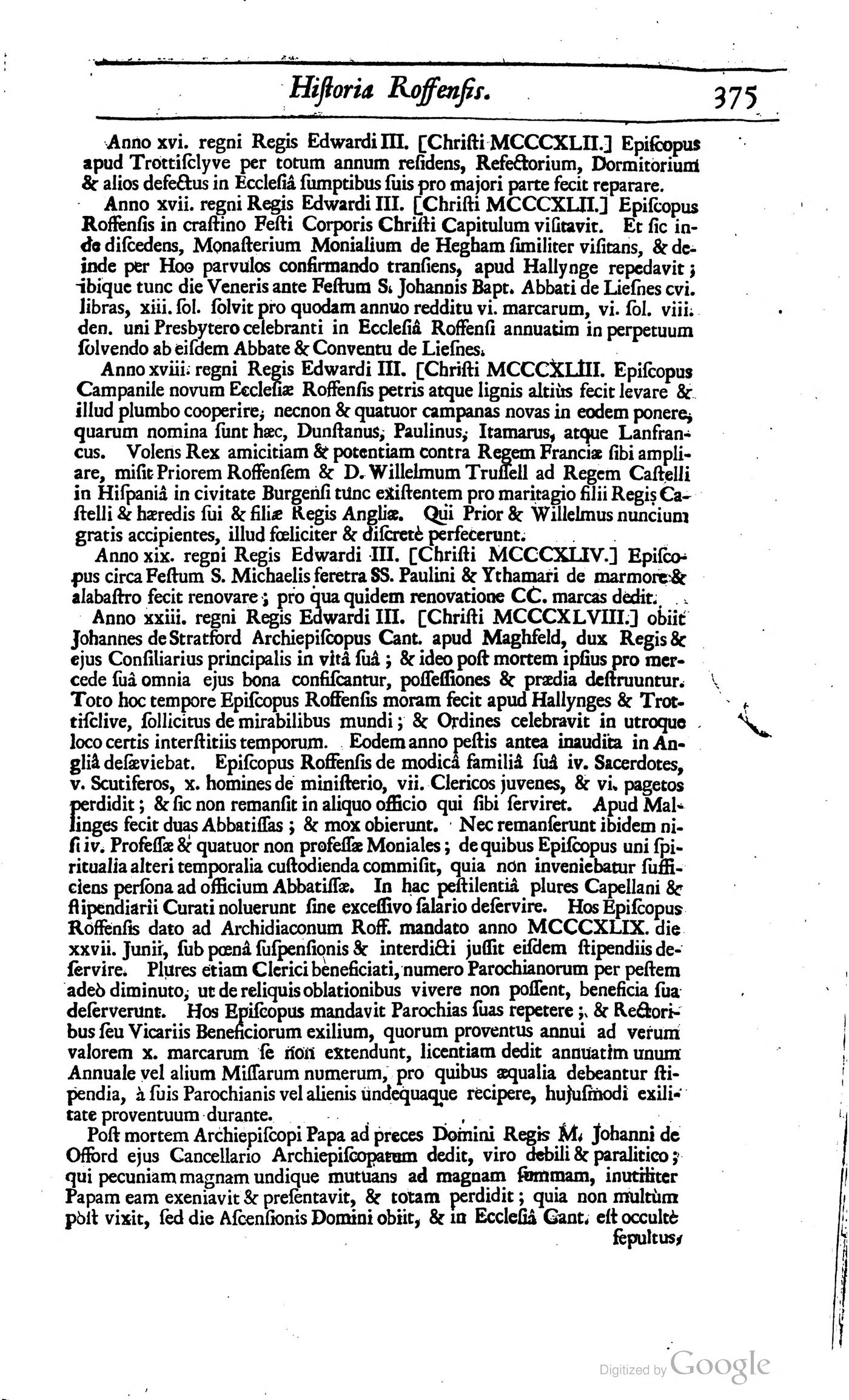
p. 375, where the passage begins 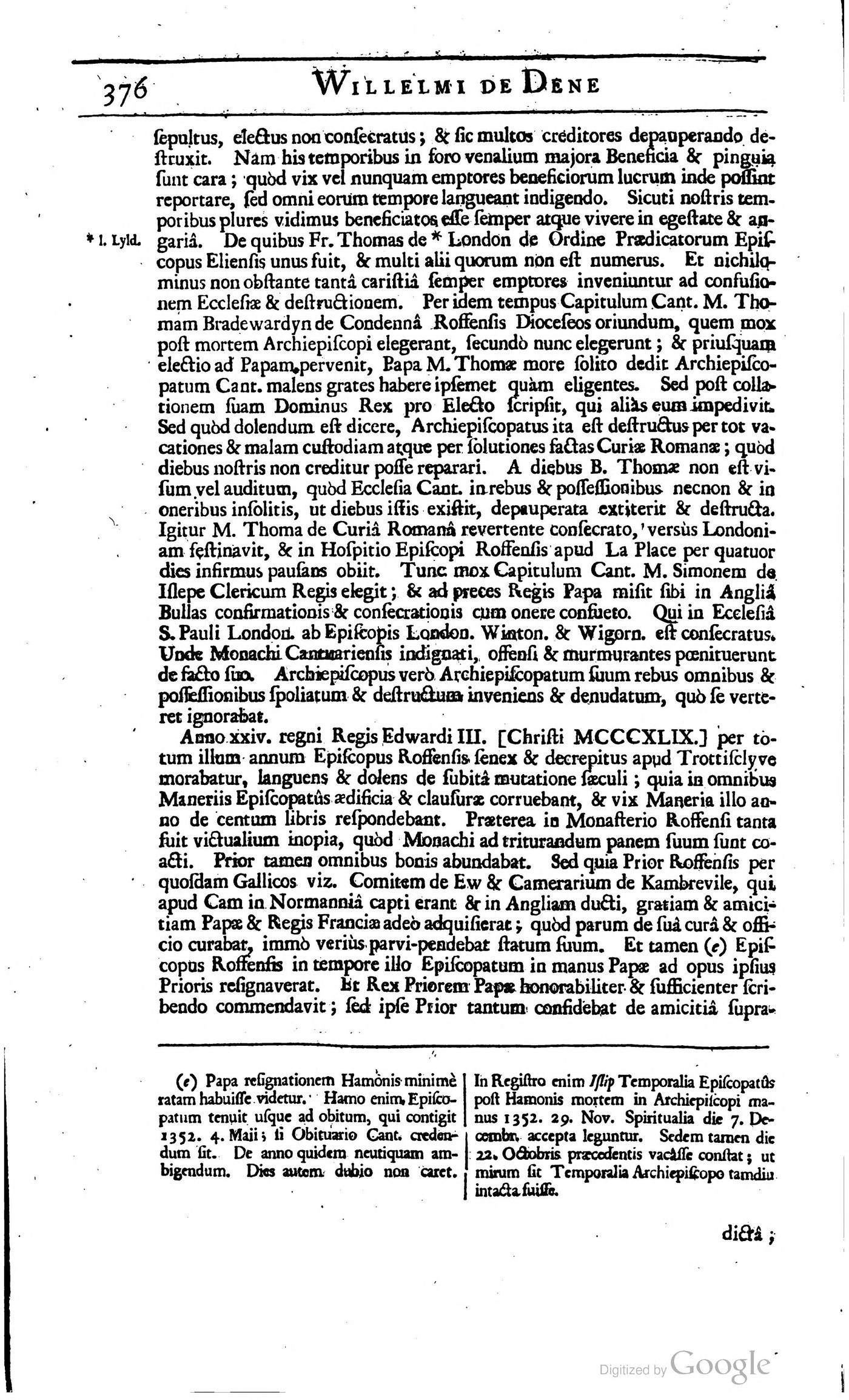
p. 376 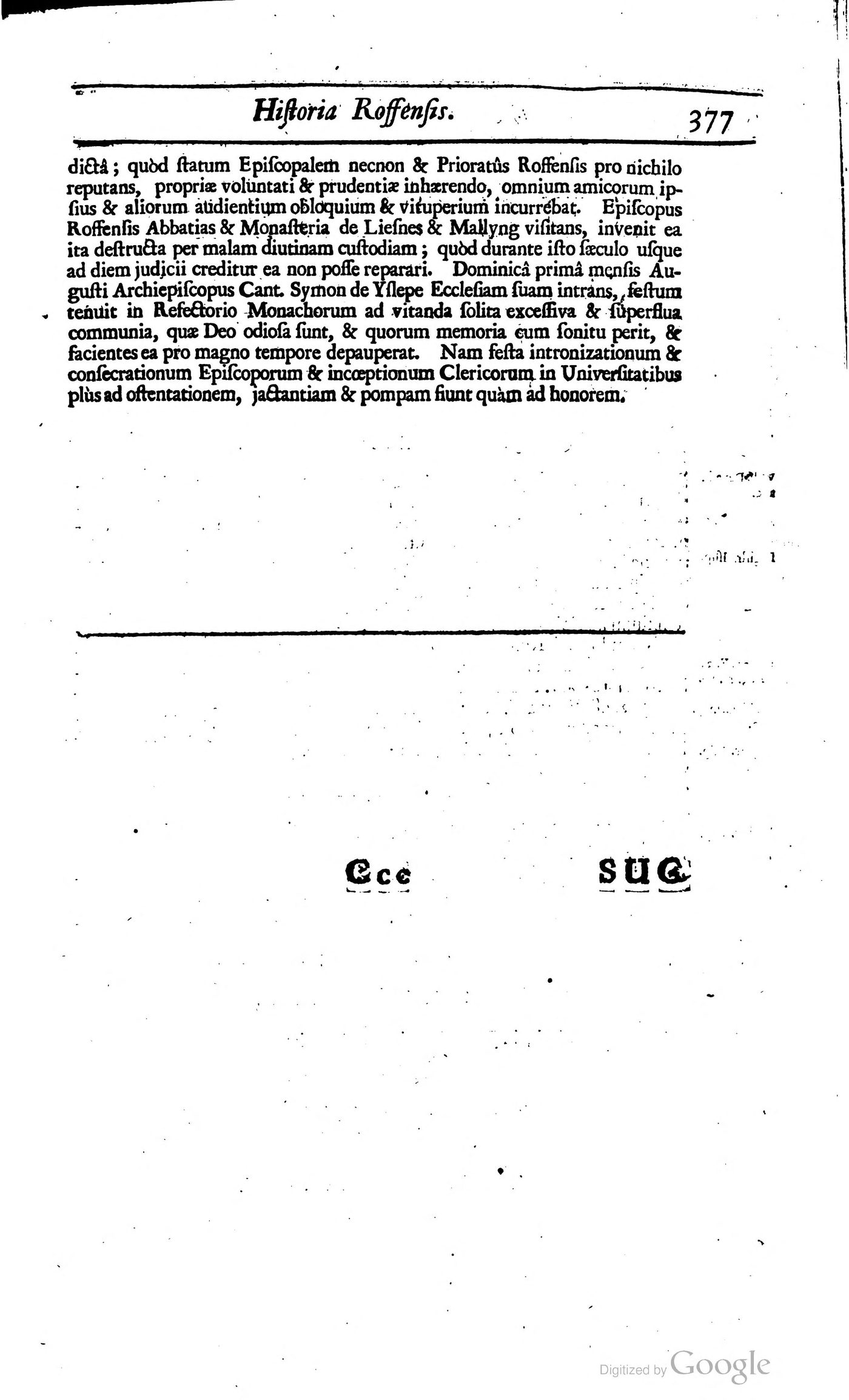
p. 377, where the extract ends
Other translations of this passage. Links go to copies that are free to read online.
The Black Death (Manchester Medieval Sources)
Rosemary Horrox, 1994. English. In copyright; not free online.
The Rochester entries.
The Black Death
G. G. Coulton, 1929. English. Public domain; not free online.
A few sentences (p. 69).
The Great Pestilence (A.D. 1348–9)
Francis Aidan Gasquet, 1893. English. Public domain.
Paraphrase and partial quotation, in chapter 6.
Difficulty: Moderate, short entries in plain language, but full of church offices; the notes explain the few that matter.
Fits these units
- After the Plague. Did epidemics change societies, or did people go back to normal?
- Faith and Catastrophe. How did religious believers respond, and did responses differ?
- Reading Sources Critically. How do we decide whom to believe?
Key vocabulary
- bishop
- the leader of the Christian church in a city and its region
- chronicle
- a record of events set down year by year
- chaplain
- a priest without a parish of his own, paid to say Mass or to serve for another priest
- parish
- the district served by one church and its priest
- abbess
- the woman in charge of a community of nuns
- manor
- a lord’s estate, with its fields, buildings, and tenants
Questions
- Comprehension
List the ways the plague touched the bishop’s household, the clergy of his diocese, and his estates.
- Analysis
The chronicle never describes a sick person. What does the writer record instead, and what does that suggest about who he was and what he cared about?
- Analysis (reliability)
The writer took the bishop’s side against the prior. How might that shape the line about the prior having plenty while the monks threshed their own grain? How could a historian check it?
- Connection
Read Cyprian (P05), a bishop preaching during an epidemic in the third century. What does each source suggest a church leader was expected to do in an epidemic, and what problems could he not solve?
Activity
Half the class drafts the bishop’s order of June 27, 1349, to the chaplains, in plain words, explaining why they must serve for the old pay. The other half drafts the chaplains’ reply. The class then discusses whose case was stronger, and why the king and the bishop sided as they did.
New translation from the Latin text of Henry Wharton’s Anglia Sacra (London, 1691), volume 1, pages 375–377. Wharton printed only selections from the chronicle. This excerpt gives about 55 percent of what he printed for these two years: the passages on the plague and its effects on the bishop’s household, the clergy, the archbishops of Canterbury, and the bishop’s estates. Passages on church politics are cut.
Wharton’s dates in brackets and his notes are left out. Names of people and places keep the chronicle’s spellings; the notes give modern forms where they are known.
- Original
- Text as printed in the named edition or on the object, read from page images. Edition: Henry Wharton, ed., Anglia Sacra, sive Collectio historiarum … de archiepiscopis & episcopis Angliae, pars prima (London: Richard Chiswell, 1691), “Willelmi de Dene Historia Roffensis,” pp. 375–377. Digital text: Text Creation Partnership, EEBO-TCP Phase I, A65588 (Wing W1560; CC0), keyed from microfilm images, extracted by code from the TCP XML (github.com/textcreationpartnership/A65588). Every unit read against page images of a Google-digitized copy, Internet Archive item AngliaSacra (Public Domain Mark), leaves 440–442; the TCP text’s one-letter gaps in units 5 and 11 resolved from the images. The TCP text prints æ and œ as ae and oe and long s as s; the printed accents are kept. Wharton’s bracketed year conversions, marginal note and footnote are not copied. Authors’ text only.
- Transliterated
- Not needed: the original is in the Latin alphabet
- Close English
- Close translation drafted by Claude (Anthropic), kept as a working draft
- Simplified English
- Drafted by Claude (Anthropic) from the original and checked unit by unit against the original in a separate review, then compared with earlier translations and tested for borrowed wording.
- Editor’s review
- Not yet.
- Specialist review
- Not yet. Readings a specialist should confirm are listed for later review.
- Rights
- Original: public domain. Edition: public domain.
Sources for the notes
- Wharton, Henry, ed. Anglia Sacra, sive Collectio historiarum … de archiepiscopis & episcopis Angliae. Pars prima. London: Richard Chiswell, 1691. Preface, item 37 (on the Rochester chronicle and its author); “Willelmi de Dene Historia Roffensis,” pp. 356–377, this passage pp. 375–377; “Successio Episcoporum Roffensium,” p. 378. Digital text: EEBO-TCP A65588. Page images: Internet Archive, AngliaSacra.
- Coulton, G. G. The Black Death. London: Ernest Benn, 1929 (1930 printing). Pages 69–70.
- DeWitte, Sharon N. “Mortality Risk and Survival in the Aftermath of the Medieval Black Death.” PLOS ONE 9, no. 5 (2014): e96513. Abstract.
- Jones, B., comp. Fasti Ecclesiae Anglicanae 1300–1541. Vol. 4, Monastic Cathedrals (Southern Province). London: Institute of Historical Research, 1963. “Archbishops of Canterbury,” pp. 3–5; “Bishops of Rochester,” pp. 37–40. British History Online.
- Page, William, ed. “Houses of Benedictine Nuns: The Abbey of Malling.” In A History of the County of Kent, vol. 2, 146–148. London: Victoria County History, 1926. British History Online.
- Historic England. “Lesnes Abbey.” National Heritage List for England, list entry 1002025.
- White, Albert Beebe, and Wallace Notestein, eds. Source Problems in English History. New York: Harper and Brothers, 1915. The Ordinance of Labourers (1349), as given in the Internet Medieval Sourcebook, Fordham University.
- Wigan, Bernard. “Whatever Happened to Hamo?” Friends of Rochester Cathedral Annual Report for 1983. Online at rochestercathedral.org.
- Carlin, Martha. “Glossary of Technical Terms Used in the Four 13th-Century English Treatises on Household and Estate Administration.” University of Wisconsin–Milwaukee. Entry “mark.”
- Middle English Dictionary. University of Michigan. Entry “annuel.”
- Murdoch, John E. “Thomas Bradwardine.” In Complete Dictionary of Scientific Biography. New York: Charles Scribner’s Sons, 2008. (Birthplace uncertain; died of plague at the bishop of Rochester’s residence in Lambeth, August 26, 1349.)