Once in a Lifetime, part 2
How to Care for the Sick in the Epidemic of 737
- Written
- 737 (sixth month, twenty-sixth day)
- Place
- Heijō-kyō (Nara), Japan
- Language
- Classical Chinese (kanbun)
- Kind of source
- government order
- Reading time
- 4 minutes
- Difficulty
- Moderate
- Intensity
- Low: symptoms described plainly (fever, sores, bloody diarrhea); nothing graphic
Japanese smallpox epidemic (735–737)SmallpoxDoctors and medical ideasRelief and public measures
Once in a Lifetime themes: Unknowns, Exhaustion
Do not let the sick drink cold water, the order says, however much they want it. Wrap their bellies, keep them off the bare ground, feed them rice gruel, and forbid fresh fish, raw vegetables, and fruit. Even twenty days after recovery, no bathing, no sex, no walking in the rain.
In the summer of 737, as the epidemic that had begun in Kyushu two years earlier swept the capital, the Council of State, the highest office of the Japanese government, sent these instructions to the provinces. It is dated the twenty-sixth day of the sixth month. Two officials of the Council signed it. The text survives because a later compiler copied it into the Ruijū fusenshō, a collection of government orders arranged by subject, made in the late Heian period, after 1093. It is one of the two earliest documents in that collection.
The order describes the disease carefully: days of fever before the sores appear, burning heat, then diarrhea as the sores heal, which it treats as the most dangerous stage. Its words and ideas come from Chinese medicine: heat and cold, food that suits a weak body, and the danger of strain after recovery. No one at the time knew what caused the disease or how it spread. The order says nothing about keeping the sick apart from the healthy.
This is a document written by officials for officials. It tells us what the government believed and what it wanted done, not what was actually done in the villages. Its rules name things that cost money: raised beds, reed mats, silk floss, glutinous rice, ginseng. At the end it tells governors to give out government stores where families had nothing to make gruel with.
As you read, notice which instructions forbid something and which offer help. Notice too how the order travels: copied in each province, carried on by a district official, and read out to the common people.
What we know now
Smallpox, the disease most historians identify here, was caused by the variola virus. It spread from person to person, mostly through droplets from coughing and sneezing during close contact, and through bedding or clothing soiled by the sores; about three in ten people who caught it died (CDC 2024). After a worldwide vaccination campaign, the last natural case occurred in 1977, and in 1980 the World Health Assembly declared smallpox eradicated (CDC 2024).
Read alongside
- The Great Epidemic of 735–737
The court's own chronicle records the same epidemic from 735 to 737, with its offerings to the kami, sutra readings, amnesties, and the deaths of the four Fujiwara brothers who led the court. Compare those responses with the practical care this order asks for.
- The Pump in Broad Street, 1854
In 1831, as cholera approached Britain, the Board of Health in London published rules for towns and villages. Compare what each government told local officials to do, and how each expected its advice to reach ordinary people.
The edited translation, in simplified modern English. Bracketed words were added for clarity; [...] marks a cut. Tap a note number to read the note. Point at or tap a phrase to see the original behind it. Phrase links checked in a separate review.
Order of the Council of State1 to the governors of the provinces of the Tōkaidō, Tōsandō, Hokurikudō, San’indō, San’yōdō, and Nankaidō circuits.2 Seven articles in all, on caring for the body and on foods to avoid while lying sick with the epidemic.
This epidemic disease is called red spot sores.3 When it first appears, it looks like an intermittent fever.4 Before the sores come out, the sick lie suffering in bed for three or four days, or five or six. The sores then take another three or four days to come out. The limbs and inner organs5 burn with fever as if on fire. At this point the sick want to drink cold water, but they must hold back firmly and not drink. As the sores go down and begin to heal, the fever slowly eases, and then diarrhea breaks out. If it is not treated early, it turns into bloody diarrhea. (The diarrhea may come earlier or later; there is no fixed time.) Four other illnesses also come with it: coughing (in Japanese, shiwabuki), retching (tamahi), vomiting blood, and nosebleeds. Of all these, the diarrhea is the most urgent. Understand this, and work hard to save and treat the sick.
Use a strip of cloth and silk floss6 to bind the belly and lower back firmly. Always keep them warm, and never let them get cold.
Bedding is thin, so the sick must not lie on the ground. Let them lie and rest only on a raised bed, with a reed mat spread over it.
Thin and thick rice gruel, and broth from boiled rice, millet, and the like, may be given warm or cool, as the sick prefer. But they must not eat fresh fish or meat, or any raw vegetables or fruit. Nor may they drink water or eat ice; guard firmly against this. When the diarrhea comes, cook garlic chives and green onions well, and let them eat plenty. If it turns into red and white diarrhea,7 mix glutinous rice flour [with water] and bring it to the boil eight or nine times. Let them drink it warm two or three times. Or let them eat dried glutinous or ordinary rice in hot water or gruel. If the diarrhea does not stop, give this five or six times, without slacking. (Pound the glutinous rice to pieces; do not leave the grains whole.)
People with this disease always lose their appetite, but they must make themselves eat. From the moment the illness begins, have them roast miru seaweed8 over a fire and hold it in the mouth often, with pounded salt. This works well even when the mouth and tongue are raw with sores.
After the illness has healed, even when twenty days have passed, the sick must not be quick to eat fresh fish or meat, or raw vegetables or fruit. They must not drink water or bathe, insist on sex, or walk out in wind and rain. Anyone who breaks these rules will surely fall ill with sudden vomiting and diarrhea,9 and the diarrhea will come back as well. This is what is called rōhatsu, a relapse brought on by strain. (An illness that stirs up again is called rōhatsu.) Then not even Yu Fu or Bian Que10 could stop it.
After twenty days, those who want to eat fish or meat must first boil or roast it well; only then may they eat it. Dried abalone, dried bonito, and the like are all good, cooked or not. (Dried meat is fine too.) But mackerel, aji, and similar fish must not be eaten, even dried. (Sweetfish may not be eaten even cooked.) So,11 honey, and [one word missing] are not forbidden.
In treating the epidemic, do not use pills, powders, or other such medicines. If the sick have a fever in the chest, give them only ginseng broth.12
Since the fourth month, everyone in the capital and the home provinces has fallen sick with the epidemic, and many have died. Clearly the common people of the provinces are suffering from it too. That is why the articles above have been written out. Each province is to pass this order on. When it arrives, have it copied. Then at once send one official of the district, a clerk or higher, as messenger to carry it quickly to the next province, without delay. The governors are to travel through their provinces and announce it to the common people. If any have nothing to make gruel with, the province is to judge what is fitting, give them relief from government stores, and send a full report. This order now bears the Council’s seal. When it arrives, carry it out.
Ki, Major Controller of the Right. Mibu, Senior Scribe of the Right.13 Tenpyō 9 (737), sixth month, twenty-sixth day.14
Notes
- The Council of State (Daijōkan) was the highest office of the Japanese government under the emperor. Its written orders went out to the provincial governors. back
- Japan’s provinces were grouped into seven circuits along the main roads. The order went to six. The seventh, the Saikaidō, was Kyushu, where the epidemic had begun two years before. back
- The order’s name for the disease. The court chronicle calls the same epidemic “epidemic sores” and “pea sores.” Most historians identify it as smallpox. back
- In Chinese medicine, a fever that comes and goes in bouts, with chills. back
- In Chinese medicine, the body’s inner organs were grouped into two kinds, those that store and those that pass things through. The order means the whole inside of the body. back
- The printed word, literally “arm cloth,” is uncertain; it seems to mean a strip of cloth for wrapping. Silk floss was soft silk wadding, used for warmth. back
- Diarrhea with blood (red) and mucus (white), what is now called dysentery. back
- A green seaweed, eaten in Japan. back
- In Chinese medicine, a sudden illness of violent vomiting and diarrhea. back
- Two physicians of ancient China, one legendary and one half-legendary, remembered as the greatest healers of all. back
- A dairy food made by boiling down milk, which the provinces sent to the court. back
- A ginseng decoction, possibly the classical Chinese formula of that name. back
- Two officials of the Council of State who drafted and sent out its orders. The edition gives only their clan names, Ki and Mibu. back
- Japan used a lunisolar calendar from China, with each month beginning at a new moon. The sixth month fell in roughly July and August. back
太政官符Daijōkanpu。東海東山北陸山陰山陽南海Tōkai, Tōsan, Hokuriku, San'in, San'yō, Nankai等道tō no dō諸國司no shokokushi。合Awasete臥疫之日eki ni fusu no hi治身mi o osame及禁食物oyobi jikimotsu o kinzuru等事tō no koto柒條shichi jō。
Order of the Council of State. To the provincial governors of the Tōkai, Tōsan, Hokuriku, San'in, San'yō, Nankai, etc. circuits. In all, seven articles on matters such as caring for the body and forbidden foods on the days of lying sick with the epidemic.
Order of the Council of State to the governors of the provinces of the Tōkaidō, Tōsandō, Hokurikudō, San’indō, San’yōdō, and Nankaidō circuits. Seven articles in all, on caring for the body and on foods to avoid while lying sick with the epidemic.
- The Council of State (Daijōkan) was the highest office of the Japanese government under the emperor. Its written orders went out to the provincial governors.
- Japan’s provinces were grouped into seven circuits along the main roads. The order went to six. The seventh, the Saikaidō, was Kyushu, where the epidemic had begun two years before.
一Hitotsu凡是疫病Oyoso kono ekibyō wa名赤斑瘡sekihansō to nazuku。初發之時Hajimete hassuru toki。既似瘧疾sude ni gyakushitsu ni nitari。未出前Imada idezaru saki。臥床之苦toko ni fusu no kurushimi。或三四日arui wa san-yokka。或五六日arui wa go-rokunichi。瘡出之間Kasa izuru aida。亦經三四日mata san-yokka o fu。支體府藏Shitai fuzō。大熱如燒ōi ni nesshite yaku ga gotoshi。當是之時Kono toki ni atarite。欲飲冷水reisui o nomamu to hossu。固忍莫飲Kataku shinobite nomu koto nakare。瘡入欲愈Kasa irite iemu to hossuru ni。熱氣漸息netsuki yōyaku yami。痢患更發rikan sara ni hassu。早不療治Hayaku ryōji sezareba。遂成血痢tsui ni ketsuri to naru。〈痢發之間Ri hassuru aida。或前或後arui wa saki, arui wa nochi。無有定時sadamareru toki aru koto nashi。〉其共發之病Sono tomo ni hassuru yamai。亦有四種mata shishu ari。或咳嗽arui wa gaisō〈志波不岐shiwabuki〉。或嘔逆arui wa ōgyaku〈多麻比tamai〉。或吐血arui wa toketsu。或鼻血arui wa biketsu。此等之中Korera no naka。痢是最急ri kore mottomo kyū nari。宜知此意Yoroshiku kono kokoro o shirite。能勤救治yoku tsutomete kyūji subeshi。
Item. This epidemic disease is named red spot sores. When it first breaks out, it already resembles intermittent fever. Before [the sores] come out, the suffering of lying in bed lasts three or four days, or five or six days. While the sores are coming out, it also passes three or four days. The limbs and organs are greatly hot, as if burning. At this time [the sick] want to drink cold water; firmly endure and do not drink. When the sores go in and are about to heal, the fever [hot qi?] gradually subsides, and the diarrhea illness then breaks out. If not treated early, it finally becomes bloody diarrhea. (The diarrhea breaks out sometimes before, sometimes after; there is no fixed time.) The illnesses that break out together with it are also of four kinds: either cough (shiwabuki), or retching (tamahi), or vomiting blood, or nosebleed. Among these, the diarrhea is the most urgent. You should know this meaning and diligently save and treat [them].
This epidemic disease is called red spot sores. When it first appears, it looks like an intermittent fever. Before the sores come out, the sick lie suffering in bed for three or four days, or five or six. The sores then take another three or four days to come out. The limbs and inner organs burn with fever as if on fire. At this point the sick want to drink cold water, but they must hold back firmly and not drink. As the sores go down and begin to heal, the fever slowly eases, and then diarrhea breaks out. If it is not treated early, it turns into bloody diarrhea. (The diarrhea may come earlier or later; there is no fixed time.) Four other illnesses also come with it: coughing (in Japanese, shiwabuki), retching (tamahi), vomiting blood, and nosebleeds. Of all these, the diarrhea is the most urgent. Understand this, and work hard to save and treat the sick.
- The order’s name for the disease. The court chronicle calls the same epidemic “epidemic sores” and “pea sores.” Most historians identify it as smallpox.
- In Chinese medicine, a fever that comes and goes in bouts, with chills.
- In Chinese medicine, the body’s inner organs were grouped into two kinds, those that store and those that pass things through. The order means the whole inside of the body.
一Hitotsu以肱巾并綿Kōkin narabi ni wata o motte。能勒腹腰yoku fukuyō o shime。必令溫和kanarazu onwa narashime。勿使冷寒reikan narashimuru koto nakare。
Item. With an arm-cloth [?] and silk floss, bind the belly and waist well. Always make them warm; do not let them be cold.
Use a strip of cloth and silk floss to bind the belly and lower back firmly. Always keep them warm, and never let them get cold.
- The printed word, literally “arm cloth,” is uncertain; it seems to mean a strip of cloth for wrapping. Silk floss was soft silk wadding, used for warmth.
一Hitotsu鋪設既薄Fusetsu sude ni usushi。無臥地上Chijō ni fusu koto nakare。唯於床上Tada shōjō ni oite。敷簀席sakuseki o shikite。得臥息fushi yasumu koto o eyo。
Item. Since the bedding is already thin, do not lie on the ground. Only on a [raised] bed, spread a reed mat, and you may lie and rest.
Bedding is thin, so the sick must not lie on the ground. Let them lie and rest only on a raised bed, with a reed mat spread over it.
一Hitotsu粥饘kayu, katakayu并煎飯粟等汁narabi ni ii, awa tō o senzuru shiru。溫冷任意onrei kokoro ni makasete。可用好之kore o konomi mochiiru beshi。但莫食Tadashi … kurau koto nakare鮮魚完sengyo, shishi及雜生菜菓oyobi kusagusa no namanaru saika。又不得Mata … koto o ezu飲水喫氷mizu o nomi kōri o kurau。固可戒愼Kataku kaishin su beshi。其及痢之時Sono ri ni oyobu toki wa。能煑韮葱yoku nira, negi o nite。可多食ōku kurau beshi。若成赤白痢者Moshi sekihakuri to naru mono wa。糯紛和mochi no ko o … washi八九hachi-ku。沸令煎wakashite senzeshime。溫飲再三atatamete nomu koto saisan。又糯糒粳糒Mata mochi no hoshii, uruchi no hoshii o。以湯饘飡之yu, kayu o motte kore o kurae。若有不止者Moshi yamazaru mono araba。用五六度go-roku do mochiite。無有怠緩taikan aru koto nakare。〈其糯舂碎Sono mochi wa tsukikudakite。勿令全mattakarashimuru koto nakare。〉
Item. Rice gruel, thin and thick, and the liquid of boiled rice, millet, and the like: warm or cool as one wishes, may be used as liked. But do not eat fresh fish, meat, or the various raw vegetables and fruits. Also one may not drink water or eat ice. Firmly guard against this. When it reaches the diarrhea [stage], boil garlic chives and green onions well; eat much. If it becomes red and white diarrhea, glutinous rice flour mixed [with?] eight or nine [?], boiled, let it be decocted; drink it warm two or three times. Also glutinous dried rice and nonglutinous dried rice: eat them with hot water or gruel. If there are those [whose diarrhea] does not stop, use it five or six times; let there be no slackness. (Pound the glutinous rice to pieces; do not let it stay whole.)
Thin and thick rice gruel, and broth from boiled rice, millet, and the like, may be given warm or cool, as the sick prefer. But they must not eat fresh fish or meat, or any raw vegetables or fruit. Nor may they drink water or eat ice; guard firmly against this. When the diarrhea comes, cook garlic chives and green onions well, and let them eat plenty. If it turns into red and white diarrhea, mix glutinous rice flour [with water] and bring it to the boil eight or nine times. Let them drink it warm two or three times. Or let them eat dried glutinous or ordinary rice in hot water or gruel. If the diarrhea does not stop, give this five or six times, without slacking. (Pound the glutinous rice to pieces; do not leave the grains whole.)
- Diarrhea with blood (red) and mucus (white), what is now called dysentery.
一Hitotsu凡此病者Oyoso kono yamai no mono wa。定惡飯食sadamete hanjiki o nikumu。必宜強喫Kanarazu yoroshiku shiite kurau beshi。始從患發Hajime yamai no hassuru yori。灸火海松hi ni aburu miru并擣鹽narabi ni tsukeru shio。屢含口中shibashiba kuchi no naka ni fukume。若口舌雖爛Moshi kōzetsu tadaruru to iedomo。可用良之mochiite kore o yoshi to su beshi。
Item. Those with this disease surely dislike food. They must be made to eat by force. From the start of the illness, [take] seaweed roasted over the fire and pounded salt, and often hold them in the mouth. Even if the mouth and tongue are ulcerated, it is good to use them.
People with this disease always lose their appetite, but they must make themselves eat. From the moment the illness begins, have them roast miru seaweed over a fire and hold it in the mouth often, with pounded salt. This works well even when the mouth and tongue are raw with sores.
- A green seaweed, eaten in Japan.
一Hitotsu病愈之後Yamai ieshi nochi。雖經廿日hatsuka o furu to iedomo。不得輙喫tayasuku … kurai … koto o ezu鮮魚完sengyo, shishi生菜菓namanaru saika。并飲水narabi ni mizu o nomi及洗浴oyobi sen'yoku shi。房室強行bōshitsu shiite okonai。步當風雨ayumite fūu ni ataru。若有過犯Moshi kahan araba。霍亂必發kakuran kanarazu hasshi。更亦下痢sara ni mata geri su。所謂勞發Iwayuru rōhatsu nari。〈更動之病Sara ni ugoku yamai名曰勞發na o rōhatsu to iu。〉兪附扁鵲Yu Fu, Henjaku mo。豈得禁斷ani kindan suru koto o en ya。
Item. After the illness has healed, even though twenty days have passed, one may not lightly eat fresh fish, meat, raw vegetables and fruit, nor drink water or bathe, [nor] force sexual relations, [nor] walk exposed to wind and rain. If there is a transgression, huoluan [sudden vomiting and diarrhea] will surely break out, and further diarrhea again. This is what is called relapse from strain [rōhatsu]. (An illness that stirs again is named rōhatsu.) [Even] Yu Fu and Bian Que, how could they stop it?
After the illness has healed, even when twenty days have passed, the sick must not be quick to eat fresh fish or meat, or raw vegetables or fruit. They must not drink water or bathe, insist on sex, or walk out in wind and rain. Anyone who breaks these rules will surely fall ill with sudden vomiting and diarrhea, and the diarrhea will come back as well. This is what is called rōhatsu, a relapse brought on by strain. (An illness that stirs up again is called rōhatsu.) Then not even Yu Fu or Bian Que could stop it.
- In Chinese medicine, a sudden illness of violent vomiting and diarrhea.
- Two physicians of ancient China, one legendary and one half-legendary, remembered as the greatest healers of all.
廿日已後Hatsuka igo。若欲喫魚完moshi uo, shishi o kurawan to hossuru mono wa。先能煎灸mazu yoku senji aburite。然後可食shikaru nochi ni kurau beshi。但乾鰒堅魚Tadashi hoshiawabi, katsuo等之類tō no tagui wa。煎否皆良senzuru mo ina mo mina yoshi。〈乾脯亦好Hoshiniku mo mata yoshi。〉但鯖及阿遲Tadashi saba oyobi aji等魚者tō no uo wa。雖有乾腊hoshi ari to iedomo。愼不可食tsutsushimite kurau bekarazu。〈年魚者Ayu wa煎亦不可喫senzuru mo mata kurau bekarazu。〉其蘇蜜Sono so, mitsu并□等narabi ni □ tō不在禁例kinrei ni arazu。
After twenty days, if one wants to eat fish or meat, first boil or roast it well; only then may one eat it. But dried abalone, dried bonito, and such kinds are all good, boiled or not. (Dried meat is also good.) But mackerel and aji and such fish, even if dried, take care not to eat. (Sweetfish, even boiled, also may not be eaten.) So, honey, and □ and the like are not within the prohibition.
After twenty days, those who want to eat fish or meat must first boil or roast it well; only then may they eat it. Dried abalone, dried bonito, and the like are all good, cooked or not. (Dried meat is fine too.) But mackerel, aji, and similar fish must not be eaten, even dried. (Sweetfish may not be eaten even cooked.) So, honey, and [one word missing] are not forbidden.
- A dairy food made by boiling down milk, which the provinces sent to the court.
一Hitotsu凡欲治疫病Oyoso ekibyō o osamen to hossuru ni wa。不可用mochiiru bekarazu丸散等藥gansan tō no kusuri。若有胸熱者Moshi kyōnetsu aru mono wa。僅得人參湯wazuka ni ninjintō o u。
Item. Whenever one wants to treat the epidemic disease, pills, powders, and such medicines may not be used. If there are those with heat in the chest, only ginseng decoction may be had.
In treating the epidemic, do not use pills, powders, or other such medicines. If the sick have a fever in the chest, give them only ginseng broth.
- A ginseng decoction, possibly the classical Chinese formula of that name.
以前Izen四月已來shigatsu yori konokata。京及畿內kyō oyobi kinai。悉臥疫病kotogotoku ekibyō ni fushi。多有死亡ōku shibō ari。明知Akiraka ni shiru諸國佰姓shokoku no hyakusei。亦遭此患mata kono urei ni au。仍條件狀Yotte jōken shite jō su。國傳送之Kuni kore o densō seyo。至宜寫取Itaraba yoroshiku utsushitore。即差Sunawachi … sashite郡司主帳已上gunji shuchō ijō一人hitori。宛使tsukai ni atete早達前所hayaku zensho ni tasseshime。無有留滯ryūtai aru koto nakare。其國司Sono kokushi wa巡行部內bunai o junkō shite。告示百姓hyakusei ni kokuji seyo。若無粥饘等料者Moshi kayu tō no ryō naki mono araba。國量宜kuni hakarite yoroshiku賑給官物kanmotsu o shinkyū shi。具狀申送tsubusa ni jō o mōshiokure。今便以官印印之Ima sunawachi kan'in o motte kore ni osu。符到奉行Fu itaraba bugyō seyo。
The foregoing: since the fourth month, in the capital and the home provinces, all have lain sick with the epidemic, and many have died. We know clearly that the common people of the provinces also meet this affliction. Therefore we have set out the matters in articles. Provinces shall pass it on. When it arrives, it should be copied. At once dispatch one person of district clerk or above, assigned as messenger, to reach the next place quickly, with no delay. The governors shall go around within their jurisdictions and announce it to the common people. If there are those without provisions such as gruel, the province shall judge fittingly and give relief from official goods, and report the details. Now, accordingly, it is stamped with the official seal. When the order arrives, carry it out.
Since the fourth month, everyone in the capital and the home provinces has fallen sick with the epidemic, and many have died. Clearly the common people of the provinces are suffering from it too. That is why the articles above have been written out. Each province is to pass this order on. When it arrives, have it copied. Then at once send one official of the district, a clerk or higher, as messenger to carry it quickly to the next province, without delay. The governors are to travel through their provinces and announce it to the common people. If any have nothing to make gruel with, the province is to judge what is fitting, give them relief from government stores, and send a full report. This order now bears the Council’s seal. When it arrives, carry it out.
正四位下Shō-shii no ge行右大弁gyō udaiben紀朝臣Ki no Ason 從六位下Ju-rokui no ge守右大史shu udaishi勳十一等kun jūittō壬生使主Mibu no Omi 天平九年Tenpyō kunen六月rokugatsu廿六日nijūrokunichi
Senior fourth rank, lower grade, acting Major Controller of the Right, Ki no Ason. Junior sixth rank, lower grade, Senior Scribe of the Right, Order of Merit eleventh class, Mibu no Omi. Tenpyō 9, 6th month, 26th day.
Ki, Major Controller of the Right. Mibu, Senior Scribe of the Right. Tenpyō 9 (737), sixth month, twenty-sixth day.
- Two officials of the Council of State who drafted and sent out its orders. The edition gives only their clan names, Ki and Mibu.
- Japan used a lunisolar calendar from China, with each month beginning at a new moon. The sixth month fell in roughly July and August.
Questions a reader might ask, with short answers and the sections they rest on. Not yet checked.
What happens
Who sent this order, and to whom?
The Council of State, the highest office of the Japanese government, sent it to the governors of the provinces in six of the seven circuits. It is dated the twenty-sixth day of the sixth month of 737.
How does the order describe the course of the disease?
It starts like an intermittent fever, and the sick lie in bed for several days before the sores come out. The body burns with fever, and as the sores heal, diarrhea breaks out, which the order calls the most urgent danger.
Read section 1
What may the sick eat, and what must they avoid?
Warm or cool rice gruel and broth, cooked garlic chives and green onions, and glutinous rice for bloody diarrhea. They must not eat fresh fish, meat, raw vegetables or fruit, or drink cold water.
What must people avoid after they recover?
Even twenty days after healing, no fresh fish or meat, no raw vegetables or fruit, no bathing, no sex and no walking in wind and rain. Breaking these rules was thought to bring on a relapse that no doctor could stop.
How was the order supposed to reach ordinary people?
Each province copied it and sent a district official to carry it on to the next province. The governors were to travel through their provinces and announce it to the common people.
Read section 8
Thinking further
Could poor families follow these rules?
Many could not easily, since the rules call for raised beds, reed mats, silk floss and rice. The order tells governors to give relief from government stores to those with nothing to make gruel with.
What does the order leave out, and what does that suggest?
It says nothing about keeping the sick apart from the healthy. Its writers drew on Chinese medicine, with its ideas of heat, cold and strain, and no one at the time knew how the disease spread.
Who and what this source names, in the original. Each name links to every source in the library that mentions it. Not yet checked.
Ideas
- epidemic, plague, pestilence The words the writers themselves used for an epidemic: Greek loimos and nosos, Latin pestis, pestilentia and mortalitas, Chinese 疫 yi, Japanese 疫瘡 "epidemic sores". Sections 0, 1, 8.
- relief for the sick and poor Help given by rulers, churches or neighbors: food, medicine, tax relief, care. Sections 8.
People
- Bian Que (扁鵲), also Qin Yueren (秦越人) A famous early physician known mostly through legend. Sections 6.
- Yu Fu (兪附) A legendary physician of the Yellow Emperor's time. Sections 6.
Places
- Heijō-kyō (平城京), Nara The capital of Japan from 710 to 784. Sections 8.
Dates
- Tenpyō 9 (天平九年) The ninth year of the Tenpyō era, under Emperor Shōmu. Sections 9.
Page images of the original object or of the printed edition, from the libraries and archives that hold them. The pages shown are copied here where the holder marks them public domain; titles link to the holder's own viewer. Click a page to see it full size.
Kokushi taikei, vol. 12, Ruijū fusenshō, Tokyo 1900
National Diet Library Digital Collections (pid 991102). pp. 1141–1143 (frames 584–585). Public Domain Mark.
The printed edition our text was transcribed from.
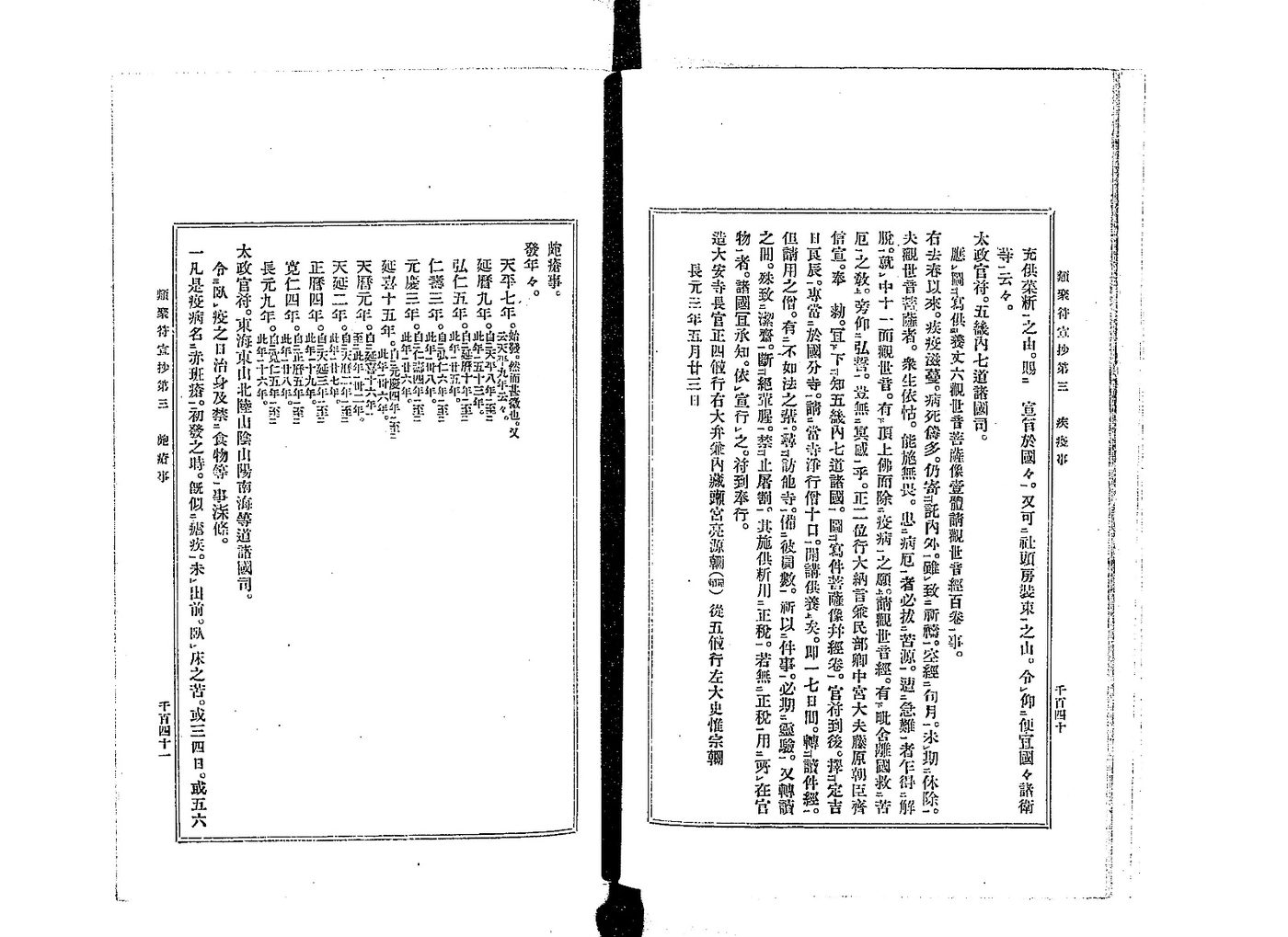
pp. 1140–1141; the order begins on p. 1141 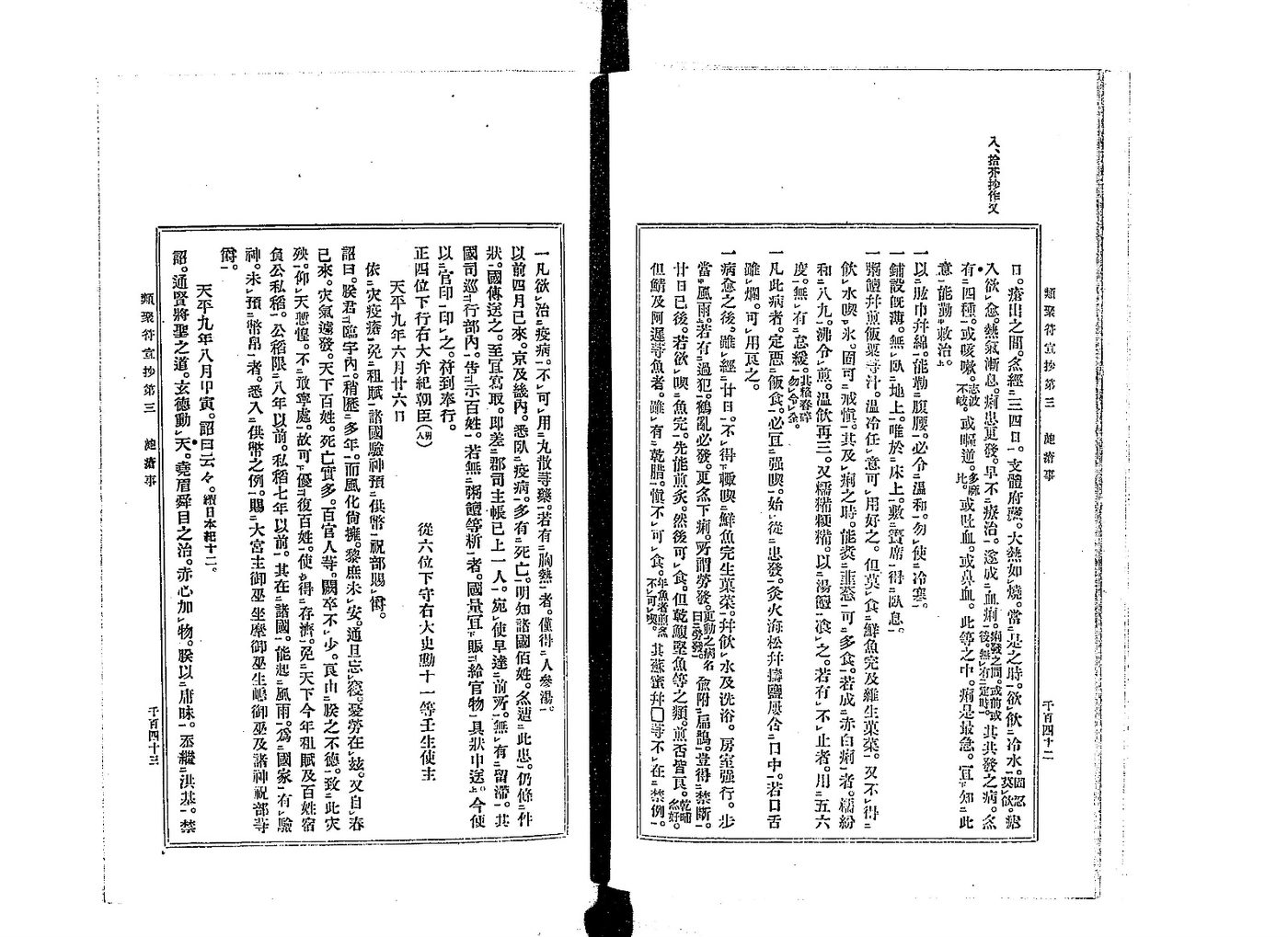
pp. 1142–1143; the rest of the order, to its date
Difficulty: Moderate, short numbered articles in plain language; a few foods and medical words are glossed in the notes.
Fits these units
- Explaining Disease Before Germs. How did people make sense of what they couldn't see?
- Governments, Quarantine, and Consent. When may authorities restrict people to stop a disease?
- Case Study: Smallpox. How did a terrifying disease become the only one ever eradicated?
Key vocabulary
- epidemic
- an outbreak of disease that spreads quickly through many people at once
- Council of State
- the highest office of the Japanese government under the emperor
- province
- one of the regions into which the country was divided, each run by a governor sent from the capital
- relief
- food, goods, or money given by a government to people in need
- relapse
- falling ill again after seeming to recover
- dysentery
- severe diarrhea with blood or mucus
Questions
- Comprehension
Sort the seven articles into rules about food, rules about the body and bedding, and rules about medicine. Which instructions forbid something, and which offer help?
- Analysis (reliability)
This order tells us what the government wanted done. What can't it tell us about how the sick were actually cared for? What other evidence would you want?
- Analysis
The order never mentions keeping the sick away from the healthy. What does that suggest about how its writers understood the disease?
- Connection
Read the Shoku Nihongi entries for 735–737 (P07). The same government made offerings to the kami and ordered sutra readings. How do those responses fit with this order's practical advice?
Activity
In small groups, students act as a provincial governor's staff who have just received the order. They write a short notice, in plain words, to be read aloud in a village, and list what the province must supply so that poor families can follow it.
New translation from the Classical Chinese text of the Ruijū fusenshō, Book 3, in the Kokushi taikei edition (Tokyo, 1900), transcribed from images of its printed pages. A few apparent misprints are followed as printed and explained in the working notes.
The whole order is given.
- Original
- Text as printed in the named edition or on the object, read from page images. Edition: Ruijū fusenshō 類聚符宣抄, Book 3 (第三), under 疱瘡事, in Kokushi taikei 國史大系, vol. 12 (Tokyo: Keizai Zasshisha, 1900), pp. 1141–1143. Page images: National Diet Library Digital Collections, pid 991102 (DOI 10.11501/991102), Public Domain Mark, frames 584–585. No usable digital text was found, so the text was transcribed from the page images and read against them a second time. The editor's reading marks (kaeriten), and his note on the missing personal name of the first signer, are not copied.
- Japanese reading
- The Classical Chinese read aloud as Classical Japanese (kundoku), the way such documents are read in Japan, romanized in modified Hepburn with macrons. Pronunciation follows modern Japanese, not Nara-period sounds. Drafted by Claude (Anthropic); not yet reviewed by a specialist.
- Close English
- Close translation drafted by Claude (Anthropic), kept as a working draft
- Simplified English
- Drafted by Claude (Anthropic) from the original and checked unit by unit against the original in a separate review, then compared with earlier translations and tested for borrowed wording.
- Editor’s review
- Not yet.
- Specialist review
- Not yet. Readings a specialist should confirm are listed for later review.
- Rights
- Original: public domain. Edition: public domain.
Sources for the notes
- Ruijū fusenshō 類聚符宣抄. Book 3, under 疱瘡事 (pages 1141–1143). In Kokushi taikei 國史大系, vol. 12. Tokyo: Keizai Zasshisha, 1900. National Diet Library Digital Collections, pid 991102. https://doi.org/10.11501/991102.
- Centers for Disease Control and Prevention (CDC). "About Smallpox" and "How Smallpox Spreads." Pages dated October 22, 2024. https://www.cdc.gov/smallpox/about/index.html; https://www.cdc.gov/smallpox/causes/index.html.
- Iino Ryōichi 飯野亮一. "So" 蘇. In Sekai daihyakka jiten 世界大百科事典. Tokyo: Heibonsha. Kotobank. Accessed October 6, 2026. https://kotobank.jp/word/蘇. (Made by boiling down milk; sent to the court by the provinces in rotation.)
- "Miru" 海松. In Dejitaru Daijisen デジタル大辞泉. Tokyo: Shōgakukan. Kotobank. Accessed October 6, 2026. https://kotobank.jp/word/海松. (An edible green seaweed.)
- Yoshioka Masayuki 吉岡真之. "Ruijū fusenshō" 類聚符宣抄. In Sekai daihyakka jiten 世界大百科事典. Tokyo: Heibonsha. Kotobank. Accessed October 6, 2026. https://kotobank.jp/word/類聚符宣抄. (Contents, date range 737–1093, ten books of which eight survive.)
- Yumino Masatake 弓野正武. "Ruijū fusenshō" 類聚符宣抄. In Nihon daihyakka zensho (Nipponica) 日本大百科全書(ニッポニカ). Tokyo: Shōgakukan. Kotobank. Accessed October 6, 2026. https://kotobank.jp/word/類聚符宣抄. (About 730 documents, to 1093; ten books.)