News of the First Voyage
- Written
- dated February 15, 1493 (events of October 1492 onward)
- Place
- At sea, off the Azores
- Language
- Spanish
- Kind of source
- letter
- Reading time
- 1 minutes
- Difficulty
- Moderate
- Intensity
- Low
First contact in the AmericasVoyages and sea travelCaribbean and IsthmusRulers and courts
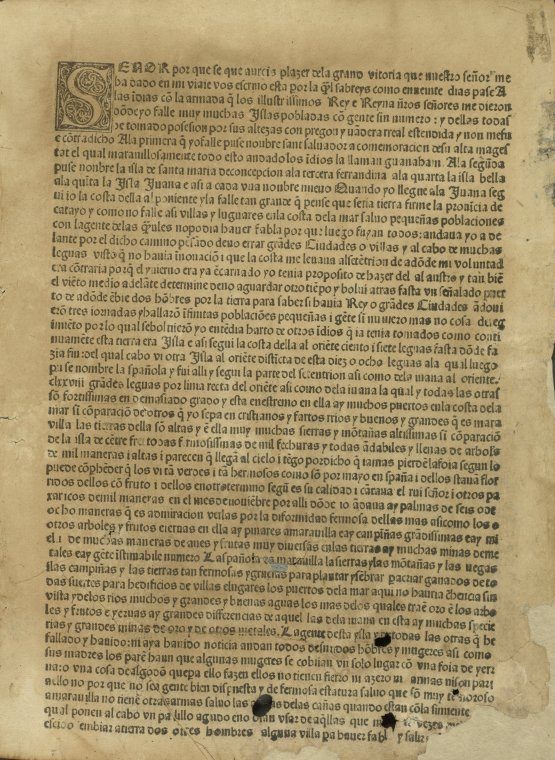
Christopher Columbus wrote this letter on his way home from his first voyage across the Atlantic. He dated it February 15, 1493, aboard his ship, and added a short postscript after a storm drove him into Lisbon in early March. He addressed it to Luis de Santángel, an official of the King of Aragon who had helped raise money for the voyage. It was meant to spread the news, and it did: printed at Barcelona that spring, it was the first report of the voyage to reach print.
Columbus believed he had reached islands off the coast of Asia, which Europeans called the Indies. The islands he describes are in the Bahamas and the Caribbean, and the people he met were Taíno. As you read, notice how he takes possession of each island: by proclamation and a raised banner, and by giving it a new Spanish name.
The edited translation, in simplified modern English. Bracketed words were added for clarity; [...] marks a cut. Tap a note number to read the note. Point at or tap a phrase to see the original behind it. Phrase links checked in a separate review.
Sir: I know you will be glad to hear of the great success our Lord has given me on my voyage, so I am writing to tell you about it. In twenty days1 I crossed to the Indies2 with the fleet that our most illustrious King and Queen gave me. There I found a great many islands, filled with more people than anyone could count. I took possession of them all for Their Highnesses, with a proclamation and the royal banner unfurled, and no one opposed me.
The first island I found I named San Salvador [Holy Savior], in honor of His Divine Majesty, who has so wonderfully given all this. The Indians call it Guanahani.3 The second I named the island of Santa María de Concepción, the third Fernandina, the fourth Isabela, and the fifth Juana.4 And so I gave each one a new name.
Notes
- The Barcelona printing also says twenty; later printings say thirty-three. In the Simancas manuscript the numeral is unclear. back
- Columbus believed he had reached islands off Asia, which Europeans called the Indies. He called the people he met Indians for the same reason. They were Taíno, the people of the Bahamas and the larger Caribbean islands. back
- The Taíno name of the island where Columbus first landed. Which island of the Bahamas it was is still debated. back
- Fernandina and Isabela honor King Ferdinand and Queen Isabella. Juana is the island of Cuba. back
Borrador: esta traducción todavía no se ha revisado por separado. Las palabras entre corchetes se añadieron para que se entienda mejor.
Señor: Sé que se alegrará de saber del gran éxito que nuestro Señor me ha dado en mi viaje, así que le escribo para contárselo. En veinte días1 crucé a las Indias2 con la flota que me dieron nuestros ilustrísimos Rey y Reina. Allí encontré muchísimas islas, con más gente de la que se podía contar. Tomé posesión de todas ellas en nombre de Sus Altezas, con un pregón y la bandera real desplegada, y nadie se opuso.
A la primera isla que encontré le puse el nombre de San Salvador, en honor de Su Divina Majestad, que tan maravillosamente ha dado todo esto. Los indios la llaman Guanahani.3 A la segunda le puse el nombre de isla de Santa María de Concepción; a la tercera, Fernandina; a la cuarta, Isabela, y a la quinta, Juana.4 Y así le di a cada una un nombre nuevo.
Notas
- La edición de Barcelona también dice veinte; ediciones posteriores dicen treinta y tres. En el manuscrito de Simancas la cifra no se lee bien. volver
- Colón creía que había llegado a unas islas frente a Asia, que los europeos llamaban las Indias. Por eso llamó indios a la gente que encontró. Eran taínos, el pueblo de las Bahamas y de las islas grandes del Caribe. volver
- El nombre taíno de la isla donde Colón desembarcó primero. Todavía se discute cuál de las islas de las Bahamas era. volver
- Fernandina e Isabela honran al rey Fernando y a la reina Isabel. Juana es la isla de Cuba. volver
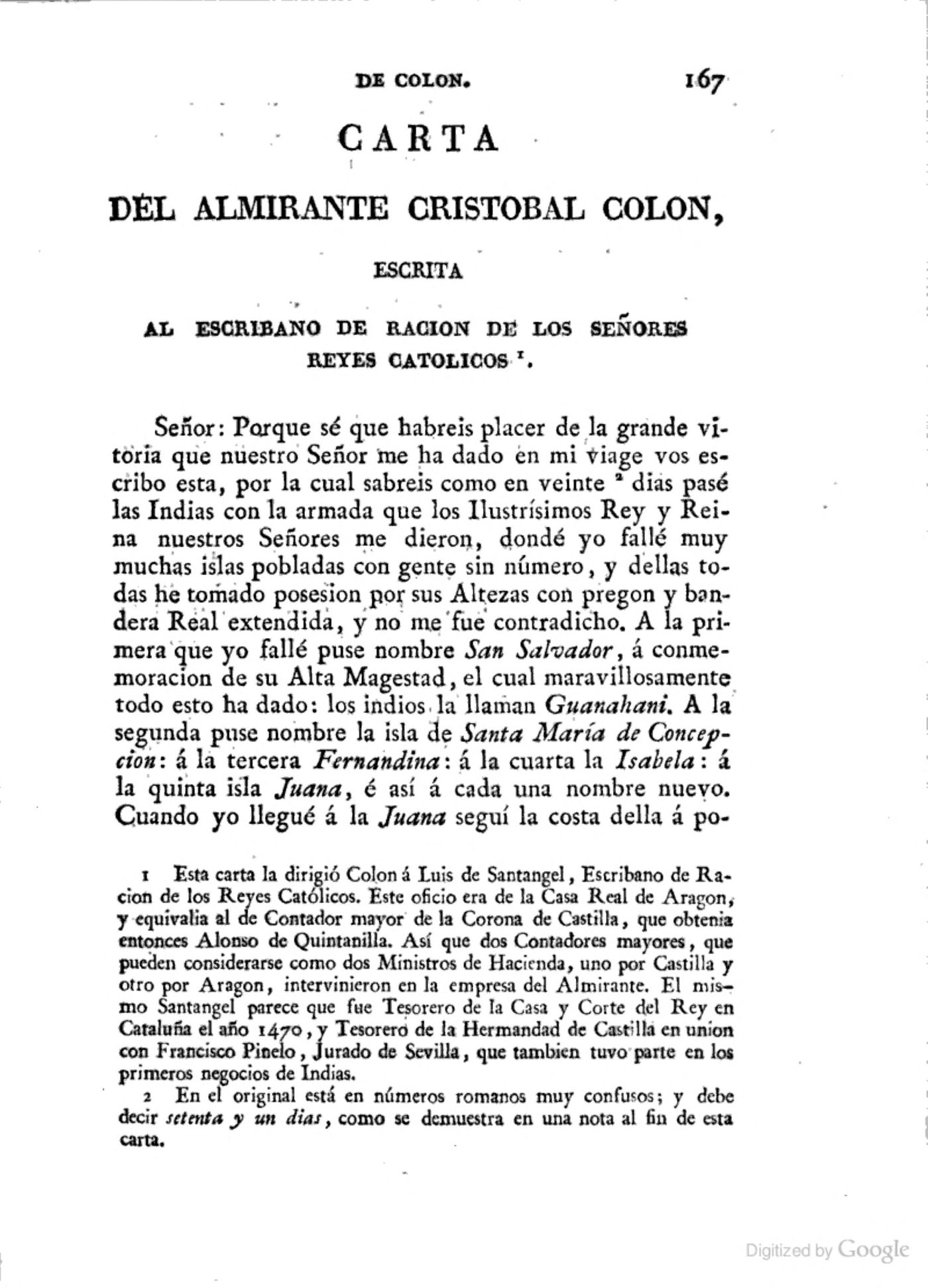
Señor: Porque sé que habreis placer de la grande vitoria que nuestro Señor me ha dado en mi viage vos escribo esta, por la cual sabreis como en veinte dias pasé las Indias con la armada que los Ilustrísimos Rey y Reina nuestros Señores me dieron, dondé yo fallé muy muchas islas pobladas con gente sin número, y dellas todas he tomado posesion por sus Altezas con pregon y bandera Real extendida, y no me fue contradicho.
Sir: Because I know that you will have pleasure from the great victory that our Lord has given me in my voyage, I write you this, by which you will know how in twenty days I passed [over] to the Indies with the fleet that the most illustrious King and Queen our Lords gave me, where I found very many islands peopled with people without number, and of them all I have taken possession for their Highnesses with proclamation and royal banner unfurled, and it was not contradicted [to] me.
Sir: I know you will be glad to hear of the great success our Lord has given me on my voyage, so I am writing to tell you about it. In twenty days I crossed to the Indies with the fleet that our most illustrious King and Queen gave me. There I found a great many islands, filled with more people than anyone could count. I took possession of them all for Their Highnesses, with a proclamation and the royal banner unfurled, and no one opposed me.
Señor: Sé que se alegrará de saber del gran éxito que nuestro Señor me ha dado en mi viaje, así que le escribo para contárselo. En veinte días crucé a las Indias con la flota que me dieron nuestros ilustrísimos Rey y Reina. Allí encontré muchísimas islas, con más gente de la que se podía contar. Tomé posesión de todas ellas en nombre de Sus Altezas, con un pregón y la bandera real desplegada, y nadie se opuso.
SIR,—Believing that you will take pleasure in hearing of the great success which our Lord has granted me in my voyage, I write you this letter, whereby you will learn how in thirty-three days’ time I reached the Indies with the fleet which the most illustrious King and Queen, our Sovereigns, gave to me, where I found very many islands thickly peopled, of all which I took possession without resistance, for their Highnesses by proclamation made and with the royal standard unfurled.
- The Barcelona printing also says twenty; later printings say thirty-three. In the Simancas manuscript the numeral is unclear.
- Columbus believed he had reached islands off Asia, which Europeans called the Indies. He called the people he met Indians for the same reason. They were Taíno, the people of the Bahamas and the larger Caribbean islands.
A la primera que yo fallé puse nombre San Salvador, á conmemoracion de su Alta Magestad, el cual maravillosamente todo esto ha dado: los indios la llaman Guanahani.
To the first that I found I put [the] name San Salvador, in commemoration of His High Majesty, who marvelously has given all this: the Indians call it Guanahani.
The first island I found I named San Salvador [Holy Savior], in honor of His Divine Majesty, who has so wonderfully given all this. The Indians call it Guanahani.
A la primera isla que encontré le puse el nombre de San Salvador, en honor de Su Divina Majestad, que tan maravillosamente ha dado todo esto. Los indios la llaman Guanahani.
To the first island that I found I gave the name of San Salvador, in remembrance of His High Majesty, who hath marvellously brought all these things to pass; the Indians call it Guanaham.
- The Taíno name of the island where Columbus first landed. Which island of the Bahamas it was is still debated.
A la segunda puse nombre la isla de Santa María de Concepcion: á la tercera Fernandina: á la cuarta la Isabela: á la quinta isla Juana, é así á cada una nombre nuevo.
To the second I put [the] name the island of Santa María de Concepción; to the third Fernandina; to the fourth the Isabela; to the fifth the island Juana, and so to each one a new name.
The second I named the island of Santa María de Concepción, the third Fernandina, the fourth Isabela, and the fifth Juana. And so I gave each one a new name.
A la segunda le puse el nombre de isla de Santa María de Concepción; a la tercera, Fernandina; a la cuarta, Isabela, y a la quinta, Juana. Y así le di a cada una un nombre nuevo.
To the second island I gave the name of Santa-Maria de Concepcion; the third I called Fernandina; the fourth, Isabella; the fifth, Juana; and so to each one I gave a new name.
- Fernandina and Isabela honor King Ferdinand and Queen Isabella. Juana is the island of Cuba.
Questions a reader might ask, with short answers and the sections they rest on. Not yet checked.
What happens
Who is Columbus writing to, and why?
He writes to Luis de Santángel, an official of the King of Aragon who had helped raise money for the voyage. The letter was meant to spread the news of its success, and it was soon printed at Barcelona.
Read section 1
Where did Columbus think he had arrived?
He says he crossed to the Indies, the islands Europeans believed lay off the coast of Asia. In fact he was in the Bahamas and the Caribbean, and the people he met were Taíno.
Read section 1
How does Columbus take possession of the islands?
He takes them for the King and Queen with a proclamation and the royal banner unfurled, and notes that no one opposed him. Then he gives each island a new Spanish name.
Thinking further
Who and what this source names, in the original. Each name links to every source in the library that mentions it. Not yet checked.
People
- Ferdinand II of Aragon King of Aragon who ruled Spain jointly with his wife, Isabella of Castile, and sponsored Columbus's voyages. Sections 1.
- God The one God worshiped by Jews, Christians and Muslims. Sections 1, 2.
- Isabella I of Castile Queen of Castile who ruled Spain jointly with her husband, Ferdinand of Aragon, and sponsored Columbus's voyages. Sections 1.
Places
Page images of the original object or of the printed edition, from the libraries and archives that hold them. The pages shown are copied here where the holder marks them public domain; titles link to the holder's own viewer. Click a page to see it full size.
Navarrete, Colección de los viages, vol. 1, Madrid 1825
Internet Archive (digitized by Google). p. 167. Public Domain Mark 1.0.
The printed edition our text follows, from the Simancas manuscript.
p. 167, the whole passage Columbus letter, Barcelona printing, 1493
New York Public Library, Rare Book Division (*KB+ 1493). leaf 1 recto (the opening). Public domain in the United States (NYPL).
The only known copy of the first Spanish printing (Pedro Posa), two leaves.
Leaf 1 recto, the opening
Other translations of this passage. Links go to copies that are free to read online.
Select Letters of Christopher Columbus, 2nd ed. (Hakluyt Society)
R. H. Major, 1870. English. Public domain.
The whole letter, translated from the early printed Spanish copy in the Ambrosian Library, Milan, with the Simancas readings in his notes. His first edition (1847) translated the Latin version, the letter to Raphael Sanchez, instead.
The Spanish Letter of Columbus to Luis de Sant’ Angel
Anonymous (Bernard Quaritch, publisher), 1891. English. Public domain.
The whole letter.
The Letter of Columbus on the Discovery of America
Wilberforce Eames, 1892. English. Public domain.
The whole letter, from its Latin version.
New translation from the Spanish text printed by Martín Fernández de Navarrete (Madrid, 1825) from a manuscript copy, which matches the Barcelona printing of 1493 almost word for word. The opening of the letter only.
Nueva traducción al español sencillo. Claude (Anthropic) la redactó a partir del original, con nuestra versión en inglés como guía. Todavía no la ha revisado nadie por separado.
- Original
- Text as printed in the named edition or on the object, read from page images. Edition: Martín Fernández de Navarrete, ed., Colección de los viages y descubrimientos que hicieron por mar los españoles desde fines del siglo XV, vol. 1 (Madrid: Imprenta Real, 1825), p. 167, from the manuscript at Simancas, which the Simancas archivist's certificate, printed by Navarrete, calls the original document. Page images: Internet Archive, bub_gb_Jui6IGo47eQC (Public Domain Mark). Author's text only; the editor's footnotes are not copied.
- Transliterated
- Not needed: the original is in the Latin alphabet
- Close English
- Close translation drafted by Claude (Anthropic), kept as a working draft
- Simplified English
- Drafted by Claude (Anthropic) from the original and checked unit by unit against the original in a separate review.
- Simplified Spanish
- Drafted by Claude (Anthropic). Not yet checked by a separate review.
- Editor’s review
- Not yet.
- Specialist review
- Not yet. Readings a specialist should confirm are listed for later review.
- Rights
- Original: public domain. Edition: public domain.
Sources for the notes
- Fernández de Navarrete, Martín, ed. Colección de los viages y descubrimientos que hicieron por mar los españoles desde fines del siglo XV. Vol. 1. Madrid: Imprenta Real, 1825. Internet Archive. https://archive.org/details/bub_gb_Jui6IGo47eQC
- New York Public Library. Letter of Columbus to Luis de Santangel, dated 15 February 1493 (Barcelona: Pedro Posa, 1493). Digital Collections. https://digitalcollections.nypl.org/items/07fda820-0035-0130-671f-58d385a7bc34
- Ife, B. W. "Introduction to the Letters from America." King's College London, 2005. https://ems.kcl.ac.uk/content/pub/b002.html
- Wolper, Ruth G. Durlacher. "A New Theory Identifying the Locale of Columbus's Light, Landfall, and Landing." Smithsonian Miscellaneous Collections 148, no. 1 (1964). https://repository.si.edu/server/api/core/bitstreams/3bdbc4c4-d25b-4d51-b603-392003676587/content